
The new decision-making pipeline utilizes sinusoidal position encoding to help neural networks maintain an accurate sense of relative space inside a freight car. In the high-stakes environment of global logistics, the automated loading of rail freight remains one of the most persistent operational bottlenecks, particularly when dealing with the physical constraints of narrow, enclosed railcars. While theoretical 3D spatial optimization has existed for years as a purely mathematical challenge, the jump from digital models to physical execution has often been marred by mechanical failures and collisions. Traditional systems frequently generate packing arrangements that look perfect on a screen but prove impossible for a robotic manipulator to execute because they ignore the reach limitations and joint ranges of the industrial hardware. This disconnect creates an “execution gap” that slows down transit times and increases the risk of damage to both the cargo and the expensive robotic infrastructure within the terminal.
To bridge this gap, a sophisticated joint optimization framework has been introduced that merges spatial packing logic with physical robotic trajectory planning into a single, cohesive workflow. This system leverages deep reinforcement learning and advanced computer vision to ensure that every placement decision is both space-efficient and mechanically feasible. By treating the loading sequence as a unified decision pipeline, the framework moves beyond simple geometry into the realm of physics-aware logistics. This development is crucial for the transition toward fully autonomous freight terminals, where robotic arms must navigate cramped, increasingly crowded spaces without human intervention. The ability to calculate collision-free paths in real-time while maximizing every cubic inch of railcar volume represents a significant evolution in industrial automation, ensuring that standard freight cars are loaded with unprecedented precision and speed.
Integrating Perception and Decision Pipelines
Part 1: Developing a Unified AI Decision Process
The core methodology of this system redefines the act of railcar loading as a closed-loop Markov decision process, which allows for continuous adjustment based on environmental feedback. Rather than using the traditional two-step process—where one algorithm decides where a box should be placed and a separate program determines how to move it—this framework integrates both considerations into a Transformer-based policy network. By analyzing the “where” and the “how” simultaneously, the AI can anticipate potential obstructions several moves ahead. For instance, the system might reject a theoretically dense placement if it identifies that the resulting stack would block the robot’s access to the rear of the car in the next step. This predictive capability is essential for avoiding scenarios where the robotic arm becomes physically trapped or restricted by its own previous work.
This holistic approach to decision-making ensures that the AI never selects a layout that is physically impossible for the robotic manipulator to achieve. The policy network evaluates the state of the carriage, including the dimensions of incoming cargo and the current occupancy of the floor space, to generate actions that are inherently executable. By unifying the spatial arrangement with the kinetic requirements of the robot, the system eliminates the trial and error often associated with reinforcement learning in physical environments. This results in a much smoother operational flow, as the robotic arm can move confidently from the pickup point to the final placement coordinate. The integration of these two previously siloed processes marks a fundamental shift in how industrial robots are programmed to interact with complex, evolving environments in the freight industry.
Part 2: Utilizing High-Precision Computer Vision
A high-fidelity perception module serves as the primary sensory input for the framework, utilizing an overhead 3D camera to create a digital twin of the loading environment. This optical system is designed to scan the interior of the railcar and the incoming cargo with extreme accuracy, identifying the exact dimensions and orientation of every item before it is moved. Experimental data from current implementations show that the system can estimate length and width with an error margin as low as 0.14 to 0.20 millimeters, while vertical height detection is nearly perfect. This level of precision is necessary because even a small discrepancy in the perceived size of a box can lead to cascading errors in a 3D packing plan, eventually resulting in a collision or a stack that is structurally unstable and prone to collapsing during transit.
By processing this complex visual data in less than 0.5 seconds, the framework provides a real-time foundation that allows the AI agent to make decisions without causing delays in the terminal’s workflow. The vision system does more than just measure boxes; it continuously monitors the “topography” of the loaded cargo to detect any shifts or deviations from the planned arrangement. If a package is placed slightly off-center or if a stack begins to lean, the perception module immediately updates the occupancy maps and height tensors. This rapid feedback loop allows the reinforcement learning agent to adjust its subsequent moves to compensate for real-world irregularities. This level of environmental awareness ensures that the robotic arm always operates with a perfect understanding of its surroundings, which is a critical requirement for maintaining safety in high-speed, high-density industrial loading zones.
Spatial Representation and Technical Constraints within Modern Computing Environments and Digital Modeling Frameworks
Part 1: Advanced Encoding of 3D Environments
To manage the immense computational load of processing three-dimensional space, the framework uses a multi-layered 2D-plus representation instead of traditional, resource-heavy voxel grids. This innovative approach involves three distinct layers of data: height maps that record the elevation of the cargo, occupancy masks that define which areas of the floor are occupied, and dimensional tensors that store the specific sizes of every item. By flattening the 3D space into these intelligent layers, the system can maintain a high level of detail without the exponential increase in processing power required to track every individual cubic centimeter of the container. This allows the system to run on standard industrial hardware while still providing the AI with all the information it needs to make complex spatial trade-offs across long loading sequences.
This data is processed by a Transformer network that utilizes sinusoidal 3D position encoding, a technique that helps the AI understand the absolute and relative coordinates of every item within the railcar. This spatial intelligence is further enhanced by “virtual filler tokens,” which allow the network to handle varying amounts of cargo without needing to change its underlying architecture. By projecting these features into a 128-dimensional latent embedding space, the model can identify patterns and dependencies between different items that a simpler heuristic would miss. For example, the system can learn that placing a larger, heavier item at the base of a stack provides better structural integrity for subsequent, smaller items. This sophisticated sense of space is what enables the framework to achieve such high density while maintaining the stability of the entire load during the jolts of rail transport.
Part 2: Implementing Dynamic Feasibility Masking
One of the most impactful innovations within this framework is the implementation of a “dynamic feasibility mask,” which acts as a physical safety filter for the AI’s decision-making. In typical reinforcement learning, an agent learns by trying different actions and receiving a penalty if it fails; however, in a physical warehouse, a failure can result in a broken robotic arm or damaged cargo. To prevent this, the feasibility mask runs background calculations for every potential placement spot to check whether an action is physically possible. This includes performing inverse kinematics checks to see if the robot’s joints can reach the coordinates and scanning for potential collisions with the container walls or existing cargo. If an action is found to be impossible, it is masked out entirely, meaning the AI never even considers it an option.
This masking system ensures that 100% of the decisions passed to the robot are executable, removing the risk of mechanical strain or accidental impact. By filtering out these “invalid” moves before the agent makes a choice, the system drastically speeds up the learning process and ensures the safety of the hardware. The feasibility mask is updated dynamically after every placement, reflecting the new geometry of the railcar as it fills up. This is particularly important in the final stages of loading a railcar, where space is tightest and the risk of collision is highest. By embedding these physical constraints directly into the neural network’s logic, the researchers have created a system that respects the laws of physics while striving for mathematical optimization. This safety-first approach is what makes the technology viable for the unpredictable environments of modern logistics centers.
Evaluating Performance and Robotic Costs
Part 1: Calculating Path Execution Costs
Efficiency in robotic loading is not just about where an item is placed, but also the mechanical cost of getting it there. The framework incorporates a sophisticated weighted formula to evaluate the “path execution cost” for every feasible move. This formula looks at three primary factors: the length of the trajectory, the proximity to obstacles, and the kinematic strain on the robot’s joints. By prioritizing shorter, more direct paths, the system minimizes the time each move takes, which is vital for maintaining high throughput in a busy terminal. Furthermore, the system applies a heavy penalty to any path that brings the robotic arm too close to an obstacle, even if a direct collision is not predicted. This “safety buffer” reduces the likelihood of minor scrapes or mechanical jitter that could occur if the robot operated at its absolute physical limits.
By favoring smooth and sustainable motions, the framework actively reduces the wear and tear on industrial equipment. Robotic arms represent significant investments, and pushing their joints to extreme angles or making erratic, sudden movements can lead to premature mechanical failure and increased maintenance costs. The joint optimization framework addresses this by penalizing movements that force the robot into awkward positions. Instead, it encourages “parallel scanning” paths that mimic the methodical nature of human organization but with the tireless precision of a machine. This focus on the long-term health of the machinery ensures that the automated system remains cost-effective over its entire operational lifespan. This shift from pure spatial density to a balanced approach that includes mechanical sustainability is a key hallmark of next-generation industrial AI.
Part 2: Training with Reinforcement Learning
The policy network was trained using Proximal Policy Optimization (PPO), a robust algorithm that is particularly effective at handling the complex, multi-dimensional reward functions found in robotic tasks. During the training phase, the agent completed over one million environment steps, learning to balance five competing goals: space utilization, collision avoidance, path efficiency, structural stability, and sequence order. To handle this massive amount of data, researchers utilized high-performance computing hardware and NVIDIA CUDA acceleration, which allowed the system to rapidly refine its strategy. The resulting model is capable of making placement decisions in just 28 milliseconds, with the entire “vision-to-decision” pipeline completing in under 150 milliseconds. This low latency is essential for the continuous, non-stop operation required in 24-hour freight terminals.
The success of the training process was evidenced by the agent’s ability to handle increasingly complex loading scenarios without any manual intervention. As the agent progressed through its training, it developed a strategic understanding of railcar loading, such as filling the car from front to back and bottom to top to maintain clear access for the arm. The reward function was designed to be unforgiving; any collision or unstable placement resulted in a significant penalty, forcing the AI to prioritize safety as much as efficiency. This rigorous training regimen produced a model that is not only highly effective but also incredibly reliable under a wide range of conditions. By the end of the training period, the system had mastered the art of high-density packing, consistently finding solutions that outperformed traditional heuristic-based models in both speed and space utilization.
Validation Through Benchmarks and Physical Testing
Part 1: Exceeding Industry Standard Baselines
When tested against current industry-standard baselines, such as motion-aware genetic algorithms and traditional bin-packing heuristics, the joint optimization framework demonstrated clear superiority across every performance metric. The most significant achievement was a space utilization rate of 87.4%, which represented a 3.3% improvement over the most advanced learning-based models currently available. While a few percentage points might seem minor, in the context of global rail freight, this translates to thousands of tons of additional cargo being moved with the same number of trains. Furthermore, the system achieved a loading success rate of 91.2%, representing nearly a 4% boost compared to systems that do not use feasibility masking. These results confirm that integrating physical constraints into the AI’s core logic is the most effective way to solve the complex puzzle of 3D packing.
Beyond just packing density, the framework showed a remarkable ability to reduce operational risks, demonstrating a 0.271 improvement in collision avoidance metrics and a 0.226 gain in the structural stability of the packed items. This means that not only was the cargo packed more tightly, but it was also packed more safely, with a lower risk of shifting or falling during transit. These benchmark results were consistent across various container sizes and cargo types, proving the robustness of the Transformer-based architecture. By successfully navigating the trade-offs between space, speed, and safety, the framework set a new standard for what automated logistics systems can achieve. The data suggests that this approach could significantly reduce the total cost of ownership for robotic loading systems by minimizing both the time spent on loading and the frequency of cargo damage incidents.
Part 2: Confirming Results with Physical Testbeds
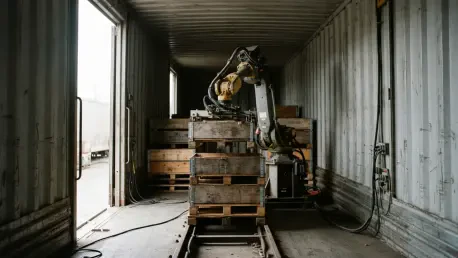
To ensure that the results were not limited to a digital simulation, the research team conducted extensive physical validation using an industrial palletizing robot equipped with a pneumatic suction gripper. These real-world tests closely mirrored the simulation results, as the robot consistently executed the AI’s plans without requiring manual corrections. The physical robot followed the predicted “parallel scanning” paths, which allowed it to move fluidly between the pickup area and the freight car. This physical validation proved that the perception module and the feasibility mask worked in perfect harmony to provide the robot with a reliable, executable map of its environment. The robot’s movements were smooth and steady, avoiding the jerky, erratic motions often seen in less sophisticated robotic control systems.
Sensitivity analysis performed during physical testing revealed that the system is highly tunable to specific industrial needs. By adjusting the penalty weights in the software, operators could choose to prioritize either absolute packing density or mechanical longevity. For instance, increasing the path penalty successfully reduced the overall mechanical wear on the robot by 11% during a standard loading shift. Similarly, by increasing the collision avoidance penalty, the researchers were able to reduce the physical intervention rate—the frequency with which a human had to reset the system—from 8.4% down to just 4.3%. This flexibility makes the framework a versatile tool for a wide variety of logistical environments, from high-speed package sorting to the heavy-duty loading of industrial components. The physical success of the testbed provided definitive proof of concept for the feasibility of fully autonomous, physics-aware railcar loading terminals.
Future Outlook for Autonomous Logistics
Part 1: Addressing Current System Limitations
While the current framework has proven to be highly effective, several limitations remain that will be the focus of research moving into the next phase of development. One of the primary constraints of the existing model is the assumption that all cargo items are rigid, rectangular cuboids. In real-world scenarios, logistics companies often handle deformable items, such as bags of grain, or irregular shapes, such as machinery parts, which do not fit into a standard 3D grid as easily. Future iterations of the AI will need to incorporate soft-body physics and more advanced 3D scanning to manage these non-standard items without sacrificing the precision of the current system. Expanding the framework to include these complexities will be essential for making it a truly universal solution for all types of rail freight.
Another area for improvement involves the “generalizable kinematics” of the system, as the current logic is somewhat tied to the specific dimensions and joint limits of the robot used in the study. To make the framework commercially viable on a global scale, it must be able to adapt to any robotic arm model without requiring a complete retraining of the neural network. Researchers are currently working on a modular approach where the kinematic profile of a specific robot can be “plugged in” to the existing decision pipeline. This would allow warehouse managers to upgrade their hardware or use a fleet of different robots while still utilizing the same optimized AI logic. By decoupling the spatial logic from the specific mechanical hardware, the system will become far more flexible and easier to implement across the diverse landscape of international shipping terminals.
Part 2: Advancing the Future of Freight
The successful deployment of this joint optimization framework represents a significant milestone in the journey toward fully autonomous freight operations. By solving the combinatorial complexity of 3D packing through a physics-aware lens, this research provides a viable blueprint for the smarter, faster logistics hubs of the future. The ability to maximize the utility of expensive rail freight volume while ensuring the complete safety of robotic equipment addresses the two most critical concerns of the modern shipping industry. As these systems continue to evolve, the integration of AI with physical constraints will likely become the standard for all forms of automated transport, from ships and trucks to the railroad terminals of tomorrow. The transition from theoretical geometry to this new form of physics-aware automation is expected to redefine global shipping efficiency in the coming years.
The actionable next steps for the industry involve the pilot testing of these frameworks in high-volume, real-world terminals where they can be integrated with existing warehouse management systems. Companies that adopt these physics-aware AI models early will likely see a significant competitive advantage through reduced labor costs, lower damage rates, and faster turnaround times for their freight trains. As the technology matures, the data gathered from these deployments will further refine the AI’s ability to handle the unpredictable nature of global trade. The era of manual, slow, and error-prone loading is quickly coming to an end, replaced by a new generation of robotic systems that understand the world as both a mathematical puzzle and a physical reality. This evolution will ensure that the logistics sector remains capable of meeting the ever-increasing demands of the global economy.