
The integration of Arrive AI’s proprietary operating system with Ottonomy’s mobile robotics seeks to eliminate the need for human intervention during the final stage of delivery. This strategic collaboration, formalized on November 11, 2026, represents a significant milestone in the evolution of autonomous logistics infrastructure. Arrive AI, a specialist in physical AI and secure delivery endpoints, has committed to an equity investment in Ottonomy, Inc., a developer of advanced autonomous ground robots. The primary objective of this union is to bridge the gap between autonomous transport vehicles and the physical infrastructure required to complete a delivery without any human oversight. By integrating Arrive AI’s proprietary operating system and secure handoff hardware with Ottonomy’s mobile robotics, the two companies aim to create a scalable, standardized network for the movement of goods across various sectors. This framework ensures that autonomous systems move beyond simple transit and toward a complete, unattended chain of custody for all users.
Bridging the Gap in Autonomous Delivery
Solving the Persistent Handoff Bottleneck
A recurring theme in the partnership is the elimination of the handoff bottleneck, which remains one of the most persistent challenges in autonomous logistics. Historically, the requirement for a human recipient to be present at the exact moment a robot arrives has limited the economic viability of robotic delivery. Arrive AI addresses this through its Arrive Point technology and the Arrive OS operating system, which function as a smart mailbox that can communicate with robots to facilitate an unattended exchange. These systems act as a secure intermediary, allowing the robot to identify the correct receptacle, verify security protocols, and trigger the opening mechanism autonomously. By establishing this automated handshake, the system eliminates the inefficiencies caused by waiting times and failed delivery attempts. The Arrive OS manages the entire lifecycle of the exchange, providing a digital trail that ensures every item is tracked from the moment it leaves the sender until it is securely stored.
Utilizing Contextual Artificial Intelligence for Navigation
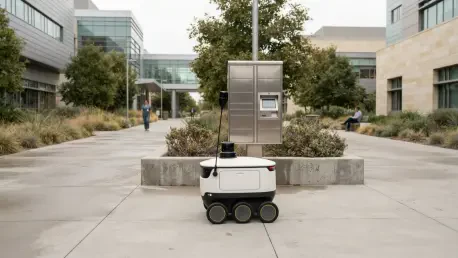
Ottonomy contributes the mobile component through its Ottobot AI platform and Contextual AI technology, which are designed to navigate complex, high-traffic environments. Unlike basic delivery bots, these machines are designed to operate both indoors and outdoors while distinguishing between moving pedestrians, static obstacles, and various traffic zones. The synthesis of these technologies allows for a completely touchless chain of custody where a robot can navigate a campus, identify the Arrive Point, and securely deposit the item without any human interaction. Through the integration of Arrive AI’s operating system, these robots can now navigate to a specific secure locker with surgical precision. The contextual AI allows the robot to approach the landing or docking zone, align itself perfectly with the receptacle, and execute a touchless handoff. This capability is critical for scaling operations in urban environments or sprawling corporate campuses where the high density of people makes traditional navigation entirely insufficient.
Operational Excellence and Healthcare Logistics
Enhancing Workflow Efficiency in Clinical Settings
The partnership is not merely theoretical but is built upon existing live operations at Hancock Regional Hospital in Greenfield, Indiana. In this healthcare setting, Ottonomy robots are utilized to transport medical specimens between various facilities on the hospital campus to improve overall staff efficiency. The integration of Arrive Points allows these robots to complete deliveries autonomously, which has profound implications for how medical personnel manage their time. By delegating the repetitive and time-consuming task of specimen transport to an autonomous network, healthcare professionals can refocus their attention on patient care rather than logistical errands. The success at Hancock provides a roadmap for expanding into other high-stakes environments, such as data centers and industrial facilities, where security and reliability are paramount. This model serves as a proof of concept for the broader healthcare industry, demonstrating how autonomous networks can handle repetitive tasks with high security and reliability.
Scaling Autonomous Networks Beyond the Medical Sector
The success of the implementation at Hancock Regional Hospital provides a clear roadmap for future expansions into diverse markets such as data centers and large industrial complexes. In these settings, the movement of sensitive hardware components or secure documents requires a level of accountability that human-based delivery cannot always guarantee. The initial rollout of 50 Ottonomy robots is just the beginning of a broader plan to install these autonomous systems across Arrive AI’s extensive partner network. The elasticity of the deployment agreement allows for a rapid scale-up, adapting to the specific spatial and security needs of different industries. By proving the technology in a demanding healthcare setting, the companies have created a blueprint for operational efficiency. This framework demonstrates how physical AI can be used to optimize internal logistics, reducing overhead costs and improving the overall speed of business operations across the nation.
Market Strategy and Future Growth
Leading Trends in Universal Robotic Infrastructure
The collaboration highlights several broader trends in the robotics and logistics sectors, most notably a commitment to robot-agnosticism. Arrive AI is positioning itself as a platform-independent player, building a network that supports drones, ground robots, and human couriers alike. This approach recognizes that no single vehicle type will dominate the market, and the winning infrastructure must be compatible with all forms of autonomous transport. Furthermore, the industry is moving toward unattended delivery as the standard, as waiting for a human recipient reduces the economic efficiency of automation. This shift toward physical AI represents the next frontier, where software interacts directly with the physical world to manage the movement of goods. By creating a standardized docking protocol, Arrive AI and Ottonomy are setting the stage for a future where disparate robotic systems can work together within a unified infrastructure to provide seamless end-to-end service.
Strategic Integration of Physical AI Networks
The alliance successfully bridged the technological divide between autonomous mobility and physical security infrastructure. By establishing a framework where Ottonomy’s robots utilized Arrive AI’s operating system, the partnership offered a concrete solution to the inefficiencies of manual delivery handoffs. This approach encouraged other industry leaders to consider the importance of standardized endpoints in the broader robotics ecosystem. Looking ahead, companies should prioritize the adoption of vehicle-agnostic platforms to ensure long-term compatibility with evolving robotic hardware. The integration of physical AI into existing workflows proved that operational efficiency depended as much on the destination as it did on the vehicle. This strategic move provided a scalable roadmap for organizations seeking to automate internal and external logistics while maintaining high standards of security. Ultimately, the focus shifted from individual robotic deployments toward the creation of a resilient network.