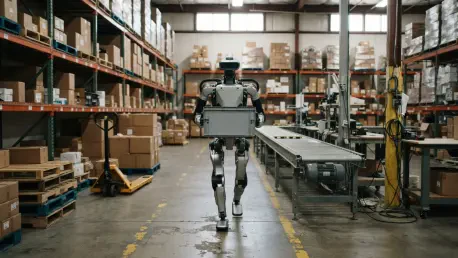

In the quiet corridors of a Georgia distribution center, a pair of metallic legs moves with rhythmic precision, marking the moment humanoid automation transitioned from a laboratory curiosity to a cornerstone of modern industrial strategy. The era of robots confined to protective cages is coming to an abrupt end as bipedal machines successfully move over 100,000 containers within active commercial environments. While many skeptics once viewed humanoid robots as futuristic novelties destined for laboratory testing, recent high-volume deployments in Georgia prove they are now essential operational assets.
This transition from experimental pilots to multi-state rollouts signals a fundamental shift in how global supply chains manage high-volume repetitive tasks. The shift toward flexible, mobile intelligence allows facilities to adapt without the rigid constraints of traditional fixed automation. Consequently, the industry is witnessing the birth of a more dynamic warehouse environment where mechanical agility matches the demands of modern commerce.
Scaling Automation: Beyond the Pilot Phase
Modern logistics faces a persistent challenge: the need for flexible automation that fits into spaces originally designed for people. The partnership between GXO Logistics and Agility Robotics addresses this by moving beyond a “proof of concept” into long-term operational integration. By deploying robots in e-commerce fulfillment centers in North Carolina and Tennessee, the industry is moving toward a scalable service model that eliminates traditional barriers to high-tech adoption.
New deployments scheduled for early 2027 represent a significant expansion of the footprint established during initial testing. This progress is facilitated by a Robot-as-a-Service (RaaS) agreement, which allows companies to deploy advanced automation as a scalable expense rather than a massive capital burden. Such financial flexibility is crucial for logistics leaders who must balance the need for innovation with the reality of tight operational margins.
Redefining Logistics: Human-Centric Design
Technological evolution is moving rapidly from the Digit 4 model to the upcoming Digit 5, which is specifically engineered for close-proximity work with human colleagues. These machines utilize the Agility Arc cloud platform to integrate seamlessly into existing warehouse management workflows, allowing for precise container transfers between autonomous mobile robots and conveyor systems. This sophisticated coordination ensures that robots and humans can share the same floor space safely and productively.
This human-centric approach ensures that robots navigate environments built for people without requiring expensive facility overhauls or specialized infrastructure. By prioritizing the ability to handle standard totes and navigate common warehouse obstacles, designers have made it possible for robots to step into roles previously deemed too variable for automation. The resulting workflow maintains the efficiency of a machine while preserving the spatial logic of a human-centered workspace.
Proving Industrial Value: Real-World Performance
GXO CEO Patrick Kelleher emphasizes that the focus has shifted from technical possibility to delivering measurable value and creating a better workplace. With over 65,000 hours of real-world operation and a manufacturing facility capable of producing 10,000 units annually, the humanoid sector is reaching industrial maturity. This level of production capacity suggests that the bottleneck is no longer the technology itself, but the speed at which organizations can integrate these assets into their daily routines.
Expert consensus suggests that offloading monotonous tasks to robots allows human workers to focus on more complex, value-driven roles within the fulfillment center. This reallocation of labor addresses the chronic shortages seen in the sector while improving overall employee retention by removing the most physically taxing duties from the human workload. As a result, the “RoboFab” facility in Oregon is now supporting a diverse client list that includes major global players in the automotive and retail sectors.
Strategic Integration: Modern Facilities
Companies looking to replicate this success must adopt a “Robot-as-a-Service” strategy to ensure financial and operational flexibility. Success depends on a disciplined rollout that starts with high-volume, repetitive materials-handling tasks before expanding to more diverse industrial processes. By prioritizing safety and direct integration with cloud-based management systems, logistics leaders can maintain consistency and efficiency while future-proofing their operations against labor shortages.
The industry successfully identified that the path toward total warehouse synchronization required more than just hardware; it demanded a complete rethinking of the human-robot interface. Early adopters moved decisively to implement scalable service models that removed the financial sting of high-tech adoption. By the time these machines became commonplace, the strategic groundwork for a more efficient, safe, and technologically resilient logistics sector was already firmly established through these pioneering partnerships.