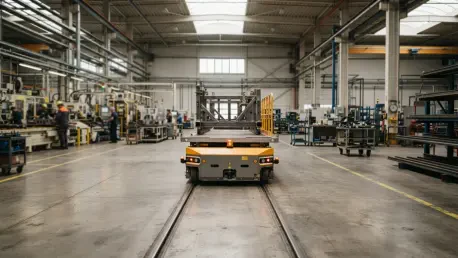

Siempelkamp Transport Systems has developed the uTrack AGV to handle massive payloads ranging from 5 to 200 tons that standard logistics systems cannot manage. This breakthrough arrives at a time when the global manufacturing sector is grappling with an acute shortage of specialized labor and a relentless drive for operational flexibility. Traditional industrial plants have historically relied on rigid floor-mounted conveyor belts or overhead cranes to move heavy goods, but these fixed infrastructures are increasingly seen as liabilities in an era of rapid product customization. By integrating these high-capacity automated guided vehicles, factories can reclaim floor space and pivot their production layouts without the prohibitive costs of structural renovation. The transition toward such heavy-duty autonomous solutions marks a definitive end to the era of static assembly, replacing it with a modular environment where massive components move with the same digital precision as small parcels in a fulfillment center.
Enhancing Precision Through Advanced Engineering
Material Efficiency: The Steel-on-Steel Interface
The uTrack AGV distinguishes itself through a track-guided design that prioritizes mechanical stability and extreme load-bearing capacity over the high-speed, free-roaming capabilities of smaller logistics robots. By utilizing a sophisticated steel-on-steel interface, where precision-engineered steel wheels move along flush-mounted floor rails, the system achieves an exceptionally low level of rolling resistance. This mechanical efficiency is a game-changer for heavy industry; it allows a vehicle with a remarkably low profile of just 260 millimeters to transport a staggering 40-ton load while consuming minimal drive power. Beyond the immediate energy savings, this configuration serves as a vital safeguard for the facility’s physical infrastructure. Unlike traditional rubber-tired vehicles that eventually create deep ruts or degrade floor joints when carrying immense weight, the track-based system distributes the pressure evenly, ensuring the factory floor remains pristine and maintenance-free.
Positioning Accuracy: Eliminating Lateral Deviations
Beyond its physical durability, the track-based approach ensures a degree of precision and repeatability that free-navigating sensor-heavy systems often struggle to maintain under extreme stress. Because the physical path is explicitly defined by the rails, the uTrack vehicles effectively eliminate the lateral deviations, angular errors, and height variances that typically plague large-scale robotic movements. This millimeter-perfect accuracy is absolutely essential when the AGV must dock with stationary robotic welding cells or high-precision machining centers where even a slight misalignment could halt production or damage expensive tooling. The inherent stability of this guidance system also accounts for shifting centers of gravity, which frequently occur during the complex assembly of heavy machinery or large-scale energy systems. By providing a consistent and predictable movement profile, manufacturers can drastically reduce the time and technical resources required for system commissioning.
Driving Productivity via Flow-Line Philosophy
Flow Dynamics: Shifting from Stationary to Cyclic Assembly
Adopting heavy-load AGVs represents a fundamental strategic shift from traditional stationary assembly toward a highly efficient flow-line production philosophy. In a conventional setup, heavy components remain static while teams of workers, tools, and materials are brought to the product—a process that inherently creates massive amounts of logistical clutter and costly downtime. In contrast, a flow-line concept utilizes the AGV to move the product through specialized workstations, establishing a consistent operational rhythm that forces coordination across the entire supply chain. This “heartbeat” of the assembly line ensures that every required part arrives at the station exactly when it is needed, effectively allowing manufacturers to double their production volume without expanding their physical footprint. By turning the transport system into a pacing mechanism, companies can achieve a level of synchronized output that was previously impossible.
Process Optimization: Exposing Operational Bottlenecks
The implementation of a heavy-duty AGV system acts as a powerful catalyst for broader operational improvements by exposing hidden bottlenecks within the production cycle. When an assembly line is governed by a steady, automated movement, any delay in the supply of sub-components or a lapse in manual labor availability becomes immediately visible to management. This forced synchronization prevents the accumulation of buffer stock and encourages a lean approach to inventory management, as the interruption of the AGV’s progress signifies a direct failure in the upstream process. Instead of simply treating the symptoms of slow production, facility managers can use the data generated by these vehicles to identify and resolve root causes in real time. This high level of transparency leads to significantly reduced throughput times and ensures that the entire factory operates as a single, cohesive unit, fostering a safer and more organized environment.
Evaluating Economic Viability and Value
Capital Allocation: Calculating Return on Investment
The decision to integrate a heavy-load AGV system is usually grounded in a rigorous financial evaluation of the return on investment over a standard two-to-three-year horizon. Financial viability becomes most apparent in manufacturing environments that operate on multiple shifts and maintain cycle times of less than one hour per station. In these high-intensity scenarios, the initial cost of automation is rapidly offset by the significant reduction in manual labor costs and the near-total elimination of non-value-adding logistics activities. For example, replacing traditional overhead crane movements—which often require multiple specialized spotters and extensive safety clearances—with a ground-based AGV directly frees up skilled personnel for more complex tasks. By automating the transport of heavy materials, companies ensure that their most expensive labor assets are focused entirely on value-added assembly, maximizing the output per man-hour.
Pragmatic Flexibility: Balancing Autonomy and Reliability
A balanced automation strategy requires finding the optimal vehicle-to-route ratio to ensure that assembly stations are never left waiting for the next unit. Experts in the field often emphasize that a modern logistics system should only offer as much flexibility as the specific industrial application truly demands to remain cost-effective. While fully autonomous, free-ranging navigation is a technological marvel, “constrained flexibility” via track guidance is often far more reliable and easier to maintain in heavy-duty environments. This pragmatic design choice avoids the excessive complexity and high maintenance costs associated with complex sensor arrays that can be easily obscured by industrial dust or debris. By focusing on a robust, track-guided path, Siempelkamp provides a solution that is both highly predictable and resilient to the harsh conditions of a factory floor, ensuring the technology remains a reliable tool for continuous productivity.
Scalability and Future-Proofing Industry
Industrial Adaptability: Serving Diverse Sector Needs
The inherent versatility of heavy-load AGV technology is demonstrated by its successful deployment across diverse industrial sectors, ranging from bus and agricultural vehicle manufacturing to the construction of massive energy storage systems. These industries are linked by a shared requirement for transport solutions that are significantly sturdier than standard conveyors but far more precise and safe than traditional forklifts or manual tuggers. Furthermore, the technology is designed with inherent scalability in mind; for smaller manufacturers who may only move heavy loads a few times per week, manual versions of the same track-based technology are available. This tiered approach allows companies to benefit from the superior steel-on-steel load capacity without the immediate financial burden of a fully autonomous software suite. As a result, businesses can begin their automation journey at a pace that matches their current operational volume while maintaining the ability to upgrade.
Future Implementation: Data-Driven Operational Insights
Ultimately, the success of an AGV integration is measured by its ability to operate almost invisibly while providing high-fidelity process data to the factory’s central management system. Automated movement allows supervisors to track the real-time location and status of every heavy component on the floor, which leads to superior decision-making and drastically reduced delivery times for final products. By allowing skilled assembly workers to focus entirely on their core competencies rather than the logistics of moving massive parts, these systems transform the factory floor into a streamlined, data-driven environment. Organizations that adopted this technology effectively future-proofed their operations against labor market volatility and shifting consumer demands. Moving forward, the integration of heavy-load AGVs will likely expand into even more complex environments, such as modular construction and aerospace assembly. Manufacturers should prioritize a phased rollout, focusing first on high-traffic bottlenecks.