
The volatility of global supply chains has placed an unprecedented burden on third-party logistics providers who must now manage a dizzying array of inventory types while meeting the rapid fulfillment expectations of the modern consumer. Traditional warehouse management systems often fall short in these high-stakes environments because they were originally designed for single-brand operations rather than the multi-client reality of the 3PL sector. As these providers navigate the complexities of 2026, the need for a unified platform that bridges the gap between the warehouse floor and the final mile has become a critical necessity for survival. DispatchTrack has recognized this systemic friction, introducing a specialized solution that treats 3PL challenges as foundational requirements rather than afterthoughts. This shift represents a broader movement toward integrated logistics ecosystems where data flows without interruption from the moment an item is received until it reaches its destination.
The modern logistics landscape demands a level of agility that older, rigid software architectures simply cannot provide. When multiple retailers share a single facility, the risk of data contamination and inventory mismanagement increases exponentially, leading to costly errors and fractured client trust. By focusing on a multi-tenant architecture from the ground up, modern systems ensure that while physical goods might occupy neighboring racks, the digital records governing them remain strictly isolated and secure. This approach allows 3PLs to optimize their physical footprint through commingled inventory strategies without compromising the granular accuracy required for financial auditing. The transition from legacy silos to these integrated platforms is not merely a technical upgrade; it is a strategic repositioning that allows logistics providers to handle higher volumes with fewer manual interventions and significantly lower overhead costs.
Innovative Architectures for Complex Multi-Tenant Environments
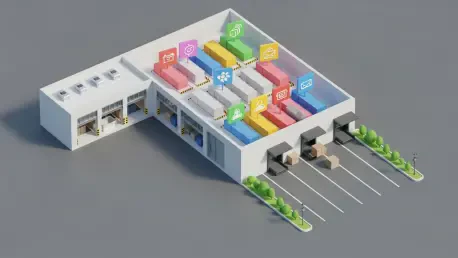
The architectural foundation of the new DT WMS is built specifically to handle the “multi-tenant” nature of third-party logistics, where diverse inventory from various retailers must be managed within a single facility. Unlike standard warehouse software that often struggles to maintain clean data boundaries between different clients, this system ensures that every SKU is accurately attributed to its owner regardless of where it is stored. This capability allows warehouse managers to utilize space more efficiently by mixing products from different clients in the same zones, a practice known as commingled inventory. By breaking down the rigid barriers of traditional storage, 3PLs can maximize their cubic footage and labor productivity. The software maintains a strict logical separation behind the scenes, ensuring that reporting and inventory counts remain precise for each individual client, which is essential for maintaining transparency and trust in a competitive market.
Beyond simple storage, the platform excels in high-velocity workflows such as cross-docking, where speed is the primary metric of success. In a cross-docking scenario, inbound freight is moved directly to outbound transportation with little to no time spent in static storage, a process that requires perfect synchronization between receiving and shipping departments. The DT WMS automates the identification of these priority shipments, directing warehouse staff to move goods immediately to the appropriate dock doors. This reduces the labor costs associated with “putaway” and “picking” cycles while drastically shortening the order-to-delivery window. For 3PLs handling high-volume retail goods or perishable items, this level of operational fluidity is a transformative advantage. It allows them to act as dynamic hubs in the supply chain rather than just storage depots, facilitating a faster flow of goods that meets the rising demands of just-in-time inventory strategies.
AI-Driven Financial Management and Settlement Automation
One of the most significant hurdles for 3PL providers involves the complex billing and settlement processes that occur when managing hundreds of different client contracts and driver payment structures. Traditionally, this required a dedicated team of administrators to manually reconcile warehouse activities with billing rules, a process prone to human error and delays. The introduction of an AI-enabled billing and settlement engine changes this dynamic by allowing operators to describe complex rules in natural language. The integrated artificial intelligence then interprets these descriptions and converts them into automated logic that tracks every movement and transaction. This ensures that every pallet moved, every hour of storage used, and every delivery completed is accurately captured and invoiced. The result is a transparent, auditable trail that eliminates disputes and ensures that the logistics provider is fairly compensated for the specific services rendered to each client.
This automation extends into the realm of driver payments, which is a critical factor in maintaining a reliable delivery fleet. By linking the warehouse activities directly to the settlement engine, the system can automatically calculate earnings based on specific route complexities, load types, and performance metrics. This level of precision is particularly valuable in 2026, where labor retention is a top priority and drivers expect prompt, accurate compensation for their work. When the software handles the heavy lifting of financial calculations, the management team can focus on strategic growth rather than administrative troubleshooting. Furthermore, the natural language interface democratizes the technology, allowing non-technical staff to update billing rules as contracts evolve without needing to write code or consult with expensive software developers. This flexibility makes the platform a living tool that grows alongside the business, adapting to new market conditions in real-time.
Achieving Seamless Integration for End-to-End Visibility
The true power of modernizing 3PL operations lies in the seamless integration between the warehouse management system and the last-mile delivery software. In the past, these two functions were often managed by disparate programs that required manual data uploads or fragile third-party integrations, creating a “visibility gap” where orders could be lost or delayed. By unifying these stages into a single ecosystem, DispatchTrack ensures that data flows naturally from the moment an order is picked in the warehouse to the moment it is signed for by the customer. This end-to-end connectivity provides managers with a holistic view of the entire fulfillment cycle, allowing them to identify bottlenecks before they impact the customer experience. When the warehouse knows exactly what the delivery fleet is doing, and vice versa, the entire operation becomes more synchronized, resulting in tighter delivery windows and higher service levels for the end consumer.
This unified approach also simplifies the technical landscape for 3PL providers, who no longer need to maintain multiple complex software licenses and support contracts. A single source of truth for all logistics data reduces the IT burden and ensures that everyone in the organization, from the forklift operator to the fleet dispatcher, is working with the same real-time information. This synchronization is vital for managing the “exception” events that are common in logistics, such as last-minute order changes or delivery re-attempts. Because the system is integrated, a change in the warehouse is immediately reflected in the delivery routing, and a delay on the road can be communicated back to the warehouse for rescheduling. This level of responsiveness was previously unattainable for most mid-sized 3PLs, but the democratization of this technology is now allowing these companies to compete with global logistics giants on both service quality and operational efficiency.
Strategic Evolution of Warehouse Management Systems
The launch of the DT WMS signified a pivotal shift in how logistics technology is developed, moving away from generic solutions toward specialized tools that respect the unique workflows of service providers. Third-party logistics companies are no longer forced to “work around” software limitations that were built for traditional retailers; they now have access to a platform that understands the nuances of shared labor and multi-client billing. This evolution has successfully bridged the gap between the storage of goods and their final distribution, creating a more resilient supply chain. Logistics providers who have adopted these integrated systems reported significant reductions in manual data entry and a notable increase in billing accuracy, which directly improved their bottom-line margins. By treating the warehouse and the last mile as a single, continuous process, the industry has moved closer to a frictionless model of commerce that can adapt to the shifting needs of the global marketplace.
Looking forward, the successful implementation of these advanced systems required a commitment to data integrity and a willingness to move away from legacy processes. Providers should have focused on training their teams to leverage the AI components of their billing engines and ensured that their physical warehouse layouts were optimized for the cross-docking capabilities offered by the software. Those who took these proactive steps found themselves better positioned to handle the high-volume surges and complex requirements of modern retail. The transition to a unified logistics platform was not just about installing new software; it was about adopting a philosophy of total visibility and operational agility. As the industry progressed through 2026, the clear takeaway was that the integration of the warehouse and the delivery fleet is no longer a luxury, but a fundamental requirement for any 3PL aiming to deliver superior value in a crowded and demanding market.