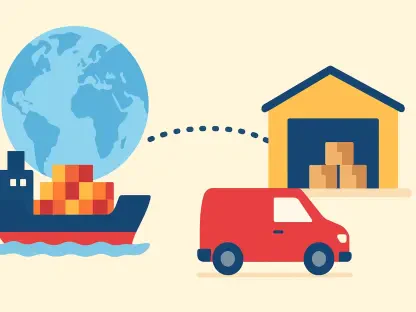

The traditional boundaries of maritime commerce have dissolved as global shipping titans aggressively pivot toward controlling the entire supply chain from the manufacturing floor to the consumer’s doorstep. This fundamental shift marks the end of the era where port-to-port transportation was the primary metric of success for ocean carriers. Today, the industry prioritizes integrated, end-to-end solutions that mitigate the complexities of modern trade. In the North American market, this transformation is particularly visible as logistics providers invest billions to bridge the historical divide between sea-based transport and domestic distribution.
The Evolution of Global Shipping and the North American Logistics Landscape
The strategic pivot from being a mere maritime carrier to a comprehensive logistics partner stems from a growing demand for reliability in an increasingly volatile global market. Shippers no longer want to manage multiple vendors for customs, drayage, warehousing, and final delivery. Consequently, the focus has shifted toward controlling the entire journey of a container. By internalizing these services, logistics leaders can offer a unified point of accountability, which significantly reduces the administrative burden on retailers and manufacturers.
North America serves as the primary theater for this evolution due to its massive domestic consumption and sophisticated e-commerce infrastructure. The region requires more than just efficient ports; it demands a seamless transition into the interior. As domestic infrastructure faces pressure from aging systems and labor shortages, the ability to provide private, reliable land-based assets becomes a major competitive advantage. This necessity has driven maritime experts to acquire inland capabilities that were once considered outside their core competencies.
Key Trends and Market Growth in Integrated Logistics
Drivers of Change in Supply Chain Management
The primary catalyst for structural change is the omnichannel revolution, which has forced a total reimagining of how inventory is stored and moved. In the past, companies maintained separate supply chains for wholesale distribution and direct-to-consumer e-commerce. However, modern logistics providers are now merging these streams into unified fulfillment centers. This integration allows for a more fluid movement of goods, enabling brands to pivot their inventory between retail stores and online orders based on real-time demand.
Strategic consolidation has also played a vital role in bridging the sea-to-land gap. High-value acquisitions of specialized domestic firms have allowed global carriers to bypass the slow process of organic growth. By absorbing established warehousing giants and customs brokerage firms, these maritime leaders have gained instant access to localized expertise and existing customer bases. This trend toward vertical integration ensures that the carrier maintains visibility over the cargo long after it has left the dock.
Market Projections and Performance Metrics
Domestic growth indicators currently reflect a massive expansion of physical assets across the United States and Canada. This footprint now includes a vast network of hundreds of trucks and thousands of trailer assets designed to move cargo from coastal hubs to inland distribution points. The move into the “big and bulky” delivery sector—handling items like furniture and appliances—further demonstrates the desire to capture every segment of the consumer market. These physical investments are projected to grow significantly from 2026 to 2028 as land-based demand continues to rise.
Digital metrics also highlight the surge in e-commerce fulfillment, with annual parcel deliveries reaching the tens of millions. The expansion of specialized domestic stations and linehaul hubs has allowed logistics providers to cut down delivery times for major retail partners. As shippers seek to reduce fragmented inventory systems, the market for integrated logistics is expected to see sustained growth. Performance is now measured by the speed of the final mile rather than just the transit time across the Pacific.
Navigating Industry Challenges and Operational Friction
The most persistent obstacle in international trade is the transload problem, where cargo often sits idle for days during the transfer between vessels or from ship to rail. Traditional linear shipping models, known as the string principle, are notoriously fragile because a single delay at an early port cascades throughout the entire schedule. To solve this, industry leaders have moved toward a hub-and-spoke model. This centralized approach utilizes high-tech hubs to sort cargo more efficiently, which has successfully cut transload times in half and increased reliability to 90% or higher.
The Regulatory Environment and Operational Compliance
Navigating the complex North American regulatory landscape requires specialized expertise in customs and border protection. The acquisition of established customs services has enabled logistics providers to manage digital documentation and compliance with extreme precision. Furthermore, environmental mandates are putting pressure on ground freight operations to adopt cleaner technologies. Meeting these emissions standards while maintaining a massive fleet of trucks requires a balance between operational efficiency and long-term sustainability goals.
The Future of Logistics: Innovation and Market Disruption
The rise of unified fulfillment centers represents the next phase of domestic logistics innovation. By co-locating wholesale and e-commerce operations in massive facilities, such as those used by global apparel brands in the Midwest, companies can drastically reduce container handling time. Emerging technologies like blockchain and the Internet of Things are also being integrated to provide factory-to-door transparency. This blueprint for integrated logistics, refined in the North American market, is now being exported to international territories to create a truly seamless global network.
Maersk’s New Identity as a Strategic Logistics Partner
The transition from a maritime carrier to a land-based powerhouse represented a total recalibration of global trade priorities. Shippers moved away from fragmented, multi-vendor systems toward unified platforms that offered granular control over their entire inventory. This shift provided a clear blueprint for how legacy industrial firms adapted to the requirements of the modern digital economy. Stakeholders recognized that the reduction of friction in the final mile became the ultimate competitive advantage in a crowded marketplace.
The expansion into domestic trucking and specialized fulfillment centers successfully insulated cargo owners from the volatility of traditional shipping cycles. New insights into data-driven routing allowed for a significant reduction in waste and operational downtime. Future strategies prioritized the integration of carbon-neutral ground transport to meet evolving environmental standards. Ultimately, the successful merger of sea and land operations transformed the logistical landscape into a more resilient and predictable environment for global commerce.