
DoorDash is currently employing a hybrid strategy that utilizes both its own FAA certifications and partnerships with established operators like Flytrex. This approach highlights the complexity of the current delivery ecosystem as companies strive to balance internal innovation with ready-made logistics networks. In the current landscape of 2026, the retail world stands at a critical juncture where the novelty of aerial couriers is rapidly transforming into a logistical necessity. With major industry players competing to standardize thirty-minute delivery windows, the next eighteen months will likely determine if these autonomous systems become a permanent fixture in suburban life. The transition is fueled by significant advancements in sensor technology and navigation software, which have moved beyond experimental phases into real-world applications across hundreds of American cities. As demand for rapid fulfillment grows, the focus has shifted toward building a resilient infrastructure that can support high-volume operations safely.
Corporate Strategies for National Scaling
Internal Development: Vertical Integration and Hardware Control
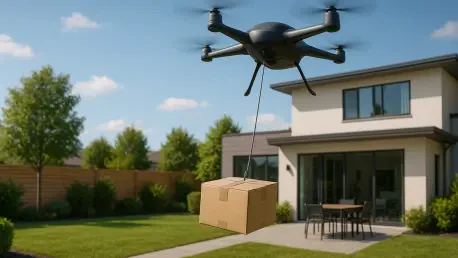
Amazon has chosen a distinct path by operating as a fully vertically integrated aviation entity, designing and manufacturing its proprietary MK30 drone specifically for urban and suburban environments. This aircraft is notable for its sophisticated detect-and-avoid capabilities, which allow it to navigate complex air traffic autonomously by identifying uncooperative obstacles or crewed aircraft in real-time. By operating under the Federal Aviation Administration’s Part 135 certification, Amazon maintains a level of oversight comparable to traditional commercial airlines, ensuring rigorous safety standards across its growing network. The company is currently leveraging its Beyond Visual Line of Sight approval to remove the need for ground observers, which significantly reduces operational overhead while increasing the range of service. This strategy enables the delivery of a wide variety of items, ranging from urgent medical supplies to small household electronics, provided they meet the weight requirements.
The engineering behind these autonomous systems focuses heavily on acoustic signatures and public safety, ensuring that drone operations do not disturb the communities they serve. Amazon’s MK30, for instance, features a reduced noise profile that makes the aircraft barely audible during standard flight altitudes. This technical refinement is paired with advanced redundant systems that allow the drone to land safely in the event of a mechanical failure. Furthermore, the integration of real-time weather monitoring allows these fleets to adjust flight paths or delay missions based on wind speeds and precipitation levels. This level of granular control is essential for maintaining a high success rate in diverse climates, from the humid conditions of the South to the colder regions of the Pacific Northwest. By prioritizing these safety and environmental factors, operators are working to prove that aerial delivery is not just a fast option, but also a reliable and socially responsible alternative to traditional ground-based logistics.
Asset-Light Models: Strategic Partnerships and Rapid Expansion
In contrast to the internal manufacturing focus seen elsewhere, Walmart has adopted an asset-light strategy by forming deep partnerships with established aviation experts such as Wing. This model prioritizes speed to market and geographic expansion by utilizing Walmart’s massive existing retail footprint as a launchpad for third-party drone fleets. By early 2026, this collaborative effort has already reached millions of households, demonstrating that capital efficiency can be just as effective as vertical integration for achieving national scale. The partnership allows Walmart to offer cutting-edge delivery speeds without the immense financial burden of developing its own aircraft hardware or managing complex regulatory departments from scratch. This approach has proven particularly effective in suburban markets where the density of customers matches the operational range of current battery technology. The success of this model suggests that the future of aerial logistics may lie in a fragmented ecosystem where retailers and technology providers coexist.
The geographic saturation achieved through these partnerships has allowed Walmart to target high-density regions with surgical precision, focusing on the last mile where ground delivery is most expensive. By utilizing Wing’s expertise, the retailer can bypass the traditional logistics bottlenecks caused by road traffic and infrastructure limitations. This operational agility is supported by specialized launch pads located directly on store roofs or in converted parking areas, which minimize the time between an order being placed and the drone taking flight. These automated nests handle battery swaps and system checks with minimal human intervention, allowing for a continuous cycle of fulfillment. As the network expands to hundreds of additional locations through 2027, the focus is shifting toward optimizing the packaging to maximize the number of items that can be transported in a single trip. This evolution of the asset-light model indicates that large-scale adoption does not always require the total ownership of the technology stack to be successful.
Expanding the Ecosystem and Market Reach
Specialized Services: Food Delivery and Small Business Access
The ecosystem is also diversifying beyond traditional retail, with high-frequency food delivery emerging as a primary growth sector for aerial logistics. Uber Eats has significantly expanded its footprint through a strategic partnership with Zipline, aiming to facilitate massive daily delivery volumes across major metropolitan hubs. These drones are specifically optimized for the quick transport of temperature-sensitive meals, ensuring that food arrives in peak condition faster than traditional ground-based couriers could manage. This focus on the on-demand nature of the restaurant industry represents a shift in how urban planners view the utility of low-altitude airspace. By removing thousands of delivery cars from congested city streets, these aerial operations contribute to a reduction in traffic and local emissions while providing a faster service for the consumer. As the technology continues to mature through 2027 and 2028, the integration of these systems into existing food service platforms will likely become a standard expectation for many urban dwellers.
One of the most significant developments in the current year is the democratization of drone technology for small and mid-sized enterprises. Previously, the high costs of entry and regulatory hurdles restricted aerial delivery to a few global corporations with deep pockets. However, the rise of drone-as-a-service providers and marketplace models now allows local pharmacies and independent restaurants to offer the same speed of service as their larger competitors. By integrating drone delivery options directly into common point-of-sale systems, these small businesses can tap into established networks like Flytrex or Manna without owning a single aircraft. This shift ensures that the technological boom provides a competitive edge to regional players, fostering local economic growth and providing communities with more diverse shopping options. As these platforms continue to expand their reach, the barrier between global retail giants and local shops is narrowing, at least in terms of logistical capabilities. This evolution marks a turning point for the industry.
Public Integration: Consumer Trust and Regulatory Path
Despite the rapid technological progress, the industry must still navigate the complexities of consumer psychology and public perception. Early data indicated that individuals who had never used a delivery drone often expressed concerns regarding noise, privacy, and potential safety risks. However, the experience of regular users has shown a remarkably high satisfaction rate, with many citing the precision and speed of the service as factors that changed their perspective. This experience gap is narrowing as more households witness the reliability of autonomous drop-offs, which often arrive in better condition than those handled by traditional road vehicles. Interestingly, the convenience of the service has also influenced shopping habits, with many consumers increasing their order frequency once the friction of delivery time is removed. The novelty factor that once drove initial orders has evolved into a genuine reliance on the technology for everyday necessities. Building long-term trust will require continued transparency and rigorous safety protocols.
The transition toward a more standardized regulatory environment proved to be the final structural pillar needed for mass-market adoption. The industry successfully moved away from a complex system of individual waivers toward the FAA’s Part 108 framework, which streamlined the requirements for commercial operations beyond the pilot’s line of sight. This shift allowed companies to scale their operations with greater predictability, reducing the administrative burden on both regulators and innovators. As these rules were finalized, the focus shifted toward integrating drones into the broader national airspace alongside crewed aircraft through advanced traffic management systems. Stakeholders prioritized the development of noise-reduction technologies and neighborhood-specific flight paths to address community concerns during this expansion phase. Consequently, drone delivery transitioned from a speculative experiment into a functioning layer of the American economy. Future considerations involved refining battery recycling and expanding hubs to increase efficiency across regions.