
The beverage industry is transitioning from a reliance on manual labor toward sophisticated robotic systems to manage the complex logistics of distribution centers. This shift represents a departure from decades of tradition where automation was largely confined to the “front end” of production, such as high-speed bottling and filling lines. As consumer preferences continue to diversify, the sheer volume of unique Stock Keeping Units has exploded, forcing modern warehouses to handle a dizzying array of flavors, package sizes, and seasonal variations. The logistical nightmare of managing these diverse products has been exacerbated by a persistent global labor shortage that makes traditional manual picking increasingly unsustainable. Modern robotics are now stepping in to provide the flexibility and intelligence required to manage the outbound side of operations. By integrating advanced sensors and artificial intelligence, these machines are transforming distribution from a historical bottleneck into a high-speed, reliable component of the modern supply chain.
Bridging the Gap in Distribution
Logistics Variability: The Challenge of Diverse Inventory
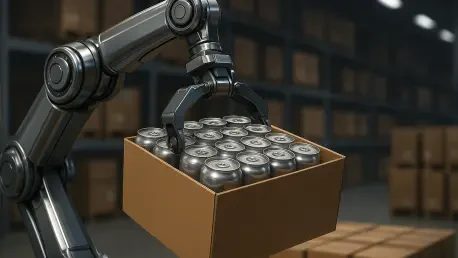
Traditional automation was primarily built for consistency, designed to handle the same bottle or can millions of times without deviation. However, the outbound logistics environment is inherently chaotic, requiring systems to process a high degree of variability in weight, packaging material, and fragility. When building mixed-case pallets for a grocery store, a robotic system must account for the density of heavy glass bottles versus the lightweight, crushable nature of aluminum cans to ensure load stability. Older, fixed mechanical systems often struggled with this lack of uniformity, leading to frequent jams and manual interventions. Today, sophisticated vision systems and adaptive grippers allow robots to identify and adjust to varied dimensions in real-time. This capability enables distributors to maintain high throughput even as order profiles become more fragmented and complex. By bridging this gap, beverage companies are finally able to apply the same level of precision to their distribution hubs as they have long applied to their manufacturing lines.
Structural Flexibility: Modernizing Legacy Facilities
Beyond product variability, the physical reality of the beverage industry often involves older, legacy facilities that were never designed for large-scale, fixed automation. Many companies operate under long-term leases in urban centers where expanding the warehouse footprint is either impossible or prohibitively expensive. In the past, installing automated storage and retrieval systems meant tearing up floors or raising roof lines, costs that few mid-market players could justify. The current generation of mobile robotics solves this problem by being “environmentally aware.” These units utilize Simultaneous Localization and Mapping technology to navigate narrow aisles and existing rack structures without the need for magnetic strips or floor modifications. This flexibility allows for a phased approach to automation, where robots are deployed into existing workflows without disrupting active production cycles. This lower barrier to entry ensures that modernization is no longer tied to massive capital projects, but rather to strategic incremental improvements.
Accessibility for Small and Mid-Sized Operations
Technical Democratization: Empowering the General Workforce
The democratization of robotic technology has shifted the landscape from a “specialist-only” domain to a practical tool for general production staff. Historically, the complexity of programming and maintaining industrial robots required a dedicated team of engineers or expensive external consultants. Modern software interfaces have changed this dynamic by utilizing intuitive “no-code” or graphical programming environments. Warehouse supervisors and floor staff can now teach a robot new palletizing patterns or pathing routes through simple touch-screen adjustments. This shift is critical for small and mid-sized enterprises that lack the overhead for specialized technical departments but face the same labor pressures as industry giants. By reducing the reliance on third-party integrators, companies can respond much faster to market changes or new product launches. The ability for local teams to “own” the technology fosters a culture of continuous improvement, where the staff closest to the process are the ones optimizing performance.
Rapid Deployment: The Value of Modular Systems
A prime example of this newfound accessibility is the rise of “off-the-shelf” palletizing systems designed for rapid deployment into active environments. Consider the case of specialized liquor producers, such as the Dutch company Schrobbelèr, who must manage heavy cases and delicate glass in a high-pressure environment. In the past, automating such a line might take months of custom engineering; now, pre-configured robotic cells can be delivered and integrated into a facility in as little as twenty-four hours. These modular systems are designed to fit into standard warehouse footprints, requiring minimal changes to the upstream conveyor systems. Because these units are self-contained and safety-rated to work alongside humans, they eliminate the need for extensive safety fencing that often consumes valuable floor space. For a small enterprise, this means the return on investment is measured in months rather than years. The speed of installation ensures that production remains steady while the facility upgrades its capabilities.
The Rise of Hybrid Logistics Models
Operational Synergy: Harmonizing Humans and Machines
The most effective modern warehouses are not those that attempt to remove humans entirely, but those that implement a hybrid model where technology and people complement each other. Industry experts have observed that while robots are superior at repetitive, heavy lifting, human workers remain unmatched in their ability to handle exceptions, such as damaged packaging or unusual spillages. By integrating Automated Guided Vehicles and pick-and-place robots into a cohesive logistics framework, companies can create a fluid workflow that maximizes the strengths of both parties. In this scenario, robots handle the bulk of the transport and stacking, while humans focus on quality control and the resolution of complex logistical errors. This synergy is particularly important as the demand for next-day or even same-day delivery necessitates a level of speed and accuracy that neither humans nor machines could achieve alone. The resulting framework is inherently scalable, allowing for the addition of more robotic units during peak seasons.
Order Complexity: Navigating Fragmented Consumer Demand
Robotics is increasingly filling the “white space” that exists between traditional fixed conveyors and manual handling, particularly regarding customer-specific order fulfillment. The modern beverage market has shifted away from bulk shipments of single products toward smaller, more frequent orders that require mixed-case pallets. Managing this level of complexity manually is slow and prone to error, yet traditional high-speed sorters are often too rigid to handle such varied pick lists. Collaborative robots and advanced picking systems can navigate these requirements with ease, identifying specific products from diverse storage locations and assembling them according to the precise needs of a local retailer. This capability allows distributors to offer more personalized service without increasing their labor costs. As the industry moves toward 2027 and 2028, the ability to execute these complex, high-variability tasks with machine precision will become a primary competitive advantage. The focus is no longer just on moving boxes, but on moving the right boxes in the most efficient sequence.
Enhancing Safety and Operational Precision
Ergonomic Protection: Mitigating Physical Strain
Improving workplace safety and ergonomics is perhaps the most immediate human benefit of integrating robotics into the beverage warehouse. The physical toll of palletizing thousands of heavy cases per shift is immense, leading to high rates of musculoskeletal injuries and employee burnout. By delegating these “dull, dirty, and dangerous” tasks to robotic arms, companies are seeing a significant drop in workplace insurance claims and a marked improvement in employee retention. Workers are no longer required to spend their days performing repetitive motions that lead to long-term physical strain; instead, they are transitioned into roles that involve monitoring the systems and managing the data flow. This shift not only protects the health of the workforce but also elevates the nature of the jobs within the warehouse, making the industry more attractive to a younger, more tech-savvy generation of workers. Creating a safer work environment is no longer just a regulatory requirement but a core strategy for maintaining a stable and productive workforce.
Digital Integrity: Precision in Data and Hardware
Beyond physical labor, modern robotic systems provide a level of digital oversight and data precision that is essential for modern compliance, especially in the alcoholic beverage sector. These machines are equipped with integrated scanning technology that tracks every lot code, SKU, and expiration date as the product moves through the facility. This continuous monitoring ensures that “first-in, first-out” protocols are strictly followed, virtually eliminating the risk of shipping expired goods to retailers. Furthermore, the move from pneumatic to electric end-of-arm tooling has reduced energy consumption and simplified maintenance. Unlike older systems that required complex air lines and were prone to leaks that could damage electronics, modern electric grippers are cleaner and more reliable. This transition has also improved the accuracy of the “pick,” reducing the financial burden of chargebacks caused by mis-shipped or damaged items. The integration of these precise systems ensures that operational transparency remains a standard feature.
Strategic Evolution: Navigating the New Logistical Standard
Integrated Networks: Harmonizing Data and Infrastructure
The shift toward robotic logistics proved to be a defining moment for the beverage industry, as it resolved the long-standing tension between manufacturing speed and distribution flexibility. Organizations that successfully navigated this change found that the most effective implementations prioritized interoperability, ensuring that new robotic units could communicate seamlessly with existing warehouse management systems. To sustain this momentum, companies began to focus on developing robust data architectures to fully leverage the real-time insights provided by their automated fleets. This required a move away from siloed information toward integrated networks where a single point of truth managed both production and distribution data. By harmonizing these elements, distributors were able to reduce inventory lag and improve the overall flow of goods from the production line to the delivery truck. This holistic approach to data ensured that the robotic hardware operated at peak efficiency, creating a responsive logistics network that could adapt to shifting market trends.
Workforce Evolution: Sustaining Momentum in the Modern Warehouse
Investment in employee upskilling was equally vital, as the workforce evolved to manage increasingly sophisticated digital interfaces rather than performing manual tasks. Future-looking strategies now include the adoption of predictive maintenance schedules that utilize robotic performance data to prevent downtime before it occurs. As the industry enters the next phase of development, the focus must remain on creating a culture that views technology as an enhancement to human capability rather than a replacement. Leaders in the field have already begun to implement ongoing training programs that prepare workers for the next generation of logistics technology, including AI-driven optimization and autonomous transport fleets. Ultimately, the industry moved to a model where automation was viewed as a modular, scalable asset that laid the groundwork for a more resilient supply chain. This evolution ensured that beverage warehouses were no longer static storage spaces, but dynamic hubs of technological innovation capable of meeting the rigorous demands of a rapidly changing consumer landscape.