
Rohit Laila brings a wealth of knowledge to the logistics sector, having spent decades navigating the complexities of supply chain management and delivery systems across the globe. As a staunch advocate for technological integration within transportation, he has witnessed firsthand the evolution of freight from simple road-bound transit to the sophisticated, multimodal networks we see today. His expertise is particularly relevant now as Australia undergoes a massive shift in its infrastructure landscape, prioritizing resilience and sustainability. In this conversation, we explore the operational dynamics of the Melbourne Intermodal Terminal (MIT), examining how its strategic design and massive scale are reshaping the way goods move through Victoria and beyond.
The discussion delves into the strategic advantages of the terminal’s location relative to major shipping hubs and the dual-gauge rail connectivity that allows for seamless interstate transit. We also explore the massive $1.6 billion investment into the surrounding industrial precinct, the environmental implications of shifting freight from road to rail, and the specific technological advancements, such as semi-automated gantry cranes, that drive the facility’s high-volume throughput. Finally, we look at the growing list of global shipping partners who are already utilizing the terminal to bypass urban congestion.
The terminal is positioned 20 kilometers from the Port of Melbourne with access to both Victorian and interstate rail networks; how does this specific “Goldilocks” geography fundamentally change the math for logistics providers?
The beauty of being situated exactly 20 kilometers from the Port of Melbourne is that it strikes a perfect balance between proximity and maneuverability. When we talk about the “Goldilocks” zone, we are referring to a location that is far enough from the port’s immediate congestion to allow for fluid movement, yet close enough to make a rail shuttle service economically viable. By being adjacent to the Hume Highway and sitting right on the junction of broad-gauge and standard-gauge networks, we eliminate the traditional bottlenecks that plague city-center logistics. For a provider, this means they no longer have to gamble on the unpredictable traffic of the Dynon port precinct or swallow the rising costs of motorway tolls just to move a container a few miles. This geographic advantage allows for a seamless flow where goods can be consolidated and processed in a 45-hectare space that doesn’t feel the cramped pressure of the urban core, effectively shortening the “last mile” into a high-speed rail sprint.
With a footprint of over 45 hectares and the ability to stack containers up to seven high, what are the physical and technical capabilities that allow the MIT to handle such a massive volume of TEUs?
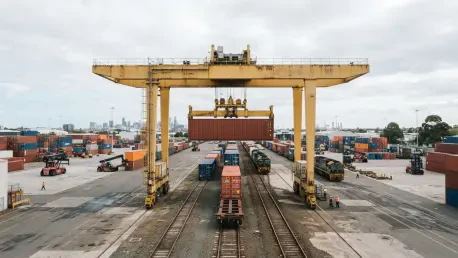
The sheer scale of the MIT is designed to handle a staggering annual capacity of one million twenty-foot equivalent units (TEUs), which is a massive leap forward for the region’s throughput. To manage this, the terminal is built on 30 hectares of heavy-duty concrete hardstands engineered to support the immense weight of full containers stacked five-high, and even empty boxes stacked seven-high. The technical heart of the operation lies in the seven 350-tonne semi-automated rail-mounted gantry cranes. These machines are marvels of modern engineering, capable of loading or unloading up to 40 containers per hour, which creates a rhythmic, high-velocity environment where dwell times are kept to an absolute minimum. When you see these cranes moving in tandem across the dual-gauge rail sidings, you realize that the MIT isn’t just a parking lot for boxes; it’s a high-performance processing engine designed to keep the supply chain moving 24/7.
How does the integration of the Melbourne Intermodal and Industrial Exchange (MIIX) create a “one-stop shop” experience that differs from traditional, fragmented logistics hubs?
The MIIX represents a broader $1.6 billion investment that essentially builds an entire industrial ecosystem around the terminal, covering a 99-hectare logistics estate. This isn’t just about moving boxes from point A to point B; it’s about creating a centralized hub where customs-bonded storage, empty container parks, and maintenance services like washing, fumigating, and repairing all happen in one place. One of the most significant advantages here is the use of internal roads that allow for container weights far exceeding what is permitted on public streets. This allows us to transfer heavy loads directly between the terminal and co-located warehouses without the need for specialized road permits or the risk of fines. By offering “rural tailgate inspections” and on-site de-hiring services, we are stripping away the administrative and physical friction that usually slows down the transition from sea to shelf.
The shift toward rail is often framed as an environmental necessity, but what are the tangible impacts this terminal has on community safety and urban congestion?
Moving freight onto rail is one of the most effective ways to decarbonize the “hard-to-abate” transport sector, but the immediate, everyday benefit for the community is the reduction of heavy vehicle traffic on public roads. Every 600-meter port shuttle train that leaves the MIT is hauling approximately 80 TEUs, which effectively removes dozens of heavy trucks from the metropolitan road network in a single trip. By keeping these trucks in the industrial north and preventing them from having to cross the city to reach the port, we are significantly lowering the risk of accidents and reducing the wear and tear on urban infrastructure. Since we commenced operations in late 2025, we have already delivered over 400 rail freight services, which translates to thousands of truck movements avoided. It’s a sensory relief for the city—fewer engine roars, less diesel exhaust in residential corridors, and a safer environment for commuters who no longer have to share narrow motorways with massive shipping containers.
Major players like COSCO Shipping and Harders Global Logistics have already signed on as early adopters; what specific commercial advantages are these global firms seeing in this new rail-centric model?
For a giant like COSCO Shipping, the draw is the ability to offer a “single through bill of lading,” which simplifies the entire bureaucratic nightmare for their end customers. Instead of having to coordinate multiple landside slots and deal with port pickups, their containers come direct to Somerton, allowing for ocean and inland transportation to be handled under one streamlined agreement. Harders Global Logistics, which specializes in beverage supply chains, sees the MIT as a way to hit their own corporate sustainability targets while ensuring the safety of their high-value products through the stability of rail. These firms recognize that the MIT provides a bi-modal solution that buffers them against the rising costs of fuel and the labor shortages often found in the trucking industry. They aren’t just looking for a place to store goods; they are looking for a strategic partner that gives them a competitive edge through speed, reliability, and lower emissions.
As the terminal moves toward its goal of one million TEUs, how does it fit into the broader national freight and supply chain strategies for the coming decade?
The MIT is a cornerstone of the 2025 National Freight and Supply Chain Strategy, which specifically calls for integrated intermodal precincts to boost Australia’s international competitiveness. We are perfectly positioned to serve the Melbourne-Adelaide-Perth east-west corridor, which is forecast to see a steady growth in container volumes between now and 2050. By acting as the primary hub for the Victorian Port Rail Shuttle Network, we are providing the volume and the infrastructure necessary to make rail the default choice for importers and exporters rather than a secondary alternative. Our facility is the realization of years of planning that previously never made it past the design phase; it provides the massive rail capacity that the state has desperately needed to replace outdated, small-scale facilities. We are essentially future-proofing the supply chain, ensuring that as Australia’s population and consumption grow, our logistics backbone is strong enough to carry the load without breaking.
What is your forecast for the role of intermodal terminals in Australian logistics over the next five years?
I forecast that by 2030, we will see a “rail-first” mentality become the standard for any freight traveling more than 50 kilometers from a major port, with the MIT serving as the blueprint for this transformation. We will likely see an even deeper integration of AI and automation within these terminals, where the 350-tonne gantry cranes we use today will be part of a fully synchronized digital twin of the entire supply chain. As the Port Rail Shuttle Network continues to offer financial incentives for rail adoption, the cost-benefit analysis will shift so heavily in favor of intermodal hubs that road-only logistics will be reserved solely for niche, ultra-local deliveries. The $1.6 billion MIIX precinct will become the bustling center of Victoria’s industrial heart, attracting global manufacturers who want to be quite literally across the street from a world-class rail link. Ultimately, the success of the MIT will prove that high-efficiency rail is not just a green dream, but the most profitable and resilient way to power a modern economy.