
The massive facility known as BFI4 in Kent, Washington, stands as a testament to how far fulfillment centers have evolved from simple warehouses into sophisticated technological hubs that process millions of packages with surgical precision. This specific site operates as a critical node within the global commerce network, utilizing a dense ecosystem of proprietary software and autonomous hardware to manage the relentless flow of consumer demand. As supply chain pressures continue to mount across the globe, the innovations perfected within these walls serve as a reference point for the entire logistics industry. Observing the seamless coordination between massive robotic arms and high-speed sorting systems reveals a shift toward a world where human labor is augmented by intelligent machines. The integration of advanced sensors and real-time data analytics allows the facility to adapt to fluctuations in order volume, ensuring that the promise of rapid delivery remains a consistent reality. This technological integration is not merely an upgrade but a complete reimagining of the logistics lifecycle.
Integrating Advanced Robotics into High-Volume Fulfillment
The Deployment of Autonomous Mobile Robots
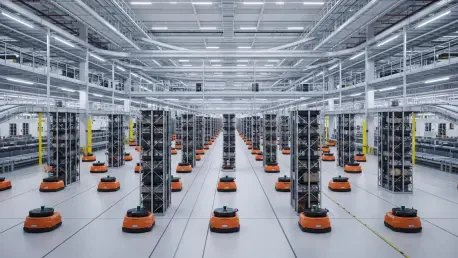
The floor of BFI4 is characterized by a constant, choreographed dance of autonomous mobile robots known as Proteus and Sparrow, which handle the heavy lifting once reserved for manual labor. These machines utilize advanced computer vision and navigation algorithms to move large carts and individual items throughout the multi-story facility without the need for fixed tracks or human intervention. Unlike older generations of automated guided vehicles, these modern iterations are capable of recognizing obstacles and humans in their path, adjusting their routes dynamically to maintain safety and efficiency. This level of autonomy allows for a denser storage configuration, as aisles can be narrower and shelving units more compact than in traditional setups. By removing the physical strain of moving heavy loads across vast distances, the facility maximizes its throughput while simultaneously reducing the risk of fatigue-related errors. This technological leap reflects a broader industry trend toward fully integrated robotic ecosystems.
Enhancing Speed through Intelligent Sorting Systems
Sorting technology within BFI4 operates at a velocity that traditional manual sorting simply cannot match, utilizing miles of smart conveyors and high-speed scanners to route packages. Each item entering the system is instantly photographed and weighed, with the data cross-referenced against order requirements to determine the most efficient delivery path. This real-time processing ensures that packages are diverted to the correct loading docks within seconds of being packed, minimizing the time an item sits idle. The complexity of these systems is managed by an overarching artificial intelligence that balances the load across different zones of the warehouse, preventing any single area from becoming overwhelmed. Moreover, the integration of these high-speed sorters with regional delivery networks allows for a higher degree of granularity in shipping, enabling faster last-mile logistics. The transition from 2026 has seen a marked increase in the accuracy of these automated sorting protocols.
Redefining the Human Element in the Modern Warehouse
Improving Safety and Ergonomics for Employees
While automation is a central theme at BFI4, the focus on human safety and ergonomics has reached new heights through the implementation of collaborative robotics and wearable tech. Employees no longer need to perform the repetitive, high-impact tasks that were once the hallmark of warehouse work, as machines now handle the most physically demanding roles. This shift has led to a significant decrease in musculoskeletal injuries, as the facility design prioritizes “golden zone” picking where items are presented at waist height. The integration of ergonomic mats, adjustable workstations, and intelligent lighting systems further enhances the working environment, catering to the long-term health of the workforce. This approach acknowledges that while machines can handle speed and weight, human oversight remains essential for complex problem-solving and quality control. The transition to this collaborative model has necessitated a shift in training programs, focusing more on technical maintenance and system management.
Scaling Solutions for Global Supply Chain Resilience
The scalability of the BFI4 model is perhaps its most significant contribution to the broader logistics landscape, providing a modular framework that can be replicated. By standardizing the robotic layouts and software stacks used in Kent, the organization can deploy similar facilities across diverse geographic regions with minimal adjustment. This standardization allows for a more cohesive global network where data and best practices can be shared instantaneously across thousands of miles. During periods of regional disruption, this interconnectedness enables the network to reroute inventory and adjust fulfillment strategies dynamically, maintaining service levels even under duress. The technological blueprint established here serves as a foundation for smaller, more localized satellite centers that bring products closer to the end consumer. As global trade patterns shift from 2026 to 2028, the ability to rapidly scale and adapt these automated facilities will be a primary driver of competitive advantage.
Strategic Outcomes and Future Logistics Standards
The development of the BFI4 facility established a new benchmark for how technology and human labor could coexist in a high-pressure logistical environment. Operations managers across the industry looked to this model as they sought to implement their own automated solutions, focusing on the integration of computer vision and autonomous robotics. It became clear that the most effective strategy involved not just the purchase of hardware, but the creation of a unified software ecosystem capable of managing diverse mechanical assets. Organizations that prioritized data-driven decision-making and ergonomic workplace design saw significant improvements in both efficiency and employee retention. To move forward, stakeholders investigated ways to decentralize their processing power and invest in modular facility designs that could be deployed rapidly. This shift toward highly automated, human-centric logistics centers transformed the global supply chain into a more resilient and responsive system. Moving beyond the pilot phase required a dedicated commitment.