
Rohit Laila stands at the intersection of traditional logistics and cutting-edge robotics, bringing over twenty years of experience to the table in global supply chain management. His deep understanding of how physical goods move across borders makes him the perfect guide to decode the massive shift toward automated fashion fulfillment recently showcased at the Venlo facility in the Netherlands. We are exploring how the integration of high-density storage and robotic agility is redefining the standard for global brands, providing a benchmark for the future of the industry.
How does the integration of 127 robots and 60,000 rack locations fundamentally transform the throughput for a high-demand fashion brand like Guess?
The numbers we are seeing at the GXO facility in Venlo are a testament to what precision engineering can achieve when it is properly scaled. When you deploy 127 robots across 60,000 rack locations, you aren’t just moving faster; you’re creating a synchronized dance of efficiency that can process between 40,000 and 70,000 pieces in a single day. During peak periods, reaching a throughput of 2,200 order lines per hour means the system is handling the intense pressure that would typically overwhelm a manual crew or a less sophisticated setup. This level of automation provides a sense of predictability and a smoother workflow that is absolutely vital for meeting the high expectations of customers across EMEA and Asia. It’s a massive leap forward that allows a brand to maintain its pace even when the market is at its most volatile.
Fashion logistics is notoriously difficult due to seasonal spikes and high SKU counts; how does this tailored automation handle those specific pressures differently than traditional systems?
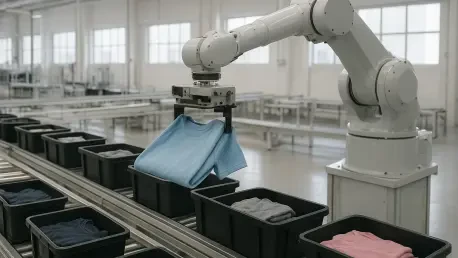
Fashion logistics is a field that simply doesn’t tolerate “approximate” solutions because the inventory is constantly shifting with new seasons and rapidly changing trends. In Venlo, the system is designed to manage the entire lifecycle of the product, from inbound logistics to complex value-added services like quality control and garment conditioning. By utilizing eight goods-to-person picking stations and a 200-meter conveyor network, the facility can pivot instantly to handle seasonal demand fluctuations without the need for the constant, expensive re-engineering of the floor space. It is about building a supply chain that adapts to the pressure of the moment while maintaining the exact precision required to manage thousands of unique SKUs. We are seeing that this tailored approach ensures that the facility scales without losing throughput, which is the ultimate goal in a high-stakes retail environment.
From an operational standpoint, what does the success of the Exotec Skypod system at GXO tell us about the future requirements of global fulfillment hubs?
The success of this deployment proves that the era of “off-the-shelf” automation is fading in favor of highly tailored, flexible solutions that can be integrated end-to-end. The impact at the site was evident from day one, allowing the operation to move to the next level without the typical growing pains associated with massive infrastructure changes. This partnership demonstrates that global brands need systems that offer both scalability and operational reliability, ensuring that as business continues to grow, the logistics backbone remains robust. We are moving toward a reality where automation isn’t just a tool for speed, but a strategic asset that allows a company to maintain a competitive edge through superior service and accuracy. It shows that when you combine operational expertise with advanced robotics, you create a facility that is ready for any challenge the market throws at it.
What is your forecast for fashion fulfillment automation?
I anticipate that from 2026 through the end of the decade, we will see a widespread move toward these modular robotic systems across all major international logistics hubs to keep up with e-commerce demands. The ability to process upwards of 70,000 pieces per day will become the industry baseline rather than an exception, as retailers can no longer afford the delays of manual sorting. We will see more facilities adopting goods-to-person technology to minimize human travel time, allowing workers to focus on quality and garment conditioning while the robots handle the heavy lifting and retrieval. Ultimately, the winners in the fashion space will be those who can scale their fulfillment operations instantly to meet the volatile swings of global consumer behavior without sacrificing a shred of precision.