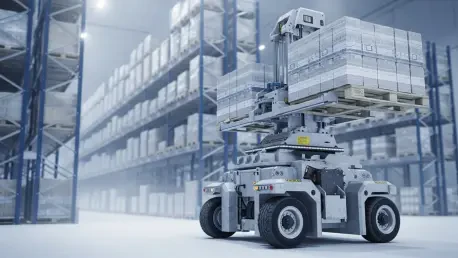

The biting reality of subzero logistics is that extreme cold eventually breaks every biological system, forcing humans to retreat while industrial demand continues to climb. In specialized facilities where temperatures regularly dip to a bone-chilling -15°F, the simple act of moving a pallet becomes a high-stakes challenge for worker safety and operational efficiency. LG CNS is now stepping into this frozen frontier with its Mobile Shuttle, a robotic solution designed specifically to endure the harsh conditions of modern cold chain facilities.
This technological leap attempts to solve the persistent issues of high turnover and physical strain in the refrigerated goods sector by replacing human labor in high-risk zones. The primary subject of this development is the total automation of warehouse tasks in subzero temperatures reaching as low as -26°C. By eliminating the need for a physical human presence in these deep-freeze environments, businesses can ensure food safety and operational continuity without sacrificing the health of their workforce.
Confronting the -15°F Barrier in Modern Logistics
Human endurance reaches its limit long before industrial needs do, especially in environments where temperatures plunge to dangerous levels. Standard warehouse tasks, which are physically demanding in temperate climates, become hazardous when performed in the dark, frozen aisles of a cold storage plant. These conditions often lead to rapid worker fatigue, increased injury rates, and a revolving door of recruitment costs that significantly eat into the profit margins of logistics providers.
The introduction of the Mobile Shuttle marks a shift toward a more resilient infrastructure where the environment no longer dictates the limit of operations. LG CNS engineered this hardware to function seamlessly in the deep freeze, ensuring that storage zones remain productive without constant human intervention. This capability allows companies to redesign their facilities for safety, moving personnel to climate-controlled command centers while robots handle the heavy lifting in the most punishing conditions.
Why Cold Chain Automation Has Become a Strategic Priority
Global consumer habits are shifting rapidly, with a heightened demand for fresh and frozen products requiring a more robust and responsive logistics backbone. Urban warehouses are under pressure to store more goods in smaller footprints, leading to a desperate need for high-density solutions that do not compromise on speed. Traditional two-way automated systems, while useful, often leave significant amounts of vertical and horizontal space unused, creating inefficiencies that the modern cold chain can no longer afford.
Labor shortages have further exacerbated these logistical bottlenecks, as finding workers willing to endure subzero shifts has become increasingly difficult. Transitioning to AI-driven storage is consequently evolving from a luxury into a fundamental requirement for business continuity. Companies that fail to automate risk losing ground to competitors who can offer faster throughput and more reliable food safety protocols through consistent, machine-led transport.
Engineering the Four-Way Architecture for Maximum Efficiency
The technical breakthrough that distinguishes the Mobile Shuttle is its departure from linear movement constraints in favor of a flexible four-way architecture. Conventional robots are often limited to back-and-forth paths, but this system navigates an intricate grid with the agility to move vertically, horizontally, forward, and backward. This multi-directional capability enables warehouse managers to design storage racks with much tighter tolerances, ultimately increasing the density and operational efficiency by roughly 30%.
Each unit is capable of hauling massive payloads up to 3,307 pounds at a steady speed of 4.9 feet per second. Whether moving delicate baking supplies or heavy industrial components like automotive batteries, the robots maintain consistent performance levels. The hardware is specifically reinforced to prevent the mechanical failures typically caused by thermal contraction and condensation, which are common killers of standard electronic equipment in cold environments.
Validation Through North American Partnerships and Safety Certifications
Proving the viability of robotic logistics required rigorous real-world testing, a hurdle that LG CNS addressed through significant industrial partnerships in the United States. A primary example is the collaboration with Paris Baguette USA, where the Mobile Shuttle was integrated into a high-volume manufacturing plant in Texas. In this facility, the robots manage the complex sorting of temperature-sensitive ingredients, ensuring that the cold chain remains unbroken from storage to production.
Securing a foothold in the American market also necessitated meeting stringent regulatory requirements, leading to the system’s official UL certification. This designation confirms that the shuttle meets the highest safety standards for mechanical and electrical components in industrial settings. With hundreds of units already operational across various affiliate plants, the technology demonstrated that it could handle large-scale deployment while maintaining the reliability required for global manufacturing.
Optimizing Fleet Performance with AI-Driven Command Systems
The physical prowess of the robot is amplified by a sophisticated software layer that acts as the brain for the entire logistics fleet. Managers have the ability to communicate with the system using conversational AI, issuing natural language commands through a chatbot interface to prioritize specific pallet movements. This removes the barrier of complex coding, making high-tech automation accessible to warehouse supervisors on the ground who need to respond to immediate logistical shifts.
Moreover, mathematical optimization algorithms work in the background to calculate the most efficient path for every unit in real time. By analyzing traffic patterns and inbound sequences, the software eliminates the gridlock that often plagues automated warehouses during peak hours. This synchronized movement ensured that high-velocity items were always positioned for immediate extraction, maximizing the speed at which goods left the facility.
The implementation of these AI-driven systems marked a significant transition from manual monitoring to autonomous oversight. Operators adopted new roles as strategic planners, focusing on fleet health rather than individual pallet movements. These efforts successfully neutralized the labor shortages that once threatened the viability of frozen logistics. The resulting infrastructure provided a sustainable path for future expansions into even more extreme industrial environments.