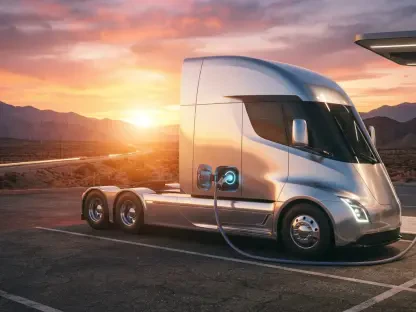

Mastering the logistics of charging schedules represents a fundamental shift in fleet management that requires years of practical experience to execute at scale effectively. This transition is no longer a distant possibility but a present-day necessity for companies aiming to maintain a competitive edge in an increasingly decarbonized global economy. Industry leaders, such as DSV, have demonstrated that waiting for a hypothetical moment of perfect price parity with internal combustion engines is a strategic mistake. Instead, the focus has shifted toward building a robust framework of data-driven insights and operational familiarity with battery-electric vehicle technology. The immediate integration of heavy-duty electric trucks allows operators to navigate the complexities of power grid limitations and infrastructure development before the market reaches a saturated state. By engaging with these technologies now, logistics providers can secure their position within the evolving supply chain and meet stringent emission targets.
Accelerating Technological Progress and Fleet Integration
The evolution of battery-electric truck performance has outpaced many conservative industry projections, moving from early prototypes to highly capable road-ready machines. Just a short time ago, the standard range for a heavy-duty electric truck hovered around 250 kilometers, which significantly limited their utility to short-haul urban distribution. However, the current generation of vehicles hitting the roads from 2026 to 2028 has successfully pushed these boundaries to 500 kilometers and beyond on a single charge. This jump in capacity changes the calculation for long-haul routes, enabling operators to cover more ground with fewer stops. While the initial purchase price of these advanced vehicles remains higher than their diesel counterparts, the gap is narrowing as manufacturing scales up and battery costs continue to decline. Large logistics firms are now leveraging their massive scale to aggregate demand, helping smaller subcontractors access better financing and centralized charging networks.
Beyond range improvements, the integration of smart software systems has become a vital component of modern fleet electrification strategies. Modern electric trucks are equipped with sophisticated telematics that provide real-time data on energy consumption, regenerative braking efficiency, and battery health. This level of granular detail allows fleet managers to optimize routes in ways that were previously impossible with traditional liquid-fueled engines. For instance, predictive maintenance powered by machine learning can identify potential failures in the electrical drivetrain before they lead to costly downtime. Furthermore, the development of megawatt charging systems is set to revolutionize the industry by significantly reducing the time required to recharge high-capacity battery packs during mandatory driver rest periods. These technological milestones ensure that electric trucks are not merely environmental substitutes but are becoming superior tools for high-efficiency logistics, enabling a more reliable supply chain.
Strategic Operational Shifts and Economic Resilience
The economic feasibility of transitioning to an electric fleet is no longer a monolithic question but a complex calculation influenced by regional variables. There is no single tipping point for global adoption; instead, the total cost of ownership is dictated by a patchwork of local electricity prices, road taxes, and government incentives. In several European and North American markets, the implementation of the ETS2 carbon pricing system has already begun to shift the balance by increasing the operational costs of diesel-powered transportation. As these regulatory frameworks become more stringent through 2027 and 2028, the financial penalty for delayed electrification will only grow. Fleet operators who have already invested in charging infrastructure and vehicle testing are finding that their operational costs are stabilizing, while those reliant on fossil fuels remain vulnerable to volatile energy markets. This variance requires a localized strategy for truck deployment to maximize efficiency.
The shift toward sustainable heavy-duty transport required a decisive move away from passive observation toward active participation in the electric vehicle ecosystem. Fleet operators who succeeded in this transition immediately prioritized the installation of depot-based charging stations to gain control over their energy costs and vehicle availability. They utilized advanced route-modeling software to identify the most profitable transitions, ensuring that initial deployments occurred where grid capacity and delivery density were most favorable. Furthermore, the development of internal expertise through specialized technician training allowed these companies to minimize operational risks and maintain high levels of vehicle uptime. By leveraging partnerships with energy providers, they secured long-term power contracts that insulated their operations from the volatility of fossil fuel markets. These proactive measures transformed the logistical landscape and solidified a new standard for industrial efficiency.