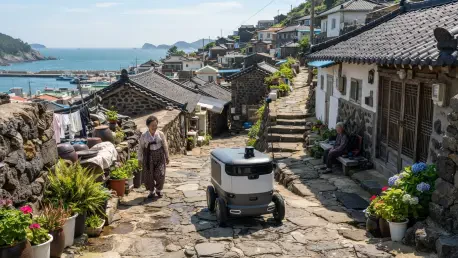

The transition from convenience-based deliveries to survival logistics is driving the development of second-generation robots with significantly increased payload capacities for bulk essential goods. South Korea is currently spearheading a transformative shift in its logistical infrastructure through the deployment of domestically developed autonomous delivery robots. This “Robot Transformation” initiative specifically addresses the “last-mile” challenges that have long plagued remote island communities. In these isolated regions, aging populations face significant barriers to receiving essential items due to acute labor shortages and the inherent unreliability of ferry schedules dictated by weather. While urban areas enjoy rapid delivery services, island residents have historically been left behind. To rectify this disparity, the government is integrating these high-tech systems into local social frameworks, ensuring that critical supplies such as specialized medicine and staple grains are accessible to even the most remote households.
Bridging the Last-Mile Gap With Multi-Modal Technology
Evolution From Aerial Drones to Ground Rovers
For several years, unmanned delivery efforts on South Korea’s islands focused almost exclusively on drone technology. While drones have proven highly efficient for “middle-mile” logistics—the process of transporting goods across the sea from mainland hubs to central island collection points—they possess inherent physical limitations that prevent them from being a total solution. These aerial vehicles are often restricted by limited flight ranges, small payload capacities, and the necessity for clear, specialized takeoff and landing zones that are rarely available at private residences. Furthermore, the unpredictable wind conditions common in coastal areas frequently ground these units, making them unreliable for consistent daily use. Most importantly, drones cannot deliver heavy parcels directly to a person’s doorstep, especially given the rugged and steep terrain typical of the many inhabited islands scattered throughout the southern and western seas of the Korean Peninsula today.
The emerging solution to these aerial limitations is a sophisticated multi-modal approach that leverages the strengths of both air and ground systems. In a series of ongoing projects coordinated by the Korea AeroSpace Administration and the Ministry of Land, Infrastructure and Transport, cargo is first transported over water by large-scale drones. Once these drones reach a central docking station on the island, the payload is automatically handed off to autonomous ground rovers. These specialized robots are designed to navigate the final and most complex leg of the journey: the last mile to the individual home. By operating on the ground, these rovers can carry significantly heavier weights than their flying counterparts and are capable of maneuvering through narrow alleyways and uneven village paths. This hybrid strategy ensures that the logistics chain remains unbroken, combining the speed of flight with the precision and heavy-lifting capabilities of terrestrial autonomous vehicles for maximum efficiency.
Field Demonstrations: The Carribot Pro Case Study
A major milestone in this technological rollout is the recent partnership between the mobile robot startup Fieldro and the Korea Island Development Institute. Their flagship project involves the deployment of the “Carribot Pro” in the Songdo district of Yeosu, an area known for its challenging topography. Unlike previous iterations of delivery robots that were largely confined to controlled, flat environments like military bases or massive indoor logistics centers, the Carribot Pro is being rigorously tested against the harsh realities of island geography. The primary objective of the Yeosu pilot project is to verify the robot’s ability to maintain perfect stability and traction while navigating steep slopes, muddy trails, and uneven outdoor paths. These units are carrying heavy loads of essential supplies to simulate real-world conditions accurately. Engineers are monitoring how the robot’s suspension and sensor arrays handle the transition from paved roads to dirt tracks.
Recognizing that the primary users of this technology are senior citizens who may not be proficient with modern smartphone applications, designers have prioritized accessibility. Many island residents are over the age of seventy and find complex digital interfaces to be a significant barrier to entry. Consequently, the Fieldro robots are equipped with alternative interaction methods such as natural language voice commands and large, intuitive physical buttons for confirming receipt. In some cases, the system uses a simple automated phone call to alert the resident that their package has arrived at their gate. The goal of the current project is to complete at least 120 successful delivery missions and cover over 250 kilometers of autonomous driving without human intervention. By proving that these systems are both mechanically reliable and easy for the elderly to use, the program aims to establish a permanent replacement for manual labor in regions where the workforce has largely vanished today.
Strategic Growth and Future Logistics Frameworks
The pilot programs established that the integration of autonomous rovers and drones provided a viable solution to the persistent last-mile logistics gap. To move forward, stakeholders focused on several key actionable steps to ensure the longevity of these systems. First, local governments prioritized the standardization of docking stations to allow robots from different manufacturers to share the same infrastructure. Second, investment was directed toward decentralized energy hubs on the islands, utilizing solar and wind power to charge the robot fleets independently of the mainland grid. Finally, comprehensive training programs were implemented for local technicians, ensuring that maintenance and minor repairs could be handled on-site without waiting for mainland support. These actions transitioned the technology from a series of successful experiments into a permanent pillar of the national welfare system. By addressing these needs, the initiative secured a sustainable future for remote communities.