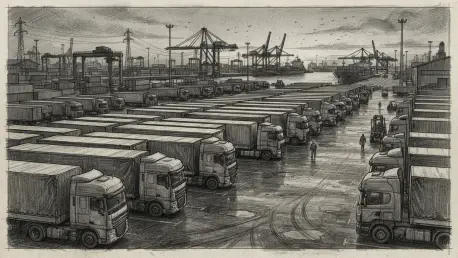

While legal counsel for MBC Trans asserts that all financial obligations to the labor provider were met, the physical immobilization of trucks proves that contract compliance does not always prevent operational failure. The European logistics sector is currently grappling with a high-stakes standoff at Truckstop Venlo in the Netherlands, where approximately 25 truck combinations belonging to the Polish carrier MBC Trans have been effectively neutralized. This protest is spearheaded by a group of international drivers, predominantly from Belarus, who claim they are owed three months of unpaid wages totaling roughly €150,000. What began as a localized grievance has quickly escalated into a cross-border labor crisis, drawing international attention to the precarious nature of employment within the European trucking industry and the desperate measures workers take when their livelihoods are at stake. The situation highlights a fundamental breakdown in the supply chain where the human element asserts control.
The Financial Friction: Navigating Indirect Employment
At the heart of the conflict lies a complex legal disagreement regarding who is actually responsible for paying the drivers. While the workers assert they have received no compensation for July, August, and September of 2026, MBC Trans maintains that it has fulfilled all its financial obligations. The carrier argues that the drivers were not direct employees but were instead contracted through a Warsaw-based temporary staffing agency called Super Job. MBC Trans claims to have documented proof of payment to the agency, effectively shifting the legal burden of the missing wages onto the staffing firm under Polish labor regulations. This creates a vacuum of accountability where the primary carrier feels legally insulated while the workforce remains unpaid. The discrepancy between bank transfers to an intermediary and actual cash in the pockets of the drivers represents a systemic flaw in the “user employer” model frequently utilized to streamline the massive fleets.
The legal framework governing these third-party arrangements often complicates the path to resolution, as jurisdictions overlap between Poland, Belarus, and the Netherlands. Under current Polish labor laws, the staffing agency holds the primary responsibility for wage disbursements, yet the operational assets—the trucks—remain the property of the carrier. This disconnect means that while the carrier might technically be in compliance with its contract with the agency, it remains physically vulnerable to the labor force it utilizes but does not directly employ. No independent judicial ruling has yet determined which party is ultimately at fault for the missing funds, leaving the drivers in a state of professional and financial limbo. This legal ambiguity emboldens intermediaries to operate with less transparency, as the consequences of financial mismanagement are often borne by the carrier in the form of service disruptions rather than by the agency itself.
Operational Paralysis: The Tactics of Technical Sabotage
The immobilization of the fleet has moved beyond a simple parking lot protest, as drivers have reportedly taken the extreme step of disabling the vehicles’ telematics and tracking systems. By “blinding” the carrier, the protesters have neutralized the company’s ability to monitor its assets or manage its cargo, resulting in a 25% reduction in MBC Trans’s total operational capacity. This tactical use of technical sabotage serves as a powerful leverage point, turning the very tools designed for logistical efficiency into instruments of protest that cause immediate and severe financial hemorrhaging for the carrier. For a company managing a fleet of over 100 vehicles, losing a quarter of its fleet represents more than just lost revenue; it signals a total loss of control over the digital infrastructure that modern logistics relies upon. The move demonstrates that technology cannot substitute for the trust of the personnel operating it, as systems are rendered useless by a determined workforce.
Beyond the physical blockade, the dispute has ignited a digital firestorm that threatens the long-term reputation of the transport firm. Videos documenting the protest and accusing the company of wage theft have gone viral on social media platforms like TikTok, reaching a global audience faster than any legal resolution could. In an industry where trust and reliability are paramount, these allegations of labor exploitation can lead to the permanent loss of major shipping contracts and create significant hurdles for future recruitment, regardless of the eventual judicial outcome. The speed of social media outpaces the speed of the legal system, meaning reputational damage is done long before a court can verify bank transfers or audit agency records. This digital escalation serves as a warning to other logistics firms that public perception is often shaped by the visibility of a protest rather than the nuances of contractual law, making labor stability a critical component of any brand management strategy.
Institutional Support: Humanitarian Crises and Legal Advocacy
The plight of the drivers has attracted the intervention of powerful advocacy groups, including the Dutch trade union FNV and the Road Transport Due Diligence Foundation. These organizations are providing much-needed legal and logistical support to the disenfranchised workers, many of whom are operating in foreign jurisdictions with limited resources. The involvement of the FNV is particularly significant, as the union frequently challenges “social dumping” practices and fights for the rights of Eastern European drivers who often find themselves caught in the gaps of international labor laws. These institutions act as a bridge, translating the grievances of isolated workers into a coherent legal and public narrative that cannot be easily ignored by corporate entities or national regulators. By providing food, legal counsel, and media access, these advocates ensure that the drivers’ demands remain at the forefront of the regional logistics conversation, forcing a level of transparency that might have been avoided.
The human element of this crisis is stark, with family members of the drivers reporting severe financial hardship in Belarus due to the lack of income. These workers are often the primary breadwinners for their households, and the three-month wage gap has pushed many families toward a breaking point. This humanitarian crisis underscores the inherent vulnerability of non-EU drivers who work for EU-based firms through third-party intermediaries, leaving them with little recourse when the chain of payment breaks down between the carrier and the staffing agency. Testimony from the families highlights a desperate situation where basic needs are becoming difficult to meet, transforming a corporate dispute into a struggle for survival. The geographic distance between the drivers in Venlo and their families in Belarus further complicates the emotional toll, as the protesters feel a profound sense of duty to remain with the trucks until they can secure the funds necessary to return home with their dignity intact.
Structural Evolution: Mitigating Risks in Logistics Outsourcing
Moving forward, the industry must prioritize direct oversight and transparency to avoid the pitfalls seen in the MBC Trans case. Companies should implement rigorous due diligence processes when selecting labor intermediaries, including mandatory proof-of-payment audits that ensure wages reach drivers directly. Establishing a “closed-loop” financial system where carriers have visibility into the payroll of their staffing agencies could prevent future standoffs by identifying payment gaps before they escalate into fleet-wide protests. Furthermore, integrating labor rights into the environmental, social, and governance (ESG) frameworks of logistics firms will be essential for maintaining long-term contracts with major global shippers who are increasingly sensitive to human rights violations within their supply chains. The adoption of blockchain-based payment verification could also provide an immutable record of wage transfers, offering both the carrier and the workforce a single source of truth.
In retrospect, the resolution of the MBC Trans crisis required a fundamental shift in how the company approached its labor relations and subcontractor management. Authorities in both Poland and the Netherlands eventually coordinated a detailed audit of the financial trail, which helped clarify the breakdown in communication and payment between the carrier and the staffing agency. This case prompted broader industry discussions regarding the necessity of a unified European labor registry for transport workers, which aimed to eliminate the jurisdictional gaps that allowed such disputes to fester. By addressing the root causes of driver disenfranchisement and moving away from fragmented labor models, the logistics sector took significant steps toward ensuring operational stability. The immobilized trucks in Venlo served as a catalyst for these reforms, reminding stakeholders that sustainable growth was impossible without a foundation of fair treatment and financial accountability for the workforce.