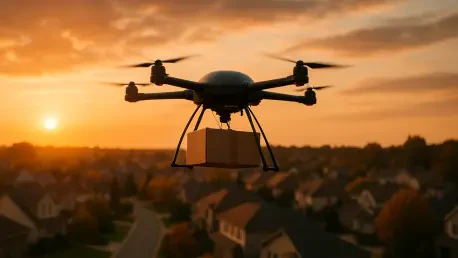

To ensure public acceptance, Amazon is proactively adjusting flight paths to avoid local sensitive areas like neighborhood churches during weddings or community events. This tactical maneuver is part of a broader strategy as the retail giant officially launches its Prime Air drone delivery program from the Darlington fulfillment center in the United Kingdom. This project is far more than a localized trial; it serves as a sophisticated technological blueprint for the company’s logistics expansion across the European continent. Centered at a specialized drone “paddock” within a fenced car park at Symmetry Park, the operation utilizes the state-of-the-art MK30 hexacopter to redefine the “last-mile” delivery concept. By navigating both the technical complexities of autonomous flight and the social nuances of suburban life, the program aims to establish a new standard for speed. The focus remains on strategic implementation, overcoming regulatory hurdles, and showcasing the specific technical capabilities of the aircraft in a real-world setting.
Innovation and Infrastructure in the North East
Engineering Heritage: The MK30 Hexacopter
The hardware at the heart of this logistics revolution is the MK30 drone, a sophisticated hexacopter designed for maximum efficiency and safety in congested environments. With a maximum takeoff weight of 37.5 kilograms, these drones are engineered to carry parcels directly to customer doorsteps at speeds reaching 70 miles per hour. Technically, the aircraft represents a significant leap in autonomous navigation, featuring obstacle avoidance sensors that allow it to safely navigate around trees, chimneys, and power lines. The drones are capable of operating in diverse weather conditions, ensuring that the promise of rapid delivery is not hindered by the typical British climate. Each unit is monitored by a sophisticated flight control system that prioritizes safety over speed, ensuring that the 12-kilometer operational radius is managed with extreme precision. This hardware iteration is significantly quieter than its predecessors, addressing one of the primary concerns regarding urban drone deployment.
The intentional selection of Darlington as the inaugural hub reflects the town’s rich history of innovation, specifically as the birthplace of the modern railway system. Vice President David Carbon noted that this historical context makes the region an ideal staging ground, as the local population possesses a unique familiarity with industrial progress and engineering expertise. By choosing a location with a strong aerospace legacy, the project taps into a community that fundamentally understands the mission of technological advancement. The geographical layout of the area, featuring a mix of dense residential zones and major thoroughfares like the A66, provides a diverse testing environment for urban and suburban navigation. This strategic placement allows the logistics team to gather data on how the aircraft handles various architectural styles and landscaping challenges. The facility at Symmetry Park has been transformed into a high-tech launch site that bridges the gap between traditional warehousing and futuristic aviation.
Regulatory Framework: Safety and Collaboration
Navigating the complex regulatory environment of the United Kingdom has been a cornerstone of the Prime Air mission. Amazon collaborated extensively with the Civil Aviation Authority and National Air Traffic Services to establish a sustainable framework for unmanned aerial vehicles in civilian airspace. This consensus-building approach was vital for moving beyond the trial phase into a full-scale commercial service. The project is currently on the cusp of receiving final approvals to transition from a pilot program to a permanent fixture of the regional economy. Such partnerships signify a global trend toward the normalization of autonomous delivery systems, provided they meet rigorous safety and noise standards. Currently, the drones operate within a specific radius to ensure maximum oversight while the system prepares for rapid scalability across the logistics network. The operational goal is to reduce standard delivery windows to an average of 90 minutes, with the fastest recorded time now standing at 39 minutes.
Establishing a reliable safety record was paramount for gaining the necessary flight permissions from government bodies. The collaborative efforts led to the creation of designated “flight corridors” that minimize interaction with manned aircraft and sensitive ground-level infrastructure. This proactive engagement with aviation experts ensured that every flight was backed by a robust emergency protocol and redundant communication systems. By working within the existing national air traffic framework, the project demonstrated that drones could coexist with traditional aviation without compromising the safety of the sky. This regulatory success in the United Kingdom serves as a benchmark for other European nations looking to modernize their logistics laws. The focus on transparency and data sharing with the authorities helped demystify the technology for the public. As the legal landscape continues to evolve, these early milestones in Darlington will likely influence future aviation policy regarding autonomous commercial transport.
Operational Challenges and Community Integration
Practical Friction: Learning from Real-World Trials
As with any pioneering technology, the initial rollout in Darlington encountered real-world friction that provided invaluable data for the engineering teams. Notable incidents, such as a parcel being mistakenly dropped into an incorrect garden or a drone encountering an object protruding from a moving vehicle, were not viewed as failures. Instead, Amazon classified these events as essential “learning moments” used to refine the drones’ autonomous algorithms. These challenges are typical for the introduction of complex robotics into unpredictable human environments. The ability of the MK30 to identify such obstacles and abort a landing safely is a testament to the sophistication of its onboard computer vision. Every minor anomaly recorded during the trial phase contributed to a more robust software update, ensuring that the system learned to account for the eccentricities of suburban living. This commitment to iterative improvement allowed the team to address technical vulnerabilities before the service expanded to a larger scale.
Many of these delivery discrepancies stemmed from antiquated mapping data that did not perfectly align with actual physical property boundaries. To resolve this, the technical team developed the capability to manually and autonomously adjust delivery coordinates in real-time. This iterative approach ensures that the system becomes increasingly accurate with every flight. By refining the software to handle the specific nuances of British architecture and landscaping, the program continues to improve its precision. For example, the difference between a paved driveway and a manicured lawn is now more easily distinguishable by the drone’s sensors. The mapping software was also updated to include temporary obstructions, such as construction scaffolding or seasonal decorations, which could interfere with the landing zone. These granular improvements in spatial awareness are what set the Prime Air system apart from traditional GPS-based delivery methods. The ongoing data collection in Darlington remains the primary source for these critical technical refinements.
Strategic Outcomes: Actionable Steps for Logistics
The Darlington trial demonstrated that high-speed drone logistics were a viable solution for modern urban delivery challenges. Stakeholders observed that the integration of the MK30 fleet effectively reduced the carbon footprint of small-package transport while significantly decreasing the time between purchase and possession. The project confirmed that technical precision in mapping and autonomous flight was achievable when supported by robust regulatory collaboration. These findings established a clear path forward for the wider implementation of Prime Air across other European hubs. The facility successfully managed a transition from manual oversight to highly automated sortation and launch processes, proving that the infrastructure could handle high volumes of regional traffic. Observers noted that the system worked best when integrated directly into the existing fulfillment workflow rather than acting as a separate entity. The successful delivery of medical supplies and urgent consumer goods highlighted the practical utility of the service for the community.
Moving forward, logistics providers should prioritize the modernization of local mapping data to ensure centimeter-level delivery accuracy. Investments in community engagement programs proved essential for mitigating privacy concerns and should be a standard part of any future UAV rollout. Furthermore, the development of specialized “drone paddocks” within existing fulfillment centers provided an efficient template for scaling operations. By focusing on these actionable insights, the industry paved the way for a more responsive and technologically integrated retail environment. The lessons learned from flight path adjustments around neighborhood events showed that social sensitivity was just as important as technical capability. Future operations will likely include a mix of human-in-the-loop oversight and fully autonomous decision-making to balance efficiency with safety. Ultimately, the success of the Darlington project laid the groundwork for a standardized approach to drone-based retail, proving that the future of logistics was already taking flight in the North East.