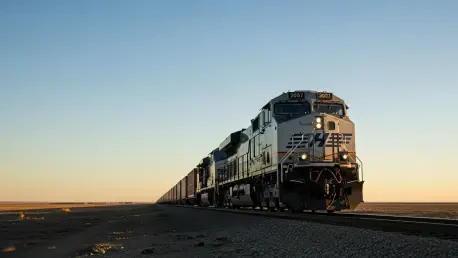

The proposed merger between Union Pacific and Norfolk Southern represents one of the most significant shifts in the North American freight landscape in decades. Navigating the complexities of this massive consolidation is Rohit Laila, a logistics veteran with over twenty years of experience managing global supply chains and integrating emerging technologies into rail operations. His deep understanding of the regulatory hurdles and operational intricacies of the industry provides a unique lens through which we can view this potential transcontinental alliance. In this discussion, we explore the challenges facing the two rail giants as they attempt to satisfy federal regulators and wary competitors.
After the initial application for this merger was rejected for being incomplete, what specific data points are now essential for a resubmission to succeed, and how do these metrics demonstrate tangible supply chain improvements rather than just corporate cost savings?
For a resubmission to hold water with the Surface Transportation Board, it must move beyond vague promises of efficiency and provide granular data on transit times and terminal dwell. The applicants need to provide comprehensive ordinary-course competition analyses that show exactly how merging these two networks will remove bottlenecks at key interchanges. In the initial filing on Dec. 19, 2025, the lack of depth was a dealbreaker, so the amended April 30 filing must prove that cost savings aren’t just being pocketed but are instead being used to harden infrastructure. We are looking for metrics that show a reduction in the number of hand-offs between carriers, which historically has been the primary cause of delays and cargo damage in long-haul freight.
Considering the skepticism surrounding truck-to-rail diversion estimates, how can railroads prove these conversions are realistic in a high-fuel-cost environment, and what mechanisms would ensure that resulting efficiency gains actually lead to lower rates for shippers?
Proving that trucks will actually move to rail requires more than just pointing at high diesel prices; it requires a commitment to price transparency that the industry hasn’t always embraced. While executives from CSX and Union Pacific have noted that rising trucking rates create a natural tailwind for intermodal growth, competitors like BNSF argue that these diversion estimates are often exaggerated to win regulatory favor. To be believable, the railroads must show specific route-by-route comparisons where rail transit time becomes competitive with a single-driver truck haul. Without a formal mechanism to pass “efficiency dividends” back to the shipper, there is a legitimate fear that these gains will only serve to boost operating ratios rather than lowering the per-mile cost for the customer.
How does a lack of detailed market impact analysis for specific commodity corridors jeopardize economic stability, and what specific traffic volume data should be required to protect the interests of regional shippers during a major transcontinental transition?
When you merge two behemoths without a clear corridor-by-corridor analysis, you risk creating “captive shippers” who have no alternative but to pay whatever rate is demanded. As Keith Creel of CPKC pointed out, failing to provide data on revenues and traffic volumes for major interregional flows puts the broader economy at risk by masking potential monopolies in key sectors like agriculture or chemicals. The STB should demand data that breaks down volume by commodity group across every major interchange point to ensure that regional shippers aren’t sidelined in favor of high-volume transcontinental traffic. Without this level of detail, we could see a degradation of service in “flyover” states as the merged entity prioritizes the most profitable long-haul routes.
Since single-line service efficiencies are often cited as a competitive advantage against trucking, what additional, concrete steps should be taken to enhance rail-to-rail competition, and why is the 2001 regulatory framework still the benchmark for evaluating these transactions?
The 2001 regulatory framework remains the gold standard because it was designed specifically to prevent the service meltdowns that followed the massive mergers of the late 1990s. CSX has rightly argued that simply being a “single-line service” is not enough to satisfy the modern requirement for enhanced rail-to-rail competition; there must be proactive measures like expanded reciprocal switching rights. To truly foster competition, the merging parties should offer to open up certain restricted terminals to their rivals, ensuring that shippers still have a choice of carriers even if the number of owners decreases. Relying on the “natural” competition of a single-line service is a passive approach that many in the industry feel does not meet the high bar set by current STB rules.
What is your forecast for the Union Pacific and Norfolk Southern merger?
My forecast for the Union Pacific and Norfolk Southern merger is that it will face an incredibly steep uphill battle characterized by heavy “pro-competitive” concessions or an outright divestiture of key overlapping routes. While the two carriers claim their amended proposal is comprehensive, the sheer volume of opposition from every other major Class I railroad—including BNSF, CSX, and CPKC—suggests that the regulatory scrutiny will be unprecedented. I expect the Surface Transportation Board to demand much more than the data provided in the April 30 refiling, likely forcing the parties to guarantee service levels with financial penalties. Ultimately, unless they can prove that this merger won’t stifle competition in the same way past consolidations did, we may see the board prioritize market stability over the creation of a transcontinental giant.