


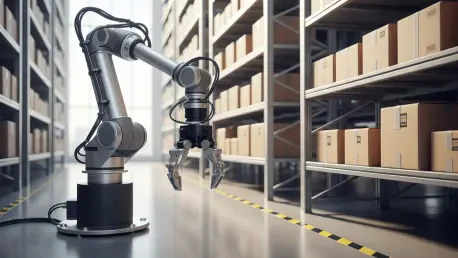

The era of bolted-down, single-purpose machinery is quickly fading into the background as logistics hubs increasingly adopt cognitive robotic systems that learn and adapt in real time. For decades, automation relied on rigid scripts, yet the current climate of labor shortages and e-commerce volatility has transformed AI-driven flexibility into an operational mandate. Static hardware simply cannot keep pace with the erratic demands of the modern consumer who expects rapid delivery regardless of inventory complexity.
This analysis explores the technological milestones enabling this transition, focusing on how global deployment strategies are reshaping the supply chain. By examining live production environments and sophisticated AI software, the discussion clarifies why adaptive manipulation is no longer a luxury for major distributors. From technical maturity to long-term network scaling, the following sections outline the trajectory of a robotics industry moving toward total cognitive integration.
The Shift Toward Cognitive Fulfillment Systems
Global Adoption Trends and the Transition to Live Operations
Logistics providers across Europe and the United States are currently migrating from isolated pilot projects toward high-volume, live production environments. This shift signals a maturation of the market, where AI is no longer a speculative tool but a core operational component. Market data indicates a growing reliance on software like Cortex 2.5, which utilizes advanced computer vision to eliminate the time-consuming process of manual item cataloging and pre-programming.
Moreover, the industry is witnessing the rise of software-defined hardware that allows for seamless transitions across complex conveyor lines and automated storage systems. These intelligent layers provide the necessary logic to handle varied throughput without requiring mechanical overhauls. Consequently, warehouses are becoming more resilient, capable of absorbing sudden shifts in volume while maintaining high efficiency through purely algorithmic adjustments.
Real-World Application: The Sereact and Arvato Global Deployment
A prime example of this trend is the strategic partnership between Sereact and Arvato, which features the deployment of intelligent single-arm robots in hubs like Dortmund and Memphis. These systems are specifically designed to bridge the gap between high-density storage and final packaging. In the AutoStore-to-carton use case, AI enables robots to pick items with human-like dexterity, ensuring that even delicate or oddly shaped goods are handled with precision and speed.
These robotic arms navigate real-world variables, such as shifting product mixes and diverse packaging materials, entirely without human intervention. By deploying these units in key international hubs, the partnership demonstrates how AI can be scaled globally while maintaining consistent performance standards. This capability is vital for managing the complex, multi-continental fulfillment networks that define the modern retail landscape.
Expert Perspectives on the Technical Maturity of Robotic Manipulation
Industry leaders emphasize that the primary technical evolution involves moving away from fixed-logic programming toward real-time, AI-driven decision-making. Traditional mechanical systems frequently struggle with the flexibility requirements of contemporary e-commerce, where product inventories change almost daily. Experts argue that established automation standards are now being rewritten to include operational resilience as a baseline metric for any robotic installation.
Furthermore, the consensus among technologists suggests that traditional hardware is hitting a ceiling that only software can break through. While the mechanical components of robotic arms have reached a plateau, the cognitive layers governing their movement continue to improve at an exponential rate. This shift ensures that even older hardware can be upgraded via software updates, prolonging the lifecycle of expensive capital investments while increasing their overall utility.
Future Outlook: The Scaling of Autonomous Logistics Networks
The long-term integration of AI at critical supply chain junctions promises to significantly boost both capacity and flexibility. Future logistics networks will likely feature self-optimizing warehouses where robots learn from collective data to improve picking accuracy and speed over time. As these machines share insights across a global fleet, the efficiency gains become cumulative, allowing the entire network to evolve faster than any single unit could alone.
This evolution also brings a fundamental shift in the human workforce, moving employees away from repetitive manual labor toward the oversight of sophisticated robotic fleets. While scaling presents challenges—particularly regarding consistent performance across different regulatory environments—the trajectory is clear. The focus is shifting toward creating autonomous logistics ecosystems that can predict and react to global disruptions with minimal lead time.
Conclusion: Embracing the Era of Adaptive Automation
The transition from rigid automation to versatile, AI-driven robotics represented a defining moment for global logistics and supply chain management. This movement proved that software intelligence was the only viable solution for overcoming the physical limitations of traditional warehouse hardware. By adopting these cognitive systems, organizations successfully navigated the volatility of a changing market, ensuring that fulfillment stayed both rapid and reliable.
In the end, the era of adaptive automation solidified the necessity of technological agility for any company aiming to remain competitive. The successful global expansion of these robotic systems demonstrated that a software-first approach provided the most resilient path forward. As these autonomous networks matured, they established a new standard for efficiency that redefined the relationship between human oversight and machine execution.


