
The sheer volume of global commerce has finally outpaced the physical limits of traditional human-centric warehousing, forcing a radical shift toward autonomous intelligence that redefined the concept of global trade. This transition marks a departure from simple conveyor systems to a cohesive digital ecosystem where artificial intelligence and robotics dictate the flow of goods. By prioritizing resilience and high-capacity processing, the industry moved toward a model capable of absorbing the erratic surges of modern e-commerce without the catastrophic failures of the past. This technological landscape serves as a direct response to global labor shortages and an insatiable consumer demand for near-instant fulfillment.
Evolution and Core Principles of Intelligent Logistics
The journey of logistics technology began with basic mechanical aids, yet it matured into a sophisticated network where every node is interconnected through data. Early automation focused on moving items from point A to point B, but modern systems prioritize the intelligent distribution of those items based on real-time demand. This paradigm shift was driven by the necessity to create error-free supply chains that operate around the clock. By embedding AI into the core of the warehouse, operators can now manage volumes that were once thought impossible for a single facility to handle.
Resilience is the cornerstone of this new era, ensuring that the supply chain remains functional despite external disruptions or internal hardware failures. This principle involves creating redundant systems and self-healing software that reroutes tasks when a specific robotic unit encounters an issue. Consequently, the reliance on manual oversight has diminished, allowing human workers to transition into roles that focus on system management and troubleshooting. This evolution is not merely a technical upgrade but a fundamental reimagining of how goods are handled in an increasingly digital economy.
Key Hardware and Automation Components
Advanced Robotics and Humanoid Systems
Humanoid robots have moved from experimental laboratory prototypes to active participants in major processing hubs. These machines are specifically designed to navigate environments originally built for humans, allowing for seamless integration without requiring a total redesign of existing floor plans. Currently, these humanoid units handle parcel feeding and item identification with a degree of precision that rivals traditional fixed-arm robots. While their current processing speed of 800 to 1,200 parcels per hour is still catching up to human benchmarks, their ability to work without fatigue provides a significant advantage during extended shifts.
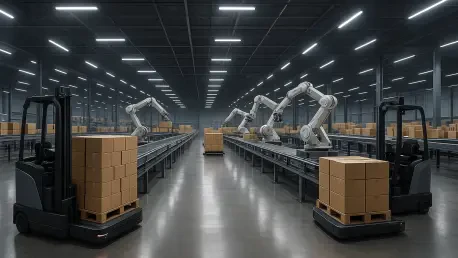
Beyond humanoid forms, specialized robotic arms have become the workhorses of high-volume sorting lines. These systems utilize advanced computer vision to distinguish between varied packaging materials and sizes at lightning speeds. During peak operational periods, these arms maintain a steady throughput of 1,400 items per hour, ensuring that the sorting process remains a continuous stream rather than a series of batches. This mechanical consistency is vital for maintaining the cadence of a global supply chain that never sleeps.
Autonomous Guided Vehicles and Smart Warehousing
Internal transportation has been revolutionized by the deployment of Automated Guided Forklifts, which navigate warehouse floors with centimeter-level accuracy. These vehicles eliminate the safety risks and inefficiencies associated with manual forklift operation, using LiDAR and ultrasonic sensors to avoid obstacles. By automating the movement of heavy cages and pallets, facilities have reclaimed significant time that was previously lost to transit delays. This fleet-based approach allows for a dynamic scaling of resources, as additional units can be activated instantly to meet sudden spikes in volume.
The physical constraints of traditional warehouses have been bypassed through the implementation of three-dimensional sorting systems. These structures utilize vertical space to maximize the density of operations, effectively increasing the capacity of a facility without expanding its footprint. Vertical scheduling software coordinates the movement of goods across multiple levels, ensuring that the most frequently accessed items are always within reach of the automated pickers. This shift toward high-density storage has significantly reduced the physical fatigue of the remaining human workforce by bringing the goods to the person rather than the person to the goods.
Emerging Trends in Digital Intelligence
A defining trend in the current logistics landscape is the shift from reactive maintenance to predictive management, powered by software-driven monitoring. Modern facilities no longer wait for a belt to snap or a motor to fail; instead, “digital intelligence” platforms analyze vibration data and thermal signatures to predict failures before they occur. This proactive stance has transformed the operational culture, moving the focus away from emergency repairs toward scheduled optimizations that ensure maximum uptime.
Furthermore, real-time data analytics are now used to identify line pressure across entire sorting networks. By monitoring the flow of parcels in real time, AI systems can detect potential bottlenecks and automatically adjust the speed of various segments to prevent a total system jam. This end-to-end integration ensures that localized automation does not lead to downstream congestion. The industry is moving away from isolated “islands of automation” toward a unified digital nervous system that provides total visibility from the moment a package enters the hub until it is loaded onto a delivery vehicle.
Real-World Applications and Industrial Impact
The practical benefits of these technologies are most visible in major processing centers, such as the China Post hubs in Guangdong Province. These facilities serve as a testament to the scaling of automation, where thousands of robots work in concert to process millions of packages daily. The massive parcel backlogs that were once a standard feature of peak shopping seasons have been virtually eliminated. This success is not just about speed but about the reliability that automated systems provide to the global trade network.
In addition to traditional sorting, technology firms are utilizing three-dimensional sorting systems to optimize warehouse floor space in urban centers where real estate is at a premium. These systems have allowed companies to maintain high inventory levels close to their customers, facilitating the rapid delivery times that modern consumers expect. By integrating AI vision with mechanical precision, these hubs have set a new standard for operational excellence, demonstrating that high technology is the primary driver of modern logistics growth.
Technical Challenges and Implementation Hurdles
Despite the impressive progress, a performance gap remains between humanoid robots and human workers regarding raw parcel-per-hour output. Human workers still possess a level of dexterity and spatial reasoning that is difficult for machines to replicate perfectly. Closing this gap requires further advancements in tactile sensors and machine learning algorithms that can better simulate human movement. Until these robots reach full parity, the industry continues to rely on a hybrid model where machines handle the bulk of the labor while humans oversee the most complex tasks.
Handling “non-standard” items remains one of the most persistent hurdles for fully automated systems. Irregularly shaped packages, soft bags, and items with reflective surfaces can often confuse the AI vision systems used in automated sorting. These items still require human intervention to prevent jams and ensure accurate routing. Ongoing efforts to refine sensors and software are focused on mitigating these limitations, with the goal of achieving higher automation rates for even the most challenging parcel types.
Future Outlook and Strategic Development Goals
The roadmap for the 2026 to 2030 period, as outlined in the latest development plans, focuses on the deep integration of AI across the entire logistics chain. This strategy aims to move beyond simple task automation toward a truly autonomous network where AI handles everything from route optimization to inventory management. Major processing centers are targeting an 88 percent full automation rate by the end of 2030, a goal that would represent a near-total transformation of the industry’s labor model.
A key milestone in this timeline is the expected achievement of human-level productivity for humanoid robots by 2027. This breakthrough will likely trigger a massive wave of hardware upgrades as companies look to replace aging mechanical systems with more flexible, intelligent units. The long-term impact of these developments will be a global delivery standard that is faster, more cost-effective, and less dependent on manual labor. This strategic push toward deep intelligence is positioning the sector for another decade of rapid expansion.
Summary and Overall Assessment
The review of smart logistics technology confirmed that the transition from manual labor to smart efficiency succeeded in creating a more resilient global network. The shift toward human-machine synergy allowed facilities to handle unprecedented volumes while maintaining high accuracy. It was observed that the integration of digital intelligence significantly reduced operational bottlenecks, proving that software is as critical as hardware in modern supply chains. The deployment of humanoid robots and AGVs demonstrated a clear path toward a more autonomous future, even as certain technical hurdles remained.
The progress made since the start of the 2026 planning period established a new global benchmark for industrial excellence. The analysis indicated that the industry successfully addressed the challenges of labor shortages through the scaling of sophisticated automation. By prioritizing end-to-end integration and predictive management, the sector moved toward a state of constant optimization. Ultimately, the review determined that the current technological trajectory ensured a reliable and scalable foundation for the next generation of global commerce.