
Rohit Laila has spent decades navigating the intricate world of logistics, witnessing firsthand the shift from manual labor to high-speed automation. As an expert in supply chain technology, he understands that while robots garner the headlines, the true stability of a warehouse rests on its physical infrastructure. He views the industry through a lens of innovation, yet he remains grounded in the practical realities of material flow and structural integrity. In this conversation, we explore how the humble pallet racking system has evolved from a simple shelf into a sophisticated, flexible foundation that enables the most advanced technologies in the industry to thrive.
Our discussion delves into the critical role of structural stability in high-tech facilities and the way racking acts as a silent partner to automated systems. We examine the strategic importance of vertical space and how it can delay the need for expensive facility expansions. Furthermore, we touch upon the long-term investment value of adaptable racking designs and why these systems must be the starting point for any successful warehouse transformation, rather than a secondary consideration.
How do high-tech robots and automated shuttles rely on a stable physical framework to function effectively within a modern facility?
Automation is often perceived as a standalone miracle, but it actually functions within a very specific physical context. High-tech robots and automated shuttles are precision instruments that require a stable, level, and rigid framework to reach their maximum speed and accuracy. Without a high-quality pallet racking system acting as the backbone, these machines would struggle to navigate or precisely place loads, leading to errors or mechanical wear. It is the solid steel structure that provides the necessary support for material flow, ensuring that every movement is safe and predictable. When you see a shuttle zipping through an aisle, you are looking at a system that relies entirely on that silent, sturdy workhorse to keep the operation from grinding to a halt.
In what ways does pallet racking serve as the silent partner for modern automation technologies like AS/RS and conveyor systems?
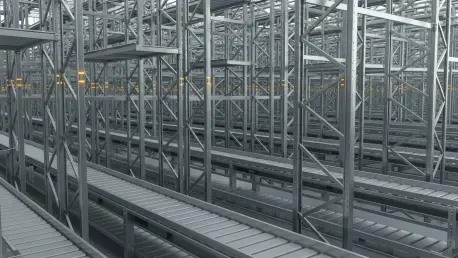
While the robots grab the spotlight, the racking system is the essential infrastructure working behind the scenes to make those technologies possible. For instance, in a mobile AS/RS or a pallet shuttle setup, the racking is not just a place to put things; it is the track and the housing for the entire automated ecosystem. It integrates seamlessly with conveyor and sortation systems, providing the height and stability needed for pick modules and complex mezzanine structures. When we design these systems correctly, the racking becomes an active participant in the facility’s productivity, allowing for a scaled operation that can handle higher throughput. It is the quiet partner that ensures the flashier components can perform their jobs without the risk of structural failure or misalignment.
How can a warehouse leader leverage vertical space and specific racking configurations to delay or eliminate the need for costly building expansions?
Space is easily one of the most valuable commodities in any logistics operation, and pallet racking allows you to claim that space vertically. By utilizing high-density systems or double deep configurations, a warehouse can significantly increase its storage capacity without adding a single square foot to the building’s footprint. This thoughtful design helps organize storage zones in a way that reduces travel time for lift equipment, making every movement more efficient. When you maximize the cube of your building, you are essentially delaying or even eliminating the massive capital expenditure required for a new facility. It is a strategic way to make the most of what you already have, creating a smarter layout from the ground up that supports better inventory visibility and safer operations.
Why is the design of a racking system considered a strategic starting point for warehouse success rather than a final afterthought?
Treating pallet racking as an afterthought is a recipe for operational bottlenecks because it dictates how everything else moves through the building. The most successful warehouses treat the racking design as the starting point because it must account for specific product characteristics, throughput goals, and the type of lift equipment in use. If the racking isn’t tailored to your future automation plans, you may find yourself stuck with a rigid system that cannot adapt to new demands. A well-designed system considers the entire lifecycle of the facility, acting as a long-term investment that can be reconfigured or expanded as the business grows. It provides the framework for integrated solutions, ensuring that the facility remains standing strong regardless of how much your SKU profile or customer demand shifts over time.
How does the inherent flexibility of modern racking allow growing operations to balance manual processes with phased automation?
One of the greatest strengths of modern pallet racking is that it is not a static or “stuck in the past” solution; it evolves right alongside your operational needs. For facilities that are currently balancing manual processes but plan to introduce automation later, the racking serves as an adaptable foundation. You can start with traditional selective racks and eventually integrate pallet shuttles or automated storage systems without a complete facility redesign. Components can be relocated or reconfigured to accommodate shifting SKU profiles and the increasing complexity of a growing business. This flexibility makes it the ideal choice for companies undergoing a phased automation journey, providing a reliable structure that supports both the humans working today and the robots coming tomorrow.
What is your forecast for the future of warehouse infrastructure?
I believe we are moving toward a future where the line between the building’s structure and its storage system will completely blur. We will see racking systems that are even more deeply integrated with sensory technology, providing real-time data on structural health and load distribution to the warehouse management system. As automation becomes more accessible, the demand for high-precision, high-density racking will skyrocket, making the “backbone” of the warehouse more critical than ever. Ultimately, the warehouses that succeed will be those that treat their physical infrastructure as a dynamic asset rather than just a collection of steel beams. The most important systems won’t be the loudest ones; they will be the reliable, adaptable frameworks that quietly support every single move in the global supply chain.