
The traditional warehouse is currently undergoing a radical metamorphosis as the demand for hyper-efficient fulfillment pushes legacy infrastructure to its breaking point. Recent industry shifts indicate that fragmented automation is no longer sufficient to manage the velocity of modern global trade. This review examines how unified intralogistics architectures are replacing siloed systems, providing a singular digital backbone that orchestrates every movement within a facility. By prioritizing a holistic framework, organizations are moving toward a future where hardware and software exist in a state of permanent, real-time synchronization.
The Shift Toward Unified Intralogistics Architectures
The transition from isolated automation components to cohesive, unified platforms marks a definitive end to the era of “patchwork” engineering. Historically, facility managers struggled with disparate systems for motion control and machine vision that rarely communicated effectively. Modern leaders like Delta are now establishing architectures where these elements share a common logic. This integration allows for a scalable foundation that can adapt as supply chain demands fluctuate.
Merging machine vision, motion control, and robotics into a single operational framework reduces the latency typically found in multi-vendor setups. When a single platform governs the entire material flow, the risk of data bottlenecks decreases significantly. This shift is critical for addressing the increasing complexity of global logistics, where even a millisecond of lag can lead to substantial throughput losses over a single shift.
Technical Components of the Integrated Automation Ecosystem
Synergistic Robotics and Motion Control Systems
Collaborative robots, such as the D-BOT DC08, represent a move toward hardware that does not require physical cages to operate safely. These units are specifically designed to interact with motion networking protocols that synchronize their movements with peripheral machinery. Such precision ensures that a cobot and a stationary conveyor can operate as a single unit rather than two independent machines trying to guess each other’s status.
The true value of these systems lies in their ability to maintain operational reliability in high-speed environments. Performance metrics now focus on the synchronization between stationary robotics and mobile units like AGVs. This orchestration ensures that material handoffs occur with surgical accuracy, minimizing the physical wear on components and extending the lifecycle of the entire robotic fleet.
Industrial Charging Infrastructure and Power Management
Energy management is often the overlooked “Achilles’ heel” of automated warehouses, yet it dictates the actual uptime of a fleet. The MOOV series, offering conductive and wireless charging solutions from 1 to 30 kW, addresses this by embedding power delivery into the automation control platform. Wireless charging, in particular, allows vehicles to receive power during short pauses in their workflow, effectively eliminating the need for dedicated charging bays and long periods of inactivity.
Integrating power infrastructure directly into the broader ecosystem allows for intelligent load balancing. By monitoring the state of charge across a fleet in real time, the system can prioritize which vehicles need power based on upcoming mission requirements. This level of oversight ensures that energy consumption remains optimized, reducing peak demand charges and improving the overall sustainability of the facility.
Machine Vision and Real-Time Data Visualization
Modern machine vision has evolved beyond simple barcode scanning into the realm of spatial awareness. Utilizing 3D Time of Flight technology, systems can now generate real-time point clouds that allow autonomous units to “see” their environment in three dimensions. This data is vital for intelligent decision-making, enabling robots to navigate around obstacles or identify damaged goods without human intervention.
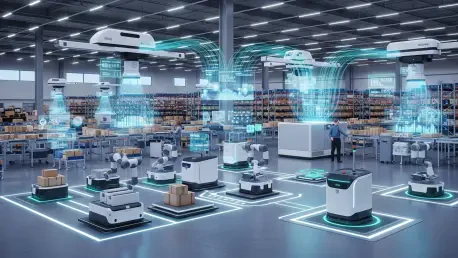
Visualization software complements this hardware by providing operators with deep operational insights through intuitive dashboards. Instead of looking at raw data strings, managers can view a digital twin of the warehouse floor. This transparency allows for rapid troubleshooting and provides a clear picture of how material flows through the facility, turning abstract metrics into actionable intelligence.
Emerging Trends in Smart Green Logistics
Sustainability is no longer a peripheral concern but a core requirement for modern industrial environments. The move toward energy-efficient “green” technologies involves more than just low-power motors; it requires a systemic reduction in wasted motion and heat. Data-driven environments prioritize the most efficient path for every pallet, ensuring that no energy is spent on unnecessary transportation or idling machinery.
Moreover, the industry is seeing an increasing demand for “plug-and-play” architectures. These systems reduce the burden on system integrators by offering pre-configured modules that communicate instantly upon connection. This shift from standalone machinery to interconnected environments reflects a broader trend where the value of a system is measured by its total material flow rather than the performance of individual hardware pieces.
Real-World Applications of Integrated Automation
In high-volume fulfillment centers, these integrated solutions are already streamlining material transport via compact conveyor drives. These drives are engineered to fit into tight spaces while providing the torque necessary for heavy loads. By coordinating these conveyors with AGVs and cobots, facilities can achieve a level of picking and sorting complexity that was previously impossible without massive manual labor forces.
Large-scale industrial vehicle depots are also implementing intelligent charging stations to optimize their energy footprint. By scheduling charging cycles during off-peak hours or when vehicles are naturally idle, these depots significantly lower their operational costs. The result is a highly coordinated dance where movement and energy replenishment happen in perfect harmony, maximizing the utility of every square foot of the warehouse.
Challenges in Adopting Integrated Automation Systems
Despite the clear benefits, technical hurdles remain, particularly regarding the interoperability of legacy hardware. Many warehouses still rely on older equipment that lacks the communication protocols required for a unified platform. Bridging this gap often requires custom middleware or expensive hardware retrofits, which can slow the pace of adoption for smaller enterprises.
Market obstacles also include high initial capital expenditure and the scarcity of specialized technical expertise. Operating a unified automation ecosystem requires a workforce that understands both mechanical systems and high-level data science. Furthermore, regulatory and safety considerations for high-power wireless charging are still evolving, necessitating constant vigilance to ensure compliance with emerging international standards.
The Future of Connected Warehouse Ecosystems
The next phase of evolution will likely see breakthroughs in autonomous decision-making powered by localized artificial intelligence. Instead of following pre-programmed paths, systems will dynamically reorganize their own workflows based on predictive analytics. This will lead to self-optimizing material handling systems that can anticipate a surge in orders before they even reach the warehouse floor.
Advanced networking, including 5G and beyond, will provide the low-latency connectivity required for thousands of devices to synchronize in real time. This will enable a “hive mind” approach to logistics, where every sensor and motor contributes to a collective awareness. The long-term impact will be a truly resilient supply chain capable of absorbing shocks and maintaining efficiency under any conditions.
Strategic Assessment and Verdict
The shift toward holistic automation proved to be a necessity for maintaining global competitiveness. Organizations that moved away from fragmented hardware in favor of seamless hardware-software integration realized significant gains in throughput and energy efficiency. The review showed that while the initial investment in unified platforms was substantial, the reduction in operational complexity and the increase in system flexibility provided a clear path to long-term profitability.
Ultimately, the transformative potential of integrated logistics automation lies in its ability to turn a warehouse from a static storage space into a dynamic, data-driven asset. The integration of power, motion, and vision into a single architecture eliminated the friction that once defined industrial automation. Future strategies should prioritize the adoption of these unified platforms to ensure that facilities remain adaptable to the ever-changing demands of the global market.