
With decades of experience navigating the complexities of global supply chains, Rohit Laila has become a leading voice in the evolution of delivery and logistics technology. As we move through 2026, the industry is witnessing a seismic shift from traditional freight management toward fully integrated, technology-driven ecosystems. Laila’s expertise covers the entire spectrum of this transformation, from the rise of fourth-party logistics (4PL) to the implementation of AI-powered robotics in global warehouses. In this discussion, we explore the nuances of 4PL, the impact of recent industry consolidations, and how emerging technologies like digital twins and control towers are redefining the way goods move across a volatile global landscape.
The following interview explores the transition from task-specific logistics to strategic orchestration, the financial and operational drivers behind the current 12.5% increase in trade value, and the critical role of artificial intelligence in managing supply chain disruptions. We also delve into the specialized requirements of healthcare and automotive sectors and the evolving role of the human logistics professional in an increasingly automated world.
Traditional logistics often focuses on specific tasks like warehousing or shipping, but 4PL seems to take a much broader view of the entire operation. How would you describe the fundamental shift in responsibility when a company moves from a 3PL model to a 4PL structure?
The shift is really about moving from execution to orchestration. In a traditional 3PL setup, you are hiring someone to move a box from point A to point B or to manage a specific warehouse, but the burden of connecting all those dots still sits on the manufacturer’s shoulders. When you transition to a 4PL model, you are essentially hiring a lead logistics partner to oversee the entire strategy, managing multiple service providers through a single, unified structure. Imagine a manufacturer working with a dozen different carriers, three regional warehouses, and various customs brokers; a 4PL steps in to coordinate all of these through a common platform, evaluating costs and performance across the entire network. It is a more holistic approach that doesn’t necessarily replace existing providers but ensures they are all playing from the same sheet of music to reduce total logistics costs.
Global trade data for the first half of 2026 shows a significant 12.5% increase in the value of goods trade compared to last year. How much of this growth is actually due to more products moving, and how much is a reflection of the rising costs of doing business internationally?
It is a bit of a double-edged sword because while the numbers look impressive—with global trade in goods and services reaching approximately $35 trillion in 2025—a significant portion of that 12.5% increase in 2026 actually reflects higher prices rather than a massive surge in volume. We are seeing intense pressure from shipping disruptions, rising energy costs, and shifting trade policies that are inflating the cost of every container and every mile traveled. For a logistics manager, this creates a high-stakes environment where you have to be incredibly precise with inventory allocation because you cannot simply spend your way out of inefficiency anymore. The weight of these costs is exactly why companies are looking toward 4PL providers to find hidden efficiencies and manage the volatility that characterizes the current market.
We are seeing major players like DHL Supply Chain rapidly digitalizing their operations, with over 9,000 robots now deployed across their network. In a live warehouse environment, how does this level of automation change the day-to-day reality of supply chain orchestration?
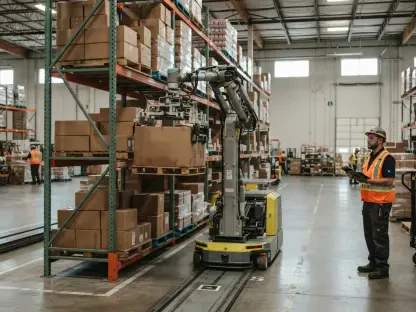
When you see more than 95% of a global warehouse network equipped with advanced digitalization solutions, the entire rhythm of the facility changes. With over 1,400 AI and analytics deployments—including 500 just this year—we are moving away from manual tracking toward a world where AI-powered robotics can adapt to real-time changes in order flow. It isn’t just about robots moving pallets; it is about AI orchestration that connects operational data with workforce management, creating a seamless loop of information. This level of integration allows a Lead Logistics Partner to have a much more granular view of what is happening on the floor, making it possible to respond to a surge in demand or a shipment delay with a level of speed that was previously impossible.
The logistics industry has seen massive consolidation recently, such as the DSV acquisition of Schenker. What are the practical challenges and potential rewards of merging such massive, global logistics networks?
A transaction of that scale, valued at roughly EUR 14.3 billion, is a massive undertaking that brings both incredible opportunities for synergy and significant operational risks. DSV is expecting approximately DKK 9 billion in annual synergies, but as we’ve seen in their 2026 updates, the integration of European road transportation businesses is fraught with challenges. You aren’t just merging trucks and warehouses; you are merging massive information systems, distinct company cultures, and complex customer service processes. The reward is clearly a more expansive geographic coverage and better access to transportation capacity, but the success of the merger ultimately hinges on how well they can standardize technology and management processes across that newly expanded network.
With the U.S. Department of Transportation’s FLOW program and the rise of digital control towers, we are seeing a push for shared logistics information. Why is this centralized visibility so critical for managing modern supply chain disruptions?
A digital control tower serves as the central nervous system of a 4PL operation, connecting data from warehouse management systems, transportation platforms, and even external carrier networks into one view. The beauty of something like the FLOW program is that it aggregates anonymized data on freight capacity and demand from ocean carriers, terminals, and railways, giving participants a “weather map” of the logistics landscape. If a company sees a major delay at a specific port, a control tower allows them to redirect shipments, adjust inventory levels at other locations, and update customer delivery schedules all at once. Without this consolidated view, you are essentially flying blind, trying to fix a problem in one corner of your network without realizing how it might crash into another part of your supply chain.
Different industries have very different logistics needs—for instance, the “just-in-time” requirements of automotive versus the temperature-controlled demands of healthcare. How does a 4PL provider adapt its strategy to handle these specialized sectors?
It requires a high degree of specialization because the consequences of a mistake are so different in each field. In automotive production, a single missing component can halt an entire assembly line, so the 4PL focuses heavily on inbound material flows and tight delivery windows. On the healthcare side, we are dealing with life-saving medicines and vaccines that require documented handling and constant temperature monitoring throughout the journey. A 4PL provider in the pharmaceutical space must coordinate specialized cold storage and customs documentation while maintaining a pristine audit trail. In both cases, the value of the 4PL is their ability to define clear operational responsibilities across multiple providers, ensuring that whether it is an engine part or a vaccine, the integrity of the delivery is never compromised.
Digital twins are becoming a more prominent tool for logistics planning in 2026. Can you walk us through how a company might use a virtual representation of their supply chain to make a major strategic decision?
A digital twin is essentially a sandbox where you can test “what-if” scenarios without risking any real-world assets. For example, a company might be considering closing a distribution center or relocating a significant portion of its inventory to a new region to save on transportation costs. By running that scenario through a digital twin, they can see exactly how it would affect delivery times, transportation expenses, and even their carbon footprint based on current market conditions. It takes the guesswork out of the equation, allowing a 4PL provider to show a client the potential impact of a change before a single contract is signed or a single pallet is moved. The accuracy of these models has improved tremendously, provided you have high-quality operational data feeding into the simulation.
For a long time, 4PL was seen as a luxury for only the largest multinational corporations. How are cloud-based platforms and modular services changing the accessibility of these strategies for small and mid-sized enterprises?
We are seeing a democratization of logistics expertise because cloud-based platforms now allow for modular adoption of 4PL capabilities. A mid-sized company might not need a lead logistics partner to take over their entire operation, but they might desperately need centralized freight procurement or better shipment visibility. These modular managed services allow smaller businesses to plug into advanced technology and expert management without having to build a massive internal team of transportation specialists. It is a way for them to gain the “bigness” of a multinational in terms of efficiency and data access, while remaining lean and agile in their actual business operations. As pricing becomes more transparent and implementation costs drop, I expect many more SMEs to jump on board.
Despite the benefits, there are clear risks involved in 4PL, particularly regarding data quality and cybersecurity. How should a company protect itself when its entire logistics operation is managed through a single centralized platform?
Dependency is a major concern, and you have to be very deliberate about how you structure those contracts and data access rights. If your 4PL provider’s platform goes down or suffers a cyberattack, it could potentially paralyze your entire distribution network, so robust cybersecurity protocols are non-negotiable. Beyond the security aspect, there is the issue of “garbage in, garbage out”—if your supplier data or inventory records are inaccurate, even the most advanced AI will give you the wrong recommendations. Companies need to maintain clear performance indicators, such as on-time delivery and disruption recovery time, while ensuring they have the internal capability to oversee the provider and maintain a level of strategic independence.
As AI and automation take over routine tasks like invoice processing and shipment tracking, what do you see as the evolving role of the human logistics professional?
The role is moving from the “engine room” to the “cockpit,” where judgment, negotiation, and strategic thinking are the most valuable assets. While an AI can identify a shipment delay and suggest a new route, it takes a human professional to navigate a complex relationship with a long-term supplier or to make a call on a high-stakes regulatory compliance issue. We are going to need professionals who are incredibly tech-savvy and comfortable with data analysis, but who also possess the commercial intuition to handle the “exceptions” that the machines can’t quite solve. The goal isn’t to remove the human from the loop; it’s to free them from the drudgery of manual tracking so they can focus on building a more resilient and flexible supply chain.
What is your forecast for the future of 4PL as we look beyond 2026?
I believe we are entering an era of “total orchestration,” where the boundaries between procurement, transportation, and warehouse management will effectively disappear. As international trade continues to face pressure from geopolitical shifts and rising costs, the ability to coordinate an entire network through a single digital lens will become the standard for any company that wants to remain competitive. We will see 4PL providers taking an even larger role in sustainability, using their centralized data to optimize routes for carbon efficiency as much as for cost. Ultimately, the most successful partnerships will be those that prioritize transparency and secure data management, turning the supply chain from a back-office necessity into a front-line competitive advantage that can withstand whatever global disruptions come next.