
Rohit Laila is a seasoned veteran in the logistics and supply chain sector, bringing decades of hands-on experience to the table. His career has been defined by a deep understanding of how physical infrastructure impacts the bottom line, particularly when navigating the complex demands of high-volume distribution and temperature-sensitive goods. In this discussion, we explore the intricate details of the recent installation at a major distribution hub in Worcester, covering the synergy between automated loading systems and thermal integrity. We look at how bespoke components, high-speed doors with over a million operating cycles, and a focus on long-term maintenance contribute to the operational excellence of a modern foodservice facility.
The conversation highlights the integration of specialized dock levellers and sectional doors designed to streamline high-performance operations. We delve into the necessity of custom-engineered dock pads to protect diverse vehicle fleets and the critical role of rapid-stacking freezer and chiller doors in maintaining the cold chain. Finally, we examine the importance of reliability in industrial hardware and the value of a robust aftersales support system to ensure minimal downtime.
In large-scale distribution facilities, the efficiency of the loading bay is often the heartbeat of the operation. How does the integration of HTL2 dock levellers and SPU67 sectional doors specifically address the logistical pressures found in a hub like the one in Worcester?
When you are managing a high-performance facility, the goal is to eliminate any friction during the transition from the warehouse floor to the vehicle. In the Worcester project, the installation of nine complete loading bays serves as the foundation for a very high operational tempo. By using HTL2 dock levellers alongside SPU67 fully automated industrial sectional doors, the facility gains a level of synchronization that is vital for rapid turnaround times. These SPU67 doors are not just simple barriers; they are part of a fully integrated solution that ensures the building remains secure and thermally efficient while the dock levellers provide a smooth, safe bridge for forklifts. Having nine dedicated bays configured this way allows for a constant flow of goods without the typical bottlenecks you see in less specialized setups.
Modern fleets are rarely uniform, featuring everything from small vans to massive heavy goods vehicles. Why were bespoke dock pads and bumpers such a critical requirement for this project, and what risks do they mitigate?
The reality of foodservice distribution is that you are dealing with a varied fleet of vehicles every single hour of the day. Using “off-the-shelf” bumpers often leads to a mismatch in height or depth, which is where you start seeing significant damage to both the vehicle rear and the building’s structural face. For the Worcester hub, designing and manufacturing these dock pads and bumpers in-house allowed for a tailored fit that specifically accommodates the unique vehicle types within the fleet. This customization ensures that every time a truck backs in, there is a consistent and safe contact point that absorbs the impact effectively. Beyond just protecting the physical assets, these bespoke components ensure a tighter seal, which is indispensable when you are trying to manage energy costs and maintain internal temperatures.
Maintaining the cold chain is a non-negotiable aspect of foodservice logistics. How do the internal door systems, such as the Mavicold and Mavipass, function to protect the integrity of temperature-sensitive environments?
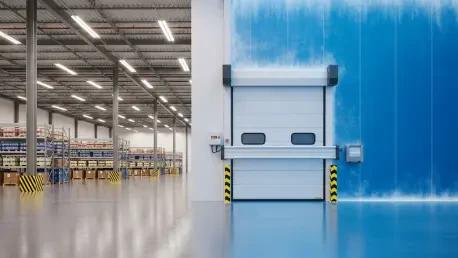
In a facility that houses both frozen and chilled goods, the internal doors are the primary defense against heat gain and energy loss. For the Worcester site, the installation included two Mavicold freezer doors and six Mavipass chiller doors, both of which utilize rapid stacking technology to minimize the time the thermal barrier is open. These doors are engineered specifically for cold environments with frost-resistant construction, which prevents the mechanical failures commonly caused by ice buildup in traditional systems. Because they are isothermal and high-speed, they significantly reduce the amount of air exchange between different zones, which is essential for keeping electricity bills down and ensuring food safety. It is that combination of speed and robust insulation that allows a busy warehouse to maintain strict temperature zones without slowing down the movement of staff and products.
The partnership mentioned involves over 100 high-speed doors across an entire estate, with many reaching a million operating cycles. From an expert perspective, what does this level of durability mean for the long-term ROI of a distribution center?
When I look at the milestone of a million operating cycles, I see a piece of equipment that has truly earned its keep as a “workhorse” in a demanding environment. In the logistics world, the initial purchase price of a door is often secondary to the total cost of ownership, which includes maintenance, repairs, and the cost of downtime. Having over 100 Maviflex doors across the estate demonstrates a massive vote of confidence in the reliability of this technology. If a door fails in a high-traffic chiller, it doesn’t just block a path; it threatens the quality of the inventory and forces expensive emergency repairs. The fact that these doors can hit such high cycle counts with low maintenance costs proves that the engineering is up to the task of 24/7 industrial use, providing a level of operational stability that is hard to quantify but easy to appreciate on a balance sheet.
What is your forecast for the evolution of temperature-controlled loading solutions?
I expect we will see a much deeper move toward “smart” integrated systems where the loading bay equipment and the temperature-controlled doors communicate directly with the warehouse management system. We are already seeing the benefits of rapid-stacking technology and bespoke physical protections, but the next step is using data from those million-plus cycles to predict maintenance needs before a part ever fails. The Worcester project, with its focus on fully integrated solutions and a robust aftersales support network, is a blueprint for this future. As energy costs continue to fluctuate, the industry will pivot even more toward ultra-fast, high-insulation barriers that can handle even higher frequencies of use while requiring virtually zero manual intervention. Efficiency will no longer be just about speed, but about the total elimination of energy waste and mechanical downtime.