
The realization that a robotic arm can identify a random bolt among thousands of disparate objects without a single line of item-specific code marks a fundamental shift in the historical narrative of industrial automation. For decades, the primary challenge of “bin picking” resided in the software’s inability to adapt to chaos, requiring engineers to painstakingly program every possible permutation of an object’s position and shape. The Festo GripperAI emerges as a corrective to this rigidity, representing a sophisticated synthesis of pneumatic muscle and artificial intelligence. By moving away from deterministic programming and toward probabilistic learning, this technology addresses the critical bottleneck in modern fulfillment centers: the need for robots that can handle high-variance inventory with the same intuition as a human operator. The transition from simple motion control to autonomous decision-making reflects Festo’s broader strategic pivot, signaling a future where the mechanical hardware is merely the delivery mechanism for a much more powerful digital brain.
The Evolution of Intelligent Picking: An Introduction to GripperAI
Festo’s entry into the AI-driven picking space is not merely a software update but the culmination of a century-long engineering legacy that started with high-precision pneumatics. Historically, Festo dominated the market by perfecting the physical components of automation—valves, cylinders, and grippers that could move with incredible speed and reliability. However, as global supply chains grew more complex and consumer demands for customization increased, the limitations of “dumb” mechanical systems became apparent. Mechanical excellence alone could no longer solve the problems of a warehouse where the SKU count reaches into the millions and items change every season. This realization led to the strategic acquisition of AI specialists like Resolto, which allowed Festo to integrate advanced machine learning directly into its motion control ecosystems.
The core principle of GripperAI is the democratization of intelligence across the factory floor. Instead of relying on a centralized supercomputer or a team of resident data scientists, the technology focuses on decentralized, adaptable units that can be deployed by traditional maintenance staff. This shift is significant because it bridges the widening gap between the physical mechanical world and the rapidly advancing digital landscape. By providing a system that can “see” and “interpret” its environment, Festo has moved from being a provider of parts to a provider of solutions, enabling machines to operate with a level of autonomy that was previously reserved for high-end research laboratories.
Technical Framework and Core Intelligence
Generic Recognition and Geometric Primitive Training
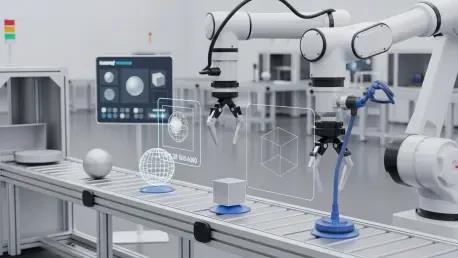
The most striking technical feature of GripperAI is its departure from Computer-Aided Design (CAD) based recognition systems. Traditional robotic vision requires a 3D model of every single item the robot might encounter, which is an impossible requirement in an e-commerce environment where new products are introduced daily. Instead, Festo’s AI utilizes generic recognition, which trains the system on geometric primitives—spheres, cylinders, and cubes. By understanding the fundamental properties of these shapes, the software can extrapolate how to handle a hammer, a box of screws, or a bottle of detergent simply by identifying their underlying geometric components. This approach eliminates the “training bottleneck,” allowing the system to be truly plug-and-play from the moment of installation.
This reliance on primitives rather than specific models creates a scalable architecture that is inherently more robust. When the AI encounters an object it has never seen before, it does not fail; rather, it identifies the most “graspable” surface based on its mathematical understanding of volume and friction. This methodology, supported by synthetic data generation, ensures that the robot is prepared for billions of variations in lighting, orientation, and texture. The result is a system that grows more capable as it encounters more diversity, turning what used to be a technical liability—chaos—into a training asset for the underlying neural networks.
Edge Computing and Real-Time Processing Architecture
To achieve the millisecond response times required for industrial-grade picking, Festo opted for an edge computing architecture rather than a cloud-centric model. Processing massive amounts of visual data in the cloud introduces unacceptable latency, which can lead to missed picks or dangerous collisions in high-speed environments. By running the GripperAI software on dedicated local hardware situated right at the robot cell, the system ensures that vision-to-motion loops remain incredibly tight. This local processing capability is what allows the robot to make split-second adjustments as an item shifts or as a suction cup makes initial contact, providing a level of responsiveness that mimics human hand-eye coordination.
Furthermore, this decentralized approach offers a layer of security and reliability that cloud-based alternatives often lack. In an industrial setting, a loss of internet connectivity cannot be allowed to halt a multi-million-dollar production line. By hosting the intelligence locally, Festo ensures that the robotic cell remains operational even if the broader network is compromised. This architecture also facilitates easier integration with existing Programmable Logic Controllers (PLCs), allowing the AI to communicate directly with the conveyor belts and safety scanners that govern the cell’s physical environment.
Innovations in AI Training and Universal Automation
The current trajectory of GripperAI is being shaped by the move toward synthetic data generation, which allows the AI to undergo millions of picking attempts in a virtual environment before ever touching a physical object. This technique bypasses the slow and expensive process of real-world physical training. By simulating gravity, friction, and material properties in a digital twin, developers can expose the AI to corner cases that would be impossible to replicate in a laboratory. This transition toward “universal automation” is a direct response to the global labor shortage, as it allows manufacturers to deploy sophisticated robotics in areas that were previously too complex or too expensive to automate.
Real-World Applications and Pilot Implementations
Practical validation of this technology is best seen in its deployment with the Würth Group, a company that manages an inventory of over one million parts. In this high-velocity environment, GripperAI is used to manage a tool-changing station where the robot must decide, in real-time, whether to use a mechanical gripper or a vacuum suction cup for a specific pick. The AI analyzes the bin, identifies the best target, selects the appropriate tool, and executes the pick without any human intervention. This implementation demonstrates that the technology is not just for niche applications but is capable of handling the heavy lifting of global logistics and e-commerce fulfillment.
Overcoming Technical Hurdles and Market Obstacles
Despite its sophistication, the technology still faces the inherent limitations of physical hardware. While the AI can identify the perfect grasp point on a heavy bag of cement, the mechanical strength of the gripper or the suction capacity of the vacuum remains a hard ceiling. There is also the persistent challenge of handling fragile or highly irregular objects, such as open-pouch liquids or intricate wire meshes, which can confuse even the most advanced sensors. Festo is currently addressing these limitations by refining its sensor integration, moving toward multimodal sensing where the AI uses both vision and haptic feedback to determine if a grip is secure.
Future Projections and the Path Toward Autonomous Networks
The next phase of evolution for GripperAI lies in the creation of networked learning environments where “knowledge sharing” becomes the norm. If a robot in a facility in Germany learns a more efficient way to pick a specific type of translucent plastic, that data could theoretically be uploaded to a shared repository, immediately updating the capabilities of every Festo robot worldwide. This collaborative intelligence would drastically accelerate the maturity of automated systems, moving us closer to a future of self-optimizing supply chains that can reorganize themselves in response to global disruptions or shifts in consumer behavior.
Final Assessment and Industrial Implications
The introduction of Festo’s GripperAI fundamentally altered the trajectory of warehouse logistics by prioritizing cognitive adaptability over mechanical brute force. It shifted the industry away from specialized, high-maintenance programming toward a more democratized form of automation where the barrier to entry was lower than ever before. This transition proved that the integration of synthetic data and edge computing could bridge the gap between virtual intelligence and physical execution. The technology established a baseline for what “flexible” really meant in a manufacturing context, allowing businesses to respond to labor shortages with scalable, autonomous solutions. Ultimately, the success of the platform demonstrated that the future of robotics belonged not to the strongest machines, but to the smartest and most integrated networks. Moving forward, the industry was tasked with ensuring these autonomous systems could maintain interoperability across diverse hardware platforms to maximize global efficiency.