
Internal reports suggest that the push for robotics manufacturing in Indiana may be part of a broader strategy to curb the company’s future hiring requirements. This massive $100 million commitment to a new facility in Greenwood signals a significant shift in how the retail giant intends to manage its logistics network. Spanning 585,000 square feet, this site represents the fourth major hub dedicated to the creation of proprietary automation technology. By establishing a presence in the Midwest, the company is bridging the gap between its existing East Coast research centers and the burgeoning demand for automated solutions across the central United States. This facility is not merely a warehouse but a sophisticated production plant where advanced engineering meets large-scale fabrication. The sheer scale of the investment underscores a move toward a self-sustaining ecosystem where the tools of the trade are manufactured in-house to ensure seamless integration across the entire global network.
Building a Self-Sustaining Robotics Ecosystem
Advanced Fabrication and Lifecycle Management
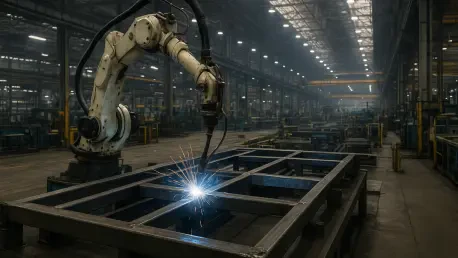
The Greenwood facility is engineered to oversee the complete lifecycle of robotic units, from the initial fabrication of frames to the final quality control checks. Unlike previous distribution centers, this plant focuses on industrial processes such as robotic welding, powder-coating, and intricate electronic assembly. By consolidating these high-tech manufacturing stages under one roof, the company aims to accelerate the deployment of new units into the field by 2028. This move signifies a departure from relying on external vendors for specialized components, allowing for more rapid prototyping and iterative improvements to their existing robotic fleet. The ability to handle repairs and updates internally further ensures that the massive fleet of autonomous mobile robots remains operational with minimal downtime. Such vertical integration is essential for maintaining a competitive edge in an environment where speed and reliability are the primary drivers of success.
Strengthening the Logistics Network Infrastructure
Indiana has emerged as a central pillar in the North American fulfillment strategy due to its favorable logistics infrastructure and proximity to major population centers. The decision to invest heavily in Greenwood is supported by the state’s existing manufacturing workforce and a business environment that fosters large-scale industrial projects. This new plant will complement the work being done at existing sites in Massachusetts and Texas, creating a more resilient supply chain for the robotics division itself. Local officials have noted that the project will create approximately 300 highly skilled positions, ranging from robotics engineers to specialized maintenance technicians. These roles often command salaries nearing $100,000 annually, reflecting the advanced nature of the work being performed. By embedding these high-value manufacturing capabilities within Indiana, the company is effectively locking in a talented labor pool that will be vital for sustaining its growth through the end of the decade.
Evaluating the Impact on the Industrial Workforce
Transitioning Toward Technical Specialization
The conversation surrounding the deployment of over one million robots worldwide often centers on the potential displacement of human labor. Company executives argue that these machines are designed to handle repetitive tasks and heavy lifting, thereby reducing physical strain and allowing employees to focus on more complex, value-added activities. In many facilities, these robots already process approximately 75% of customer orders, working in tandem with human associates to increase efficiency. However, the rapid expansion of manufacturing sites specifically for these robots indicates that the scale of automation is set to increase exponentially. This transition creates a new class of jobs that require technical training and certifications in automation and robotics repair. As the company transitions from 2026 to 2028, the focus will likely remain on upskilling the existing workforce to ensure they can manage the sophisticated machinery that is increasingly defining the modern warehouse environment.
Establishing a New Standard for Operational Resilience
The strategic investment in Indiana demonstrated how modern corporations approached the challenge of scaling autonomous logistics while navigating complex labor dynamics. By 2026, the completion of this fourth robotics plant finalized a robust internal manufacturing network that prioritized technological self-sufficiency. Analysts observed that the integration of high-skilled engineering roles within traditional manufacturing states provided a sustainable model for economic growth. This shift ensured that the focus remained on long-term operational resilience rather than short-term gains. Businesses across the sector studied this implementation to understand how to blend human expertise with mechanical precision effectively. Ultimately, the project served as a definitive case study in how large-scale automation was successfully woven into the fabric of global commerce. Leaders in the field recognized that the move to control the entire production lifecycle was essential for maintaining dominance in an increasingly automated world.