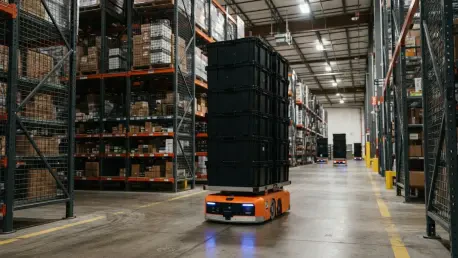

We are joined today by Rohit Laila, a titan in the logistics world with decades of experience navigating the complexities of global supply chains and delivery ecosystems. As we stand here in 2026, the landscape of warehouse fulfillment has shifted from experimental technology to essential integration, and Rohit has been at the forefront of this evolution. He has built a reputation for championing a “problem-first” approach to innovation, ensuring that every robotic arm or autonomous vehicle serves a clear, measurable purpose. Today, we dive into the nuances of modern fulfillment, exploring how robotic systems are redefining productivity, the critical importance of process optimization before automation, and the delicate balance between human intuition and machine precision in the high-stakes world of global branded payments and gift card fulfillment.
The following discussion explores the strategic implementation of goods-to-person systems, the psychological and physical shift for the warehouse workforce, and the rigorous financial and operational criteria used to justify massive technological investments. We also touch upon the pitfalls of “automating waste” and the future of humanoid robotics in industrial settings.
How does the shift from manual walking to robotic goods-to-person systems fundamentally redefine the physical and operational flow of a high-volume fulfillment center?
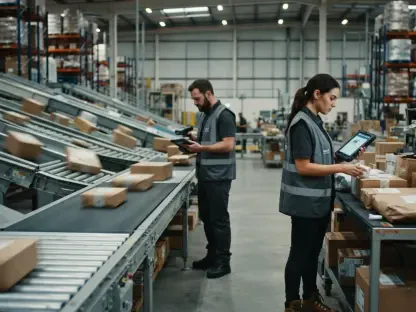
The transformation is truly night and day when you stop viewing the warehouse as a series of aisles and start seeing it as a fluid, high-density engine. In a traditional setup, you have employees walking miles every shift, their energy drained by the sheer physical demand of traversing a massive footprint to find a single gift card or tote. When we implement a goods-to-person system, like the one utilizing Quicktron’s robots, we effectively flip the script by bringing the inventory directly to the human expert. This eliminates the fatigue of “travel time,” allowing the rhythmic hum of tote-handling robots to replace the frantic pacing of manual picking. By utilizing vertical space—moving up, down, and across—we aren’t just saving our workers’ legs; we are concentrating thousands of product units into a smaller, more manageable footprint that processes volume with a precision humans alone couldn’t maintain.
Achieving a productivity increase of over 300% is a staggering figure for any operation. What are the specific operational levers that allow for such a dramatic acceleration in output?
That 300% leap isn’t just a lucky number; it’s the result of systematically removing every micro-bottleneck in the picking process. By establishing a rigorous baseline before the robots ever touched the floor, we could see exactly where the friction existed in the previous manual workflow. Once the tote transport robots took over the heavy lifting and movement, we saw our time-to-market slashed by a full 50%, meaning orders that used to linger in the queue are now out the door in half the time. We also focused on quality and speed simultaneously, reaching nearly 100% accuracy because the system removes the “human error” of searching the wrong bin. When you combine high-density storage with intelligent workstations that present the right item at the right moment, the speed of fulfillment naturally triples because the person is focused entirely on the pick, not the path.
How should warehouse managers reframe the day-to-day experience of their employees to ensure that robots are seen as partners rather than competitors?
The conversation needs to shift away from “robots versus people” and toward the idea of giving our workforce better, more sophisticated tools to do their jobs. In the Minnesota facility, the biggest change for the team was the elimination of the “treasure hunt” aspect of the job; they no longer spend hours wandering through racks. Instead, they operate at the heart of the system, handling the human-centric tasks that require dexterity and judgment while the robots manage the repetitive, grueling movement of inventory. We find that when employees see that the technology is there to take the “work” out of the work—reducing physical strain while allowing them to process record-breaking volumes—the adoption happens naturally. It’s about building a better process where the technology handles the math and the movement, and the people handle the fulfillment and the quality.
Beyond the physical robots, you’ve mentioned that “transformation takes a village.” What are the hidden challenges of integrating software and data into a legacy warehouse environment?
The robot is honestly just the tip of the iceberg; the real magic, and the real difficulty, lies in the invisible architecture of software and data. You can have the fastest robots in the world, but if they aren’t talking to a robust Warehouse Management Platform, they are just expensive paperweights. We had a significant advantage by having full control over our software side, which allowed for a smooth integration, but you still have to map out how every piece of data flows from the moment an order is placed to the moment the robot retrieves the tote. You need a collaborative ecosystem where the technology provider, the fulfillment client, and the operational team are in constant communication to ensure the software isn’t just “running” but actually optimizing. If the operating process, the data, and the people aren’t perfectly synced, you’ll find that you haven’t solved a problem—you’ve just moved the bottleneck to a different part of the building.
You have a very specific rule about not “automating waste.” How can a leader identify which processes are actually ready for robots and which ones just need a better manual strategy?
This is perhaps the most critical lesson: if you automate a wasteful, broken process, all you’ve done is make that waste faster and much harder to fix later. Before we even consider a robotic solution, we “walk the process” to understand why we are doing things a certain way and where the unnecessary steps are hiding. You have to strip the operation down to its simplest form, eliminate the fluff, and then establish a baseline of what a “perfect” manual version looks like. Only then can you look at the investment and decide if technology will create actual value or if it’s just a flashy band-aid. In Maple Grove, we didn’t start with robots; we started with the problem of scalability and speed, and only after we optimized the flow did we bring in the tote-handling technology to amplify those improvements.
With the rise of vertical storage and tote-handling technology, how does the math on warehouse real estate change for companies looking to scale quickly?
The traditional “horizontal” growth model—just buying more square footage—is becoming obsolete because robots allow us to think vertically. By using high-density storage systems where robots navigate tightly packed racks, we can store a massive variety of gift cards and payment products in a relatively small area. This allows us to scale our capacity without the massive overhead of moving to a larger facility, which is a game-changer for responding to fluctuating customer demand. We are now seeing operations that can process thousands of units every hour within a footprint that would have been impossible for a manual team to navigate efficiently. This density doesn’t just save money on rent; it compresses the entire operation, making every move shorter and every second of the robot’s battery life more productive.
What is your forecast for the role of humanoid robots in the warehouse sector over the next few years?
While the industry is buzzing about humanoid technology, my view is that it is still in a maturation phase and isn’t quite ready to solve the specific, high-velocity problems we face today. In 2026, we are seeing specialized robots—like the tote-handlers and transport units—dominating the floor because they are purpose-built for efficiency and verticality, whereas humanoids are still trying to master basic movement in complex environments. However, as the use cases for automation continue to evolve and the technology becomes more agile, we will stay incredibly close to its development. For now, the focus remains on “functional” automation that delivers a 300% productivity boost today, rather than waiting for a “general-purpose” robot that might be ready tomorrow. The key is to remain flexible and integrate whatever form factor actually solves the problem at hand, whether it has two legs or four wheels.