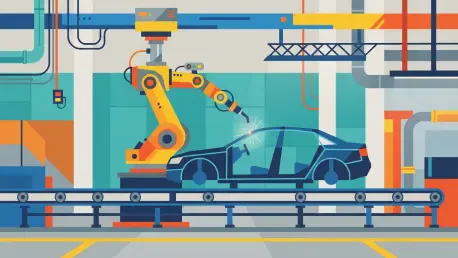

The silent dance of high-precision machinery is undergoing a radical shift as automotive assembly lines evolve from rigid iron skeletons into thinking ecosystems capable of autonomous decision-making. Today, the transition from fixed automation to flexible robotics marks a pivotal moment in manufacturing history. Traditional assembly lines relied on robots bolted to the floor, performing singular, repetitive motions with mechanical indifference. However, the modern automotive plant now demands a level of agility that these legacy systems cannot provide, especially as production cycles shorten and vehicle complexity increases.
Defining the scope of the thinking factory requires a deep understanding of high-volume series production where every second of downtime translates to significant losses. The integration of mobile humanoids into these environments allows for a dynamic material flow that adapts to real-time production needs rather than following a pre-programmed, static path. This intelligence transforms the factory from a place of mere assembly into a responsive organism capable of self-correction.
Success in this ecosystem depends on a complex synergy between hardware innovators, AI developers, and automotive giants. While hardware provides the physical dexterity, AI developers supply the cognitive frameworks required for perception and reasoning. Automotive leaders provide the operational context, ensuring that these technological advancements address the practical challenges of moving millions of parts across the factory floor daily. Physical AI serves as the essential bridge, translating digital simulations into precise, reliable execution within the messy reality of the plant.
Emerging Trends and the Data-Driven Shift in Robotic Deployment
The Rise of Flexible Automation and Simulation-First Engineering
Modern manufacturing facilities are moving away from rigid production lines in favor of mobile humanoid systems that navigate existing layouts without requiring expensive structural overhauls. These robots utilize advanced sensors to map their surroundings, allowing them to work alongside humans without the need for safety cages. This flexibility ensures that as vehicle models change, the logistics infrastructure can be reconfigured through software updates rather than physical reconstruction.
The shift toward simulation-first engineering has drastically altered the timeline for robotic integration. By utilizing virtual environments, engineers can simulate every aspect of a robot’s mission, from the torque required for a specific lift to the path taken through a crowded corridor. This process reduces commissioning time from several months to a few days, as the robot enters the physical world with a pre-validated library of behaviors and safety protocols.
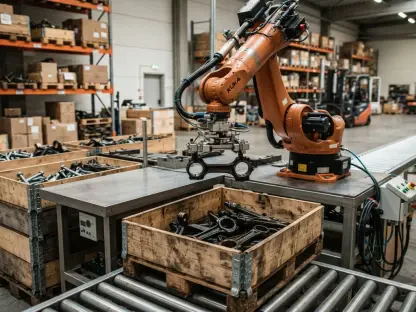
Robotic dexterity has evolved to handle the complexities of semi-rigid and flexible components that once required human touch. Dual-arm manipulation allows humanoids to pick unsorted parts from mixed containers with a level of precision that mimics human hand-eye coordination. This capability is critical for sequencing, where a vast variety of parts must be organized in the exact order required by the assembly line.
Market Projections and the Scaling of Humanoid Solutions
The growth trajectory of mobile robotics within the global automotive supply chain indicates a massive scaling phase from 2026 to 2031. As initial proof-of-concepts yield positive data, manufacturers are transitioning from single-unit trials to site-wide humanoid fleets. This expansion is driven by the need to maintain competitive margins in an era of rising labor costs and a shrinking workforce in traditional manufacturing regions.
Key performance indicators now focus on daily pick rates and the accuracy of part sequencing. Early data from integrated humanoid systems show a significant reduction in sorting errors and a steady increase in the volume of material handled per shift. These metrics provide the empirical evidence needed to justify the long-term ROI of reducing manual material handling in favor of automated Physical AI solutions.
Investment trends are heavily favoring platforms that integrate digital twins with industrial edge computing. The financial community has recognized that the value of humanoid robotics lies not just in the hardware, but in the data-rich environments they create. By automating the most physically demanding and repetitive tasks, companies are creating a more resilient logistics framework that is less susceptible to external labor market fluctuations.
Overcoming Technical and Operational Hurdles in Humanoid Integration
Sequencing remains one of the most significant challenges in automotive logistics due to the sheer variety of parts involved in premium vehicle assembly. Solving the problem of unsorted parts and mixed-container picking requires a level of visual intelligence that can distinguish between similar-looking components in varying light conditions. Mobile humanoids equipped with advanced perception software are finally making it possible to automate these high-complexity tasks.
Technological bottlenecks such as real-time reasoning in high-traffic industrial environments are being addressed through faster edge processing. A robot must be able to calculate a new path instantly if a human worker or a forklift crosses its intended trajectory. Ensuring this level of responsiveness requires a seamless connection between the robot’s local sensors and the broader factory intelligence network.
Bridging the gap between disparate hardware and software platforms is essential for industry-wide adoption. Integrating systems like NVIDIA Omniverse and 3DEXPERIENCE allows for a unified digital thread that tracks a component from the design phase through to its robotic delivery on the factory floor. This interoperability ensures that data flows freely between the virtual twin and the physical robot, maintaining high operational standards.
Navigating the Regulatory Landscape and Safety Standards
Global safety protocols for human-robot collaboration are being rewritten to accommodate mobile humanoid bases that operate in shared workspaces. These regulations ensure that as robots move more freely, they maintain a predictable and safe presence around human employees. Adherence to these evolving standards is a prerequisite for any site-wide deployment, as it mitigates the legal and operational risks of high-tech automation.
The impact of ISO standards and regional regulations is particularly evident in the deployment of mobile units. Manufacturers must ensure that their robotic fleets comply with strict guidelines regarding speed, force, and emergency stop procedures. These certifications provide a framework for trust, allowing human workers to focus on their supervisory tasks without fearing for their physical safety in a high-traffic environment.
Data security has become a paramount concern in the era of digital twins and industrial edge computing. As mobile humanoids collect vast amounts of visual and operational data, protecting this information from cyber threats is vital for maintaining production continuity. Compliance with data sovereignty laws and the implementation of robust encryption protocols are now standard requirements for any industrial AI integration.
The Future Path: Toward a Fully Autonomous Logistics Ecosystem
Industry World Models are paving the way for self-optimizing logistics networks that can predict bottlenecks before they occur. By analyzing historical data and real-time sensor feeds, these models allow the factory to adjust the speed and priority of material delivery autonomously. This proactive approach to logistics reduces idle time for assembly workers and ensures that the production line remains at peak efficiency.
Potential market disruptors such as decentralized AI and 5G connectivity will further enhance robot autonomy. These technologies allow for faster communication between robots, enabling them to coordinate their movements and tasks without a central controller. This level of swarm intelligence will be necessary as factories move toward even higher levels of customization and complexity.
Evolving consumer preferences for premium vehicle customization are driving the need for increasingly complex sequencing. As every vehicle on the assembly line potentially requires a different set of internal components, the logistics network must be capable of handling infinite variations. Mobile humanoids provide the only viable solution for this level of detail, as they can adapt to new picking lists instantly.
Final Assessment: Defining the Technological Standard for Next-Generation Factories
The integration of mobile humanoids provided a definitive answer to the long-standing challenges of automotive sequencing and material handling. This transformation was made possible through the successful synergy of dexterous hardware, high-fidelity simulation, and Physical AI. The project demonstrated that the most complex industrial tasks could be automated when the digital and physical worlds were perfectly aligned.
Strategically, the deployment of these robotic systems offered a significant competitive advantage by increasing operational resilience. Manufacturers that adopted these technologies early were able to maintain high production volumes while simultaneously improving the ergonomic conditions for their workforce. This shift represented a move away from labor-intensive manual processes toward a high-value supervisory model of manufacturing.
The transition from theoretical thinking factories to high-productivity realities was finalized as virtual validation became the industry standard. This approach allowed for the rapid scaling of humanoid fleets across global manufacturing hubs, ensuring that efficiency gains were felt throughout the entire supply chain. The industry successfully moved toward a model where technology and human expertise worked in a unified, high-efficiency ecosystem.