
The sheer scale of modern industrial engineering often pushes the limits of what was once considered physically possible on public infrastructure, requiring a level of precision that blends brute force with surgical accuracy. During the weekend of November 21–22, the specialist transport firm Allelys established a monumental milestone in British logistics by successfully moving a gross weight of 670 tons across the United Kingdom’s road network. This operation significantly surpassed the company’s previous record of 616 tons, marking an impressive growth of nearly nine percent in their operational capacity. Such a feat represents more than just a numerical record; it signifies a massive leap in the logistical capabilities required to support the nation’s evolving energy and industrial demands. By successfully navigating this gargantuan load, the team demonstrated that the constraints of terrestrial transport are not fixed but are instead a challenge to be solved through technical innovation and rigorous preparation.
Technical Specifications: The Engineering of an Ultra-Heavy Load
The Cargo Assembly: Understanding Support Mechanics
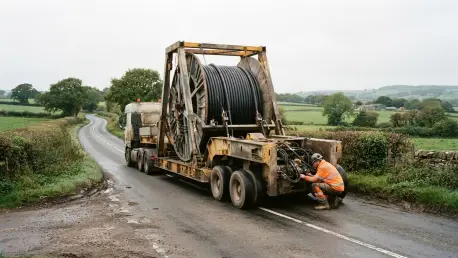
The centerpiece of this historical transport mission was a massive 400-ton cable reel, an essential component for the UK’s expanding energy infrastructure. To ensure the load remained stable and secure during transit, engineers designed a custom-built 23-ton support cradle that distributed the weight evenly across the transport system. When combined, the cargo assembly reached a staggering 423 tons, yet the total gross weight of the entire convoy was 670 tons. This massive 247-ton difference highlights the sheer volume of specialized equipment necessary to mobilize such a dense industrial asset. Moving a single piece of equipment of this magnitude requires a deep understanding of physics and structural integrity, as the stresses placed on the transport frame are immense. Every bolt, weld, and support beam in the cradle was scrutinized to ensure it could withstand the forces encountered during the journey, proving that the cargo itself is only half the battle.
The engineering behind the support cradle extended beyond mere weight bearing, as it also had to account for the center of gravity and the dynamic forces of motion. Because a 400-ton reel is inherently top-heavy, the cradle was designed to lower the center of gravity as much as possible, enhancing stability during cornering and on uneven road surfaces. High-grade structural steel was used to fabricate the frame, ensuring it could handle the tension and compression forces without deforming under the sheer mass of the reel. Every attachment point between the cradle and the girder frame was a critical failure point that required precise torque and alignment. This level of technical scrutiny ensures that even as the convoy navigates steep inclines or declines, the cargo remains perfectly centered, preventing any shifts that could lead to an imbalance. The cradle effectively acts as the interface between a delicate industrial asset and the raw power of the transport machinery.
Girder Frame Technology: Mechanics of the System
Utilizing a girder frame trailer was the only viable solution for a load of this magnitude, as traditional flatbed trailers lack the structural architecture to handle concentrated weights of several hundred tons. The girder frame design functions by suspending the cargo within a rigid structural skeleton rather than resting it directly on the trailer deck. This engineering approach is critical for protecting the road network, as it allows the massive gross weight to be distributed across dozens of individual axle lines. By spreading the weight over a much larger surface area, the pressure exerted on the asphalt and underlying bridge structures remains within safe engineering tolerances. Without this sophisticated method of weight distribution, the concentrated force of a 670-ton load would cause catastrophic failure to local road surfaces or bridge spans. The trailer acts as a dynamic bridge itself, bridging the gap between the immovable weight of industrial machinery and the nature of public roads.
Modern girder frame technology also incorporates advanced hydraulic suspension systems that allow operators to adjust the height of the load in real-time. This capability is essential when the convoy must pass over humpback bridges or under low-clearance overhead structures, as it provides the flexibility to raise or lower the frame by several inches. Each axle on the trailer is independently steered, allowing the massive assembly to navigate roundabout junctions and narrow intersections that would be impassable for a fixed-axle trailer. The synchronization of these hydraulic systems is managed through a central control unit, ensuring that the load remains level even when the terrain is not. This level of control is what makes it possible to maintain the structural integrity of both the cargo and the road network simultaneously. By leveraging these hydraulic advancements, Allelys was able to maintain a consistent safety margin, proving that high-tech machinery is the backbone of record-breaking success.
Operational Execution: Strategy and Industrial Impact
Pre-Transport Analysis: Route Assessment and Civil Engineering
Successfully moving a 670-ton load is far more an exercise in civil engineering than it is a simple trucking operation. Before the convoy could even depart, teams performed exhaustive route assessments to identify every potential bottleneck or structural weakness along the path. This involved high-precision calculations of bridge loading capacities and 3D road geometry analysis to ensure the long girder frame could navigate tight turns and steep gradients. Beyond technical calculations, the success of the project relied on a complex web of multi-agency coordination involving highway authorities and law enforcement. Moving a load that occupies multiple lanes requires rolling roadblocks and the temporary removal of street furniture, such as traffic signals and bollards. This symbiotic relationship between the transport company and public agencies illustrates the collaborative nature of modern hauling, turning a potential logistical nightmare into a choreographed display of professional precision.
The planning phase effectively acted as a digital dress rehearsal, where every inch of the journey was simulated to predict how the trailer would react to the unique topography of the landscape. Engineers had to account for environmental factors, such as wind resistance and road surface friction, which can change significantly over a multi-day journey. These simulations allowed the team to identify areas where the road might need temporary reinforcement or where the convoy speed needed to be strictly regulated. Furthermore, the logistical strategy included detailed contingency plans for mechanical failures or unexpected weather conditions, ensuring that the 670-ton mass never became a permanent obstruction. This proactive approach to risk management is what separates standard heavy hauling from record-breaking operations. It ensures that the safety of the public and the integrity of the highway network remain the highest priorities, even as the industry pushes into the territory of moving the heaviest loads in national history.
Future Benchmarks: Establishing New Industry Standards
This record-breaking achievement is a direct response to the shifting requirements of the global energy sector, where components are becoming increasingly oversized. As the United Kingdom continues its transition toward renewable energy and modernizes electricity transmission networks, the demand for super-heavy logistics has become a critical necessity for national infrastructure development. High-voltage transformers and massive cable reels are now larger than ever, requiring the transport industry to push the limits of terrestrial movement. The Allelys record serves as a powerful indicator of current technology, proving that boundaries are constantly expanding through sophisticated hardware and meticulous planning. This operation provides a roadmap for future projects, signaling to the entire transport industry that the capacity for large-scale movement is growing. Such newfound capability allows for more ambitious engineering projects, fundamentally changing how industrial sites are built.
The success of the 670-ton move also highlighted the increasing importance of professional training and specialized expertise within the heavy-hauling workforce. Operating a girder frame of this size requires a crew of highly skilled technicians, steerers, and drivers who can communicate with split-second accuracy. As components continue to grow in size from 2026 to 2028, the industry must invest in new training programs that focus on digital control systems and hydraulic management. This evolution will likely lead to the development of even more specialized trailers capable of handling weights that were previously restricted to maritime or rail transport. By proving that such loads can be moved safely on public roads, the project has opened the door for manufacturers to build larger, more efficient industrial units. This shift not only reduces the cost of large-scale construction but also accelerates the timeline for critical energy projects, demonstrating that logistics is the primary engine of modern industrial progress.
The successful execution of this record-breaking transport operation provided essential insights into the future of ultra-heavy hauling and infrastructure resilience. By analyzing the data gathered from the 670-ton move, industry leaders gained a clearer understanding of how to optimize axle loads and bridge crossing strategies for future projects. Engineers identified specific areas where digital twin modeling could further enhance the accuracy of route planning, reducing the time required for physical site surveys. Furthermore, the collaboration between the private sector and public authorities established a more streamlined framework for permitting and traffic management during super-heavy movements. These advancements suggested that the next phase of industrial growth will depend heavily on the integration of real-time sensor data and autonomous coordination. As the complexity of energy projects increased, the focus shifted toward developing modular transport systems that could be adapted for even heavier loads without exceeding road stress limits.