
Rohit Laila brings decades of seasoned expertise to the table, having navigated the complex evolution of global supply chains and delivery systems through periods of both remarkable growth and intense volatility. His deep-seated passion for logistics is matched only by his commitment to technological innovation, a combination that has made him a leading voice in understanding how geopolitical shifts rewrite the rules of international trade. As the maritime world faces an unprecedented crisis in the Middle East, Laila provides a crucial perspective on the crumbling reliability of traditional shipping lanes and the frantic search for viable alternatives that could prevent a worldwide economic shutdown.
The following discussion explores the precarious state of global oil inventories and the immediate threats facing seafarers in increasingly hostile waters. We examine the strategic pivot toward massive pipeline infrastructure projects across Saudi Arabia, the UAE, and Iraq, analyzing how these land-based solutions aim to bypass vulnerable chokepoints. Finally, the conversation shifts to the long-term implications for the tanker industry and the accelerated timeline for a permanent transformation in how energy is moved across the globe.
The global energy market is currently standing on a precipice, with oil inventories plummeting to levels we haven’t seen since 2003. How is this tightening supply, combined with the escalating hostilities in the Strait of Hormuz, forcing a fundamental rethink of maritime security and the survival of the global energy trade?
The situation is becoming increasingly dire by the hour, and the atmosphere within the logistics community is one of heavy apprehension. We are seeing a terrifying reality where the “ceasefire” many hoped for has effectively vanished, replaced by news of vessels catching fire and, most tragically, the loss of seafarers’ lives in these perilous stretches of water. When you consider that our global oil inventories are at their thinnest margins in two decades, there is no room for error or delay; a total halt in Gulf exports would likely trigger a full-blown energy crisis within mere weeks. The smell of burning fuel and the sight of abandoned tankers, like the LPG carrier recently left in the Black Sea, serve as a visceral reminder that the old routes are no longer the safe havens they once were. Energy majors are now operating in a state of high alert, realizing that the Strait of Hormuz is no longer just a logistical hurdle but a potential dead end for the world’s economy.
With maritime routes like the Bab al-Mandeb Strait becoming nearly impassable due to regional conflicts, there is an urgent move toward inland infrastructure. What is your assessment of the pipeline strategies currently being fast-tracked, and can they truly offer a meaningful bypass to the traditional sea lanes?
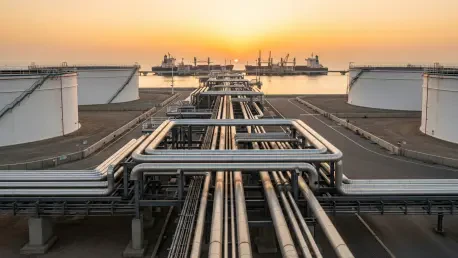
The shift toward pipeline infrastructure is no longer a theoretical “Plan B” but a strategic priority that is being accelerated at a breakneck pace. Currently, there is roughly 6.9 million barrels per day of export pipeline capacity that bypasses the Gulf, but that is just the foundation for what is coming. We are watching projects like Saudi Arabia’s East-West Pipeline to Yanbu and the UAE’s ADCOP facility in Fujairah transform from long-term investments into immediate lifelines. Even the Iraq line from Kirkuk to Ceyhan is seeing renewed focus as the industry realizes that land-based transit offers a level of control that the open, contested seas currently cannot. It is a massive engineering undertaking, involving the coordination of thousands of workers and the rapid deployment of resources that usually take decades to organize, all to ensure that the flow of energy remains unbroken despite the chaos on the water.
The shift toward these land-based routes seems to signal a permanent change for the shipping industry, particularly for those operating VLCCs and Suezmax tankers. In what ways do you believe these developments will redefine the future of “dirty” and “clean” oil trades in the coming years?
We are witnessing the beginning of a permanent structural shift in how oil and refined products are traded globally, which will have a profound impact on tanker owners and charterers. This isn’t just about moving crude; the new pipeline projects under expansion are being designed with the versatility to pump finished products like diesel, gasoline, and aviation fuel. This means the traditional reliance on massive tankers to move these products through the Strait will diminish, potentially leaving VLCC and Suezmax owners looking at a very different market landscape. The Goldman Sachs data suggests that these projects could boost bypass capacity by 3.8 million barrels per day by the end of 2027, a number that jumps to a staggering 7.3 million just a year later. For a shipowner, this means the very geography of their business is shifting, moving away from the volatile waters of the Gulf and toward new terminals on the Red Sea and the Mediterranean.
Given the incredible speed at which these projects are now moving due to the pressures of war and sanctions, what does the logistical map of the Middle East look like to you by the end of this decade?
History shows us that when oil exports become a matter of national and strategic survival, governments move with an efficiency that is rarely seen in peacetime. If we see a heavily resourced construction drive, we could realistically see up to 75% of exports bypassing the Strait of Hormuz by the end of 2028, which would have been unthinkable just five years ago. However, the human and legal elements remain the biggest wildcards, as cross-border pipelines require complex agreements and intense diplomatic coordination that can be even harder to manage than the engineering itself. We are looking at a future where the Strait of Hormuz, while still significant, loses its status as the singular, critical chokepoint of the world. It is a transition born of necessity and conflict, but it will result in a more diversified and perhaps more resilient energy network for the next generation.
What is your forecast for the global tanker market as these bypass options become fully operational?
My forecast is that we will see a dramatic “de-risking” of the energy supply chain, where the maritime industry will have to adapt to shorter, more localized routes feeding into and out of pipeline terminals. By 2028, with the potential for 60% to 75% of Gulf exports to avoid the waterway, the demand for long-haul tanker transits through the Middle East will stabilize at a much lower baseline. This will lead to a more fragmented but flexible market, where the ability to interface with land-based infrastructure becomes the primary competitive advantage for shipping firms. While the transition will be painful for those heavily invested in the old ways of transit, the result will be a global system that is far less vulnerable to the regional hostilities that currently threaten to bring the world to a standstill.