
Rohit Laila is a veteran of the logistics industry with decades of experience navigating the complex intersections of global supply chains and emerging technologies. Having managed large-scale delivery networks through periods of intense volatility, he possesses a rare vantage point on the shifting tides of the freight market. Our conversation today focuses on the dramatic surge in transportation costs and the strategic “inventory front-loading” currently being executed by major retailers across the country. We explore the implications of the latest Logistics Managers’ Index, delving into why transportation capacity has hit a seven-month losing streak and how businesses are adapting to a landscape where traditional contracts are increasingly unreliable.
With transportation prices hitting a staggering 92.4 on the index and capacity contracting for seven consecutive months, what does this environment feel like for a logistics manager trying to move freight right now?
It feels like navigating a ship through a narrow, tightening strait where the walls are closing in every single day. When you look at a pricing reading of 92.4, you aren’t just seeing a statistic; you are witnessing a market that is only 3.6 percentage points away from the absolute record pace we saw in May. The pressure is relentless because transportation capacity has plummeted to 30.8, marking over half a year of continuous decline that has left shippers scrambling for any available floor space. You can almost feel the collective breath being held across the industry as utilization hit an eight-year high of 78.8 in the latter half of June. This isn’t just a busy season; it is a fundamental squeeze where every load becomes a high-stakes negotiation, and the margin for error has effectively vanished.
We are hearing reports that traditional routing guides are effectively crumbling under the weight of these market shifts. How is this instability affecting the way carriers and shippers handle their contractual agreements?
The situation is quite volatile, and you can sense the frustration in every meeting as contractual rates set earlier this year simply fail to hold against the current market heat. Public truckload carriers are pivoting aggressively toward better load planning and freight selection, which means they are no longer feeling obligated to honor every legacy agreement if the math doesn’t work. When routing guides crumble, it creates a chaotic environment where shippers are forced to reprice their entire books of business just to keep their goods moving. Stricter regulatory enforcement has led to a material drawdown in supply, making the tender rejection index a source of constant anxiety for logistics teams. It is a sensory overload of shifting deadlines and broken promises, where the blue and green lines of tender data tell a story of a market that has completely decoupled from the stability of previous years.
Retailers seem to be ditching the “wait-and-see” approach for an aggressive restocking strategy, with inventory levels jumping to 60.5. What is driving this sudden rush to build up stock, and what are the logistical consequences of this “just-in-case” mentality?
The shift we saw in June was incredibly rapid, with restocking activity intensifying from a reading of 55.4 in the first half of the month to a frantic 66.3 by the end. Retailers are clearly spooked by the threat of new tariffs and the sudden implementation of ocean shipping surcharges, so they are rushing in goods for the back-to-school season much earlier than they normally would. Large companies with over 1,000 employees are the ones leading this charge, essentially trying to build a moat of inventory before costs spiral even further out of control. While inventory levels grew by 5.7 points, the hidden sting is in the downstream costs, which are growing 12 points faster than they are for manufacturers. It’s a desperate race against the clock where the fear of empty shelves is currently outweighing the massive financial burden of holding so much stock at once.
As all this early inventory floods into the system, warehousing capacity has dipped into contraction territory at 47.5. How are companies managing the claustrophobia of overflowing facilities and the resulting price hikes?
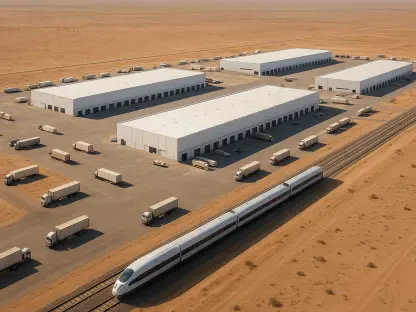
The walls are quite literally closing in as warehouse utilization has climbed by 6.5 points to nearly 70%, leaving very little room to breathe or move efficiently. When capacity drops to 47.5, it signifies a physical limit where facilities are bursting at the seams, forcing prices up to a reading of 73.8 overall. Large companies are feeling the most intense heat, with their specific warehouse price growth hitting a staggering 81.9 as they try to find a home for all that early-arrival inventory. Even though aggregate logistics costs actually dipped by 8.7 points to 242.1 in June, that number is deceptive because it follows the fastest expansion we’ve seen since early 2022. There is a heavy, physical weight to this data; you can see it in the overstuffed loading docks and the rising invoices that managers are having to approve just to ensure their summer and fall stock has a roof over its head.
What is your forecast for the transportation market over the next twelve months?
I anticipate a year of sustained “logistical fever,” where the market remains incredibly tight and the traditional seasonal lulls are nearly non-existent. The expert consensus of 42.4 for future capacity and 87 for pricing suggests that we are entering a long-term cycle of high costs and limited options for those who haven’t secured their supply chains. We will likely see utilization levels stay elevated at around 75.8, meaning carriers will maintain the upper hand and continue to be extremely picky about which shippers they partner with. My advice for our readers is to stop waiting for a market correction and instead focus on extreme efficiency in load planning; the winners in this environment will be those who can optimize every single cubic inch of their trailers and warehouses because the era of “cheap and easy” capacity is firmly behind us.