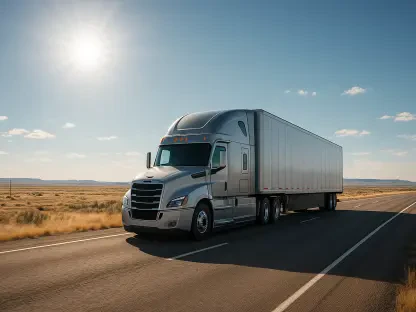

Rohit Laila is a seasoned veteran in the logistics and transportation sector, bringing over two decades of hands-on experience in supply chain management and delivery systems. Throughout his career, he has witnessed the industry transition from manual logbooks to sophisticated digital ecosystems, fuel-efficient engines, and data-driven route planning. Known for his keen interest in how innovation reshapes moving goods, Laila offers a balanced perspective on the shifting landscape of freight. In this discussion, he analyzes the latest road-freight statistics, exploring the nuances of rising productivity, the persistent challenge of empty running, and the distinct roles that different vehicle types play in keeping the economy moving.
The first quarter of 2026 showed a remarkable trend where GB-registered HGVs lifted 8% more goods, reaching 387 million tonnes, even though the total distance traveled remained almost identical to the previous year. What do you believe this says about the current state of operational efficiency in the hauling industry?
This jump is a clear indicator that the industry is squeezing more value out of every single mile driven on the road. When you see tonnage rise from 360 million to 387 million while the total mileage stays pinned at 4.5 billion kilometers, it tells me that logistics managers are finally cracking the code on vehicle utilization. We are seeing a move toward heavier, more consolidated loads and a more disciplined approach to dispatching. It’s not just about having more trucks on the road; it’s about ensuring that those 42 billion tonne-kilometres of work are done with maximum intensity. This kind of productivity surge is exactly what the sector needs to combat rising overhead costs and tighter margins.
We’ve seen a significant dip in empty running, falling from 33% to 28% in just one year, which saved roughly 200 million kilometers of wasted travel. How are companies managing to reduce these “ghost miles,” and why do trucks still end up traveling 1.3 billion kilometers without a load?
Reducing empty running is the “holy grail” of logistics, and seeing it drop to 28% is a massive win for both profitability and sustainability. This improvement suggests that digital load-matching platforms and better collaboration between shippers are finally maturing, allowing drivers to find backhauls instead of returning to base with an empty trailer. However, the 1.3 billion kilometers of empty travel that remain represent the physical limitations of our supply chains. Many HGVs carry specialized goods—like liquids, refrigerated items, or specific construction materials—that require specialized trailers which simply cannot be reloaded with generic freight for the return trip. There is a visceral frustration in seeing a high-tech vehicle burning fuel for nothing, but until we have more versatile equipment, a certain level of empty running is almost baked into the geography of trade.
According to the latest annual figures, articulated vehicles handle about 80% of all freight work, yet their average haul distance is significantly longer than that of rigid trucks. How does this division of labor between vehicle types impact the overall efficiency of the domestic transport network?
The distinction between these two classes of vehicles is fundamental to how we move everything from groceries to steel. Articulated vehicles are the undisputed workhorses of the long-haul network, accounting for 128.5 billion out of a total 161.5 billion tonne-kilometres and carrying about 63% of the total weight. Their average haul of 134 kilometers allows for the massive, efficient movement of goods between major distribution hubs, which is where the real economies of scale happen. Rigid HGVs, with their much shorter 58-kilometer average trips, act as the vital connective tissue for local deliveries and urban centers. Even as the overall average haul length edged down slightly from 106 kilometers in 2024 to 105 kilometers in 2025, the synergy between these two tiers remains the bedrock of a stable supply chain.
While the first quarter of 2026 was strong, the rolling year data shows a much more stagnant picture, with total mileage and freight moved actually slipping by 1%. Are we looking at a genuine recovery or just a temporary spike in a market that has been trending downward since 2021?
It is vital to look at that 1.559 billion tonnes moved over the full 12-month period to realize we aren’t out of the woods just yet. The slight 1% dip in both mileage—down to 18.975 billion kilometers—and tonne-kilometres suggests that the long-term trend is one of cooling or, at the very least, consolidation. We have to be careful not to mistake a single high-performing quarter for a total market reversal, especially since empty running actually increased to 31.1% over the course of 2025. What we might be seeing is a “survival of the fittest” scenario where the most efficient operators are thriving while the broader market remains in a state of flux. The next few quarters will be the real litmus test to see if the 8% growth we saw in early 2026 can be sustained or if the 5.7 billion kilometers of annual empty running will continue to drag on the industry.
What is your forecast for the HGV and logistics sector over the next few years?
I expect the industry to enter a period of “radical transparency” where data becomes the primary tool for survival. We will likely see the 28% empty running figure become the new ceiling rather than a one-time achievement, as companies integrate AI to optimize every square inch of trailer space. My forecast is that while total tonnage might remain stable around the 1.5 billion mark, the environmental and financial cost of moving that weight will drop significantly. We are heading toward a future where the 1.3 billion kilometers of empty travel are viewed not as an inevitability, but as a technical failure to be solved. Ultimately, the winners in this space will be the ones who can maintain that 8% productivity cushion without adding a single extra kilometer to their odometers.