
The logistics industry has long mastered the art of moving goods across oceans and continents, yet the final few dozen meters—the journey from a building’s lobby to a high-rise doorstep—remain the most expensive and complex bottleneck in the entire supply chain. This “last 30 meters” is where technology meets the messy reality of human infrastructure, and few people understand this friction better than Rohit Laila. With decades of experience navigating the intersection of global delivery systems and cutting-edge innovation, Laila has witnessed firsthand how the battle for efficiency has shifted from the open road to the apartment elevator. In this discussion, we explore the strategic evolution of delivery robotics through the lens of Watt’s international journey, examining how cultural nuances, architectural legacies, and complex labor structures dictate the success of automation in Korea, Japan, and the United States.
The concept of the “last 30 meters” suggests that the final stretch of delivery is often the most labor-intensive and difficult to automate. From your perspective, why has this specific micro-segment remained a human-centric bottleneck for so long, and what makes it the ultimate “battleground” for modern logistics startups?
The reason we call it a battleground is that the “last 30 meters” represents a chaotic environment that defies the logic of standardized logistics. While a truck can travel hundreds of miles on a predictable highway, a robot entering a building must navigate heavy glass doors, crowded elevators, and narrow hallways that vary from one floor to the next. For years, this remained a human-centric task because it requires high-level problem-solving—like knowing which elevator button is sticking or how to maneuver a heavy cart around a resident’s bicycle left in the hall. In high-rise environments, a delivery driver often spends more time waiting for an elevator than they do actually driving to the building, which is a massive drain on productivity. Startups like Watt recognized that until we automate this high-friction zone, the efficiency gains we’ve made in long-haul shipping are essentially being swallowed by the inefficiency of the apartment lobby. It is the final frontier because it requires a robot to behave less like a machine and more like a polite, agile tenant.
When Watt first attempted to scale their delivery robots in the Korean market, they encountered systemic barriers that had nothing to do with the technology itself. Could you elaborate on how the internal structure of courier contracts and the local delivery culture can make or break the implementation of robotic solutions?
In Korea, the challenge wasn’t that the robots couldn’t navigate the buildings; it was that the business ecosystem wasn’t ready to pay for them. The Korean courier market operates on a fragmented agency model where individual drivers are independent contractors responsible for their own routes. If you want to deploy a robot in a single apartment complex, you can’t just sign one deal with a corporate headquarters; you’d have to negotiate usage fees and workflows with multiple drivers from different companies who all service that same building. Furthermore, the Korean culture of contactless delivery—where leaving a package at the door is the gold standard—meant that the perceived “pain point” for the consumer was relatively low. Without a clear answer to who would shoulder the cost of the robot—the driver, the agency, or the resident—the technology sat idle despite being ready for immediate shipment in 2023. It’s a classic example of how a brilliant engineering solution can be paralyzed by a complex, multi-layered labor structure.
The transition to the Japanese market seemed to offer a completely different set of incentives for automation. What were the specific cultural and operational factors, such as face-to-face delivery requirements, that turned Japan into a more fertile ground for Watt’s expansion?
Japan presented a fascinating “problem-market fit” because their delivery culture is almost the polar opposite of Korea’s. In Japan, face-to-face delivery is the standard, accounting for a staggering 85% of all drop-offs, which means drivers spend an incredible amount of time coordinating schedules with residents. If a resident isn’t home, the driver has to return, often making multiple trips back and forth within the same high-rise building throughout a single day. When Watt entered the Tokyo metropolitan area, they found that Japanese logistics giants like Yamato Transport were desperate for a way to reduce these repetitive “vertical” trips. By using a robot to handle that final leg, a driver can drop off a massive load of packages at a central point and move on to their next destination, rather than trekking up and down elevators for hours. This cultural insistence on personal hand-offs created a massive time-sink that only a dedicated, on-site robotic system could realistically solve.
One of the most striking technical adaptations Watt made for the Japanese market was the use of a robotic arm rather than digital system integration. Why is this “human-like” approach to interacting with elevators and gates so significant for scaling in older urban environments?
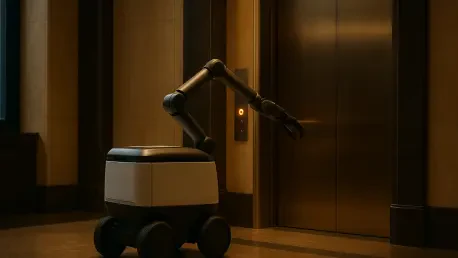
The decision to use a physical robotic arm to press elevator buttons is a masterstroke of pragmatic engineering, especially when dealing with “legacy” infrastructure. In a perfect world, every building would have a smart API that talks to a robot’s central server, but the reality in cities like Tokyo is that many luxury condominiums and older “mansions” were built long before such technology existed. Retrofitting these buildings with modern communication systems is prohibitively expensive and time-consuming for property managers. By giving the robot an arm to physically interact with the world—just as a human delivery person would—Watt eliminated the need for costly building renovations. This allows them to deploy “James mW” or “James W” into almost any environment immediately, bypassing the bureaucratic nightmare of upgrading a building’s electrical and security systems. It’s about making the robot fit the building, rather than demanding the building change for the robot.
The partnership with Yamato Transport evolved from free demonstrations to a strategic Series A investment in early 2026. What does this progression tell us about the level of rigor required for a startup to gain the trust of a major global logistics player?
The journey with Yamato shows that in the world of heavy logistics, there are no shortcuts to trust; you have to prove your worth in the trenches. It started in 2024 with a simple, free demonstration using just two robots at Yamato’s own headquarters to see if the hardware could even survive a day of work. By 2025, the relationship matured into a commercial purchase of six units for actual residential deployment, where the robots had to handle real-world variables like narrow Tokyo elevators and subterranean communication dead zones. Only after a full year of watching these machines successfully navigate the “last 30 meters” and seeing the data on driver time savings did Yamato Holdings decide to participate as a strategic investor in the Series A round during the first half of this year. This three-year timeline reflects the caution of an industry where a single failure can lead to a lost package or a frustrated customer, and it highlights how Watt’s 14-person team had to be incredibly agile to survive that vetting process.
As Watt prepares for its Connecticut deployment in December, what are the primary challenges they face in adapting their Japanese success to the American residential landscape, and how does the “W-station” fit into this new equation?
The move to the United States is the ultimate test of whether Watt’s model is truly universal or just a localized solution. American apartment complexes, like the 300-unit condo in Connecticut, often have different layouts—sprawling horizontal corridors compared to Tokyo’s vertical density—and the “W-station” will be critical here. The W-station acts as a robotic parcel locker, a centralized hub that receives the sudden influx of packages from various couriers so the drivers don’t have to wait or wander the halls. From there, the delivery robots take over, but the real challenge in the U.S. will be navigating the “who pays” question again, as the relationship between building owners, residents, and logistics companies is different than in Japan. Watt is essentially testing if the “W-station plus delivery robot” combo can create enough value for a U.S. property manager to justify the investment, perhaps by offering it as a premium amenity for residents who are tired of package theft or cluttered lobbies.
Managing a global expansion across three countries with only 14 employees is an extraordinary feat of lean operations. How does a small team balance the need for high-level software development with the physical demands of designing and assembling hardware in-house?
It is a high-wire act that requires every member of that 14-person team to be a multi-disciplinary expert. When you are doing everything in-house—from the code that governs autonomous navigation to the physical assembly of the robotic chassis—communication has to be instantaneous and ego-free. During the Japanese rollout, they realized the robots were losing server connection in underground areas, so the team had to simultaneously rework the communication hardware and the software’s “fail-safe” protocols on the fly. They don’t have the luxury of separate departments that take months to talk to each other; if a robot in Tokyo has trouble with a narrow elevator door, the engineers in the assembly shop are likely the same people looking at the telematics data. This “lean hardware” approach allows them to pivot their product line—like creating the face-to-face delivery model in just three months—far faster than a massive corporation ever could.
What is your forecast for the future of “last 30 meters” automation over the next few years?
I believe we are entering an era where the “last 30 meters” will no longer be seen as an isolated logistics problem, but as a core component of “Smart Building” identity. By the end of this decade, we will likely see a shift where the cost of these robots is integrated directly into building management fees, much like we pay for trash collection or elevator maintenance today. We currently see Watt operating in 21 buildings with over 4,100 units, but as the data from the 2026 Connecticut trial and the Japanese expansion matures, the ROI will become undeniable for large-scale developers. I expect the technology to move beyond just parcels; we will see these robots becoming multi-functional “building assistants” that handle everything from moving heavy resident luggage—as Watt started doing in Korea in 2024—to delivering hot meals and laundry. The “battle” will be won when we stop seeing the robot as a delivery tool and start seeing it as a permanent, indispensable part of the high-rise infrastructure.