
The sheer physical scale of modern distribution hubs has reached a point where manual maintenance is no longer a viable operational strategy for maintaining peak industrial hygiene. As global supply chains face a persistent squeeze on labor availability, the transition toward autonomous floorcare has shifted from a futuristic concept to a foundational requirement. This technology review examines the integration of robotic scrubbing systems within the logistics sector, specifically focusing on how these machines bridge the gap between heavy-duty cleaning and intelligent navigation. The current landscape is no longer about testing experimental prototypes but about the seamless orchestration of “co-bot” systems that work alongside human staff. By analyzing the structural components, software intelligence, and operational data from active deployments, a clearer picture emerges of how autonomous floorcare is redefining the standards of 5S compliance and facility management.
The Rise of Robotic Maintenance in Modern Logistics
The emergence of autonomous floorcare is a direct response to the “velocity versus volume” dilemma in modern warehousing. As facilities grow larger to accommodate burgeoning e-commerce demands, the surface area requiring daily sanitization has expanded beyond the capacity of manual labor teams. This review identifies the core of this technology as a hybrid system where traditional mechanical scrubbing power is governed by a decentralized artificial intelligence platform. Unlike previous iterations of automation that required fixed tracks or magnetic tape, modern systems utilize sophisticated spatial mapping to operate in dynamic, high-traffic environments.
The relevance of this shift is most visible in the changing role of the warehouse worker. The adoption of robotic maintenance signifies a move away from “dull, dirty, and dangerous” tasks, allowing human capital to be redirected toward complex logistical problem-solving. This “co-bot” evolution is not merely about replacing a person with a machine; it is about augmenting the efficiency of the entire facility. By ensuring that floorcare is handled consistently without human supervision, logistics providers can maintain safety protocols and aesthetic standards that are essential for both employee morale and client inspections.
Critical Components of Autonomous Cleaning Systems
Navigation Intelligence and BrainOS Integration
The “brain” of contemporary autonomous scrubbers is often a third-party artificial intelligence platform, such as BrainOS, which provides the necessary SLAM (Simultaneous Localization and Mapping) capabilities. This software allows the machine to perceive its environment through a multi-layered sensor array, including lidar, 3D cameras, and ultrasonic sensors. What makes this implementation unique is its ability to handle dynamic obstacles. In a warehouse, the environment changes by the minute; pallets are moved, forklifts cross paths, and employees walk through cleaning zones. The AI does not just follow a pre-set path but continuously recalculates its route to ensure safety without sacrificing coverage.
Performance metrics in obstacle avoidance have improved significantly between 2026 and the present. The current software versions allow for “path-sharing,” where multiple robots can coordinate their movements to avoid bottlenecking in narrow aisles. This level of intelligence is critical because it eliminates the need for constant human intervention to “reset” a stuck machine. The technology has reached a maturity level where it can distinguish between a stationary object, like a structural pillar, and a moving object, like a pedestrian, applying different safety buffers and braking responses to each.
Heavy-Duty Hardware and Scrubber Configurations
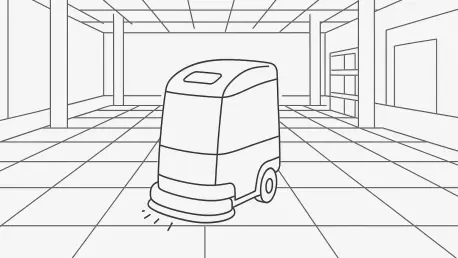
While the software provides the brains, the hardware determines the actual quality of the clean. Leading autonomous models utilize cylindrical brush configurations, which are vastly superior to traditional disk brushes in an industrial context. Cylindrical brushes rotate at high speeds and are capable of sweeping small debris—such as wood splinters from pallets or discarded plastic wrap—into a specialized hopper while simultaneously scrubbing the floor. This dual-action capability prevents the machine from clogging and ensures that the floor is truly clean in a single pass.
Furthermore, the physical design of these machines has been optimized for the massive footprints of 2026-era logistics hubs. Large-scale water tanks and high-capacity lithium-ion batteries are standard, allowing machines to operate for four to six hours on a single charge. This hardware durability is what separates industrial-grade autonomous scrubbers from smaller commercial bots. The ability to apply significant downward pressure on the brushes ensures that even stubborn tire marks from forklifts are removed, maintaining the high-gloss finish required in food-grade or high-tech storage environments.
Current Industry Trends and Shifts in Operational Strategy
The trajectory of robotic adoption is currently being shaped by the “blended automation” trend. Companies are no longer looking for a “black box” solution where the robot operates in total isolation. Instead, operational strategies now involve a collaborative workflow where the machine handles the long, monotonous aisles while human operators manage the complex corners and specialized spills. This shift has been accelerated by the rising cost of manual labor and the need for 24/7 facility operation.
Moreover, there is a growing trend toward data-driven maintenance. Modern autonomous systems are integrated into the warehouse’s broader digital ecosystem, providing real-time telemetry on cleaning performance. This transparency allows facility managers to verify that 100% of the floor was cleaned at the scheduled time, providing a “digital twin” of the maintenance schedule. This shift toward accountability and data integration is transforming floorcare from a hidden overhead cost into a measurable operational metric.
Real-World Applications: Case Study Analysis
Large-Scale Deployment at Nabuurs Supply Chain Solutions
A primary example of successful implementation is found at the Nabuurs Supply Chain Solutions facility in Oosterhout. Managing a 60,000-square-meter footprint requires a level of consistency that manual cleaning struggle to provide over long periods. By deploying heavy-duty autonomous scrubbers, the facility has achieved a “standardized clean” that adheres to strict 5S principles. The machine at this hub averages nearly 1,800 square meters of cleaning per day, which translates to over 50,000 square meters per month.
The Nabuurs deployment illustrates that the value of the technology lies in its utilization rate. By operating autonomously for 63% of its total working time, the machine has reduced the human labor requirement for floorcare by more than two-thirds. This efficiency is not just a result of the machine’s speed but of its reliability. The facility was able to transition from a model where cleaning was a reactive, labor-intensive chore to one where it is a proactive, automated background process.
Sector-Specific Implementations in Global Warehousing
Beyond general logistics, specialized sectors are finding unique value in autonomous floorcare. In food and beverage distribution, where hygiene is a regulatory requirement, the ability of autonomous scrubbers to provide a verifiable log of every square meter cleaned is invaluable for audits. In the pharmaceutical sector, the reduction of human presence in sensitive storage areas helps maintain climate and contamination controls.
These implementations often require the machine to handle specific debris or flooring types. For instance, high-tech electronics warehouses often utilize ESD (Electrostatic Discharge) flooring, which requires specific cleaning solutions and gentle but effective brush pressure. The versatility of modern autonomous hardware allows for these sector-specific adjustments, proving that a single technological platform can be adapted to a wide variety of industrial needs without extensive hardware modification.
Navigating Adoption Challenges and Limitations
Despite the clear benefits, the path to full autonomy is not without hurdles. The high initial capital expenditure remains a significant barrier for smaller third-party logistics providers. While the return on investment is clear in large-scale operations, the “break-even” point for facilities under 10,000 square meters can be harder to justify. Additionally, the setup process is not truly “plug-and-play.” Successful deployment requires a dedicated period of route optimization and staff training to ensure the robot is integrated into the daily flow of the warehouse.
Technically, managing extremely dynamic environments remains a challenge. While AI can navigate around a pallet, a sudden influx of high-speed forklift traffic can still lead to “navigation fatigue,” where the robot stops frequently to ensure safety, thereby reducing its overall efficiency. Current development efforts are focused on improving sensor fusion and predictive modeling to allow the machines to “anticipate” traffic patterns rather than just reacting to them. Simplified user interfaces are also being developed to allow non-technical staff to re-program routes on the fly.
Future Outlook: The Evolution of Industrial Automation
Looking ahead, the focus of industrial floorcare will likely shift toward “lights-out” maintenance and deeper fleet management. Between 2026 and 2030, expect to see the rise of multi-robot fleets that coordinate through a centralized cloud dashboard. These systems will not only clean floors but will also act as mobile sensor platforms, scanning pallet racks for inventory discrepancies or identifying safety hazards like floor cracks or fluid leaks. This multi-purpose functionality will further increase the value proposition of autonomous mobile robots.
Sustainability will also play a major role in future developments. Autonomous machines are already more efficient in their use of water and chemicals than manual operators, who often over-apply cleaning agents. Future iterations will likely feature advanced filtration systems that allow the machine to recycle its own water, enabling it to run for even longer periods without human intervention. This evolution will align warehouse maintenance with broader corporate environmental, social, and governance goals.
Final Assessment of Autonomous Floorcare Technology
The transition to autonomous floorcare proved to be a decisive turning point for the logistics industry. The technology moved beyond the realm of experimental gadgetry and established itself as a necessary financial and operational investment. Managers found that the consistent, data-backed results of robotic scrubbing far outweighed the initial complexities of deployment. The ability to maintain high-level hygiene standards while simultaneously insulating the facility from labor market volatility provided a significant competitive advantage.
In summary, the successful integration of autonomous floorcare required a strategic blend of robust hardware and intelligent software. The industry observed that the most effective deployments were those that treated the robot as a specialized tool within a broader human-led maintenance strategy. As these systems continue to evolve, the focus will remain on increasing autonomy and expanding the robot’s role from a simple cleaner to an integrated warehouse data hub. For any large-scale logistics operation, the move toward autonomous floorcare became not just an option, but a requirement for long-term sustainability.