
Strategic investment from Zalando in Sereact’s Series B funding round underscores a commitment to integrating advanced AI into global supply chains. This financial move coincides with a massive operational shift at major logistics hubs in Greven, Germany, and Świebodzin, Poland, where CEVA Logistics is currently deploying high-precision robotic systems to tackle the notoriously difficult task of fashion returns. For years, the unpredictability of returned apparel—items stuffed haphazardly into bags or tangled with loose tags—forced companies to rely almost exclusively on manual labor. However, the introduction of automated handling systems marks a turning point in how e-commerce giants manage the reverse logistics lifecycle. By merging Sereact’s Physical AI capabilities with CEVA’s deep operational footprint, the industry is seeing a transition from experimental automation to wide-scale, reliable deployment. This initiative effectively bridges the gap between digital intelligence and physical execution within the modern warehouse environment.
The Cortex Platform: Redefining Robotic Intelligence
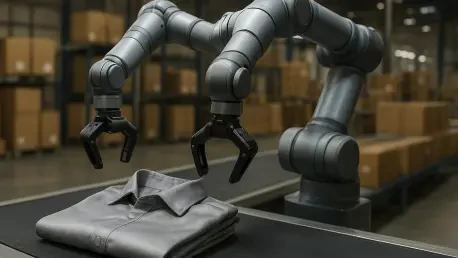
Central to this technological leap is the Cortex platform, a sophisticated Physical AI engine that powers dual-arm robotic systems. Unlike traditional industrial robots that depend on rigid, pre-defined programming to execute repetitive movements, these units utilize generative models to perceive and react to their environment in real time. This allows the robots to identify diverse items, such as a silk blouse or a pair of denim jeans, and determine the optimal way to grasp and sort them without damaging the delicate materials. The robots do not require specific training for every new SKU introduced to the inventory, which is a critical advantage in the fast-moving fashion sector where styles change seasonally. By processing visual data through neural networks, the system can autonomously handle objects it has never encountered before. This dynamic adaptability ensures that the throughput remains consistent even when the variety and condition of the incoming returns fluctuate significantly during peak periods.
Operational Scalability: The Rise of Robotics-as-a-Service
The implementation strategy follows a Robotics-as-a-Service (RaaS) model, which represents a shift in how capital-intensive technology is integrated into the supply chain. Instead of massive upfront expenditures on proprietary hardware that might become obsolete, companies like CEVA Logistics can scale their robotic fleet based on current demand. This flexibility is particularly useful for managing the seasonal spikes associated with holiday sales and major promotional events. The RaaS approach allows for a faster rollout across multiple European locations, ensuring that technological parity is maintained throughout the logistics network. By lowering the barrier to entry for advanced automation, this model encourages widespread adoption of AI-driven solutions. Moreover, the standardized nature of the Cortex platform ensures that software updates can be pushed simultaneously to all units, enhancing the capabilities of the entire fleet overnight. This creates a cohesive ecosystem where technological improvements in Germany benefit operations in Poland.
Strategic Directions: Future-Proofing Global Fulfillment
The successful integration of AI-powered robotics across European fulfillment centers demonstrated that modular Physical AI could adapt to changing product lines without extensive downtime. This collaboration between Zalando and Sereact established a clear blueprint for how e-commerce leaders utilized software-defined hardware to maintain a competitive edge. Industry leaders recognized that establishing cross-industry partnerships helped solve specific operational bottlenecks, particularly within the complex realm of reverse logistics. As the project progressed, the focus shifted toward full-cycle automation where returns were processed and restocked with minimal human intervention. Organizations that transitioned to these scalable robotic models managed to mitigate the rising costs and labor shortages that hindered traditional manual sorting methods. Stakeholders who evaluated their infrastructure and phased in RaaS models secured more resilient operations. This shift fundamentally altered the landscape of global fulfillment by prioritizing high-tech solutions.