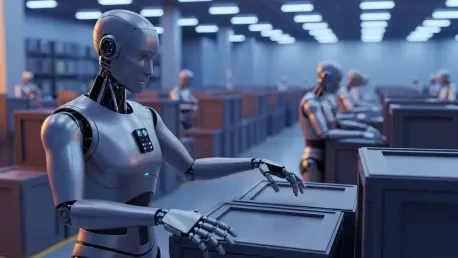

Rohit Laila brings a wealth of knowledge from decades spent at the intersection of logistics and cutting-edge supply chain technology. He has watched the industry evolve from simple automation to the complex, AI-driven landscape we see today, making him a primary voice on how robotics is shifting from a futuristic dream to a floor-ready reality. In this conversation, we explore the remarkable rise of Humanoid, a UK-based startup that recently secured a $152 million Series A funding round, catapulting its valuation to an impressive $1.35 billion in just two years. We delve into the significance of this European “unicorn” status, the strategic partnerships with industrial heavyweights like Bosch and Schaeffler, and the upcoming technological milestones—such as the KinetIQ AI brain and the 2026 Beta rollout—that are poised to fundamentally redefine global industrial productivity.
How significant is it for a company like Humanoid to reach a $1.35 billion valuation in such a short window, and what does this say about the current appetite for physical AI?
Reaching a $1.35 billion valuation in just two years is a staggering achievement that highlights a massive shift in how investors view the future of labor. The infusion of $152 million in this latest Series A round, bringing their total capital to $270 million, shows that the market is no longer just “curious” about robotics—it is betting the house on it. You can feel the intense pressure and excitement in the boardroom when a company manages to compress a decade’s worth of development into such a short timeframe. This isn’t just about flashy tech; it’s about the realization that physical AI is the missing link in the global supply chain. For those of us who have spent years in logistics, seeing this level of financial backing from groups like Prime Movers Lab and Aglaé Ventures signals that the transition from experimental prototypes to essential industrial tools is happening much faster than anyone predicted.
With the robotics race traditionally dominated by the United States and China, how does Humanoid’s success change the narrative for the European and UK technology ecosystems?
For years, there has been a lingering sense that Europe and the UK were falling behind in the global AI arms race, but this moment feels like a genuine turning point. Humanoid is positioning the region as a primary leader by becoming Europe’s first pure-play humanoid robotics unicorn, proving that the talent and infrastructure here are world-class. It’s incredibly refreshing to see a British-based company at the cutting edge, backed by a sophisticated mix of financial and industrial giants like Bosch and Fubon Financial Holding. This investment demonstrates that we can scale globally competitive companies that don’t just mimic what’s happening in Silicon Valley or Shenzhen, but actually set the standard. The presence of these robots in the European tech ecosystem adds a layer of industrial grit and manufacturing excellence that is unique to this region’s history.
What are the practical implications of Humanoid’s massive commercial agreement with Schaeffler for the broader manufacturing and logistics sectors?
The partnership with Schaeffler is perhaps the most grounded and exciting part of this entire story because it moves us past the “hype” phase and into large-scale deployment. This is the industry’s largest publicly announced commercial agreement, involving the roll-out of thousands of humanoid robots directly into manufacturing environments. When you see a motion technology leader like Schaeffler committing to this level of scale, you understand that these machines are being built to handle the heavy, repetitive, and precise work of a real factory floor. It sends a ripple through the logistics sector, suggesting that the “visionary concepts” we’ve talked about for years are finally becoming an industrial reality. Seeing names like SAP, NVIDIA, and Siemens in the mix further confirms that the software and hardware infrastructure is being built to support a total transformation of how goods are made and moved.
Looking at the company’s roadmap, specifically the KinetIQ AI brain and the wheel-based platforms, how do you see these technical milestones impacting the workplace by 2026?
The roadmap is quite tactical, focusing on the proprietary KinetIQ AI brain which will serve as the central intelligence for a truly general-purpose industrial robot. By targeting the fourth quarter of 2026 for the rollout of Beta version robots, the company is giving the industry a very clear and ambitious deadline to prepare for change. The decision to mass-manufacture wheel-based humanoid robots is a very practical move; it recognizes that in environments like retail and logistics, speed and stability across flat surfaces are often more valuable than mimicking human walking perfectly. This blend of high-level AI development and functional mechanical design is exactly what is needed to move these robots into customer facilities across manufacturing and retail. It’s a sensory experience to imagine a warehouse where these machines, powered by KinetIQ, are seamlessly navigating around human workers to solve complex tasks.
What is your forecast for the role of humanoid robotics in the global industrial landscape over the next decade?
I believe that over the next ten years, humanoid robotics will emerge as one of the defining technologies that fundamentally reshapes the concept of commercial work. We are going to see a rapid consolidation in the industry where a small cadre of leaders from the US, Europe, and China define the standards for how physical AI interacts with our world. By the time we move past the 2026 Beta phase, these robots will no longer be seen as “breakthroughs” but as common, everyday tools that are as essential as the conveyor belt or the forklift. The leap in productivity will be monumental, as companies use these platforms to bridge the gap between digital intelligence and physical labor in ways we are only beginning to grasp. Ultimately, the successful integration of these robots will turn the “physical” part of AI into a seamless, quiet, and highly efficient backbone of global trade.