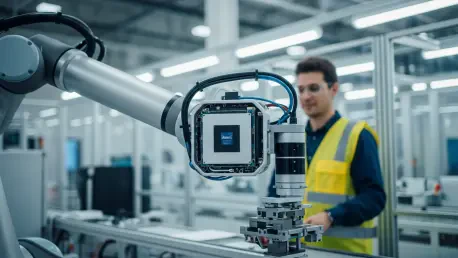

The industrial landscape is currently witnessing a tectonic shift as autonomous systems transition from isolated cages to shared workspaces where humans and machines must coexist without compromise. At the Automate 2026 conference in Chicago, NVIDIA unveiled NVIDIA Halos for Robotics, a comprehensive framework specifically engineered to bridge the persistent gap between high-performance artificial intelligence and rigorous industrial safety standards. This system represents the first full-stack solution tailored for “Physical AI,” a domain where the digital intelligence of a machine must account for the unpredictable nature of physical environments. By unifying specialized hardware, sophisticated software, and rigorous validation protocols, the initiative aims to set a global benchmark for how robots interact with their surroundings in factories, warehouses, and logistics centers. This launch marks a critical turning point for the robotics industry, transforming what were once experimental prototypes into reliable, safe, and deployable industrial assets.
Integrating Functional Safety: Hardware and Software Layers
The technical core of this framework is built upon the NVIDIA IGX Thor compute platform, which provides the immense processing power required for AI while maintaining the deterministic performance needed for safety-critical tasks. This hardware foundation is designed to handle massive influxes of data from multiple sensors simultaneously, ensuring that a robot can perceive its environment with extreme low latency. A vital component of this setup is the Holoscan Sensor Bridge, which facilitates real-time connectivity between various industrial sensors and the AI compute core. This allows the system to process high-bandwidth data, such as LiDAR and 3D vision, in milliseconds, enabling the robot to react to sudden human movements or unexpected obstacles with precision. By centralizing these functions on an industrial-grade platform, developers can bypass the complexities of integrating disparate components, focusing instead on the higher-level logic required for complex autonomous operations.
Complementing the hardware is Halos OS, a specialized operating system that manages internal safety functions while introducing a revolutionary “outside-in” safety blueprint for facility-wide monitoring. Unlike traditional robots that rely solely on onboard sensors, this blueprint integrates external environmental data from facility cameras and infrastructure sensors to provide a comprehensive view of the workspace. This holistic perspective allows the robot to adjust its behavior based on environmental changes that its internal sensors might otherwise miss, such as a worker approaching from a blind spot or a spill on the factory floor. The operating system acts as a central nervous system for safety, coordinating between the robot’s local perceptions and the broader facility’s awareness. This layered approach ensures that safety is not just a reactive measure but a proactive strategy integrated into every movement the robot makes, significantly reducing the likelihood of accidents in dense or high-traffic industrial environments.
Navigating Regulatory Barriers: Standardized Validation Protocols
Addressing the complex web of regulatory hurdles is a primary objective of the new Halos AI Systems Inspection Lab, which functions as the world’s first accredited program for physical AI functional safety. This facility provides a structured environment where developers can rigorously test their autonomous systems against established international standards, such as ISO 13849. By offering a clear path to validation, the lab helps companies navigate the often-opaque process of proving that an AI-driven machine is safe for deployment alongside human workers. The framework provides standardized testing protocols that cover a wide range of scenarios, from simple object avoidance to complex collaborative tasks. This centralized approach to validation ensures that safety is treated as a verifiable metric rather than a subjective goal. Consequently, manufacturers can move through the development cycle with greater confidence, knowing that their systems are built on a foundation that meets the highest global safety requirements.
The significance of this inspection lab extends beyond internal testing, as it serves as a critical bridge to achieving third-party certification from globally respected bodies like TÜV Rheinland and UL Solutions. By aligning the Halos framework with the specific requirements of these organizations, NVIDIA is effectively removing one of the most significant bottlenecks in the robotics industry. Historically, the process of obtaining safety certifications for autonomous systems was a fragmented and time-consuming endeavor that often delayed product launches by several years. Now, with a standardized blueprint and an accredited lab, developers can streamline the path to market, ensuring that their innovations reach the factory floor faster without compromising on security. This synergy between technology providers and certification authorities creates a more predictable landscape for investors and enterprise users alike, fostering a culture of responsible automation where safety is a non-negotiable prerequisite for any commercial deployment.
Driving Industrial Scalability: Humanoid Collaboration and Ecosystems
The transition of humanoid robots from laboratory curiosities to functional members of the workforce is gaining momentum through the integration of the Halos safety core into platforms like Agility Robotics’ Digit. By incorporating this standardized safety architecture, humanoid robots are becoming increasingly capable of operating safely in dynamic and unpredictable settings, such as those found in Amazon logistics hubs or Toyota manufacturing facilities. These robots are designed to handle tasks that require human-like dexterity and mobility, such as moving bins or navigating narrow aisles, and the addition of Halos ensures they can do so without posing a risk to their human counterparts. This evolution signifies a shift in the robotics industry toward machines that can truly collaborate with people in the same physical space. As these humanoid platforms become more reliable and safety-compliant, they provide a scalable solution to labor shortages and repetitive strain issues in the modern industrial sector.
The successful launch of the Halos framework established a new paradigm where the rigorous safety standards of the autonomous vehicle sector were successfully translated to the industrial landscape. This transition ensured that the same high-level precautions applied to self-driving cars became the baseline for every machine operating in a human-centric workplace. Looking forward, forward-thinking organizations recognized that adopting a standardized safety architecture was the most effective way to future-proof their automation investments against evolving global regulations. Companies prioritized the integration of these Physical AI systems into holistic digital twins, which allowed for virtual safety validation before a single robot ever arrived on the factory floor. By committing to this unified approach, the industry moved toward a future where intelligent machines served as reliable coworkers rather than just tools. This shift required a focus on continuous monitoring and iterative safety updates to maintain long-term operational integrity and trust.