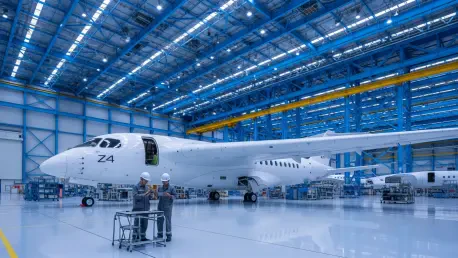

The aerospace landscape is currently witnessing a historic shift as JetZero breaks ground on its massive manufacturing campus in Greensboro, North Carolina. This ambitious project represents more than just a new factory; it is a $4.7 billion investment in the future of flight, promising to revitalize the region’s industrial core while introducing a radical new aircraft design to the world. With decades of experience navigating the complexities of supply chains and delivery systems, Rohit Laila offers a unique perspective on how this 8 million-square-foot facility will redefine manufacturing. Our conversation explores the logistical gravity of creating 14,500 new jobs, the technological leap of the blended-wing Z4 aircraft, and the cutting-edge digital twins that are bringing this “Smart Factory” to life.
Building a facility that spans 8 million square feet requires a staggering capital investment and a massive influx of talent. How do you view the logistics and economic gravity of JetZero’s $4.7 billion commitment to Greensboro?
This is an monumental undertaking that effectively anchors North Carolina as the next great global aerospace hub. When you look at the sheer scale—8 million square feet sitting on over 600 acres—you realize this isn’t just a factory; it is a self-contained industrial ecosystem. Integrating 14,500 new employees into the Triad region over the next decade will require a masterful orchestration of local resources, from universities to community colleges. You can almost feel the kinetic energy in the air as this project transforms the local landscape, backed by the largest incentive package the state has ever awarded to a startup. It is a bold vote of confidence that proves the “First in Flight” state is ready to lead the “future of flight” through high-stakes manufacturing and long-term economic stability.
The Z4 aircraft aims to disrupt the status quo with its all-wing design and a 50% increase in fuel efficiency. From a supply chain and operational perspective, what makes this specific aircraft such a game-changer for the commercial industry?
The Z4 is a masterclass in balancing radical innovation with practical utility, designed to carry 250 passengers across routes of up to 5,000 nautical miles. The most impressive feat is that while it promises to be up to 50% more fuel efficient than conventional designs, it is engineered to fit within existing airport infrastructure. From a logistics standpoint, that compatibility is everything; it means airlines can adopt this technology without the headache of demanding major terminal retrofits. You can imagine the relief of fleet managers seeing a design that slashes fuel costs—the largest variable expense in aviation—while maintaining the same operational footprint they are used to. It captures the essence of what the industry needs right now: a way to fly further and cleaner without tearing up the current playbook.
Beyond commercial flight, JetZero is looking toward military variants for refueling and transport. What potential do you see in a platform that claims to double the range or payload of current tankers?
The military applications for this all-wing design are nothing short of transformative for global logistics and defense readiness. By offering either twice the range or twice the payload compared to our current refueling aircraft, JetZero is essentially rewriting the rules of aerial endurance. In a world where rapid deployment is critical, having a tanker that can stay on station longer or carry double the fuel for other jets changes the entire strategic map. You can sense the strategic advantage this gives commanders, allowing for more flexible mission profiles and reduced fuel-chain vulnerability. It turns the aircraft into a powerhouse of efficiency, ensuring that whether it’s cargo or fuel, the “last mile” of military delivery is more robust than ever before.
Leveraging digital twins and AI through partnerships with Siemens and Deloitte suggests a factory that is as advanced as the planes it builds. How does this digital-first approach reshape our understanding of aerospace manufacturing?
We are moving away from the era of “guess and check” toward a period of absolute digital certainty. By creating a digital twin of the entire 8-million-square-foot facility before construction even finishes, engineers can virtually walk the floor to test equipment placement and material movement. This collaboration with Siemens and Deloitte allows JetZero to optimize every workflow and automate the shop floor in a way that minimizes waste and maximizes safety. You can practically see the data streams flowing between the design phase and the physical workforce, creating a seamless loop that speeds up production and ensures world-class quality. It is about reindustrializing America with a “smart” backbone, where AI-based tools take the risk out of scaling a project of this massive magnitude.
What is your forecast for the blended-wing aircraft market?
I believe we are standing at the threshold of a total design revolution where the blended-wing body becomes the gold standard for mid-to-long-haul transport. Within the next twenty years, the pressure to reach net-zero emissions will make the 50% efficiency gains of the Z4’s all-wing design an absolute necessity rather than a luxury. We will likely see a shift where traditional tube-and-wing shapes are reserved for short, regional hops, while the heavy lifting of global commerce and military logistics is handled by these high-efficiency wings. As JetZero proves the viability of this platform in North Carolina, other manufacturers will have no choice but to follow suit, leading to a sky filled with more aerodynamic, quieter, and significantly greener silhouettes.