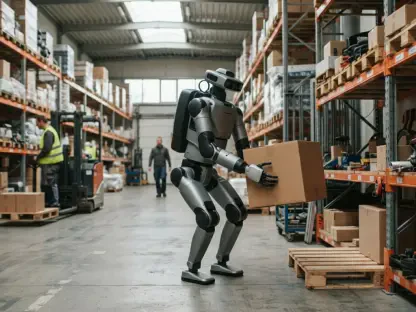

The realization that modern automated warehouses lose billions in productivity due to network congestion has sparked a radical redesign of how machine swarms communicate and move. For years, the industry struggled with the limitations of centralized control systems that required every robot to talk to a central brain every few milliseconds. Virtual Geometry Shadowing (VGS) represents a paradigm shift away from this “chatty” dependency. By treating a fleet of robots as a single, virtual geometric shape that follows a predefined path through time and space, this technology allows for a level of coordination that is both remarkably stable and computationally light. It essentially creates a digital blueprint for movement that each robot follows independently, ensuring that the collective formation remains intact even when wireless signals are blocked by heavy machinery or structural interference.
Evolution of Virtual Geometry Shadowing Technology
The transition toward autonomous transport has historically been hindered by the communication bottleneck, where robot swarms saturate wireless networks with redundant positional updates. Traditional frameworks, such as the leader-follower model, created a fragile dependency where a single point of signal failure could jeopardize a million-dollar payload. VGS emerged as a response to this fragility, drawing inspiration from virtual structure methods but adding a layer of decentralized autonomy that was previously unachievable. It moved beyond the need for a “master” robot, instead giving every unit a shared understanding of the mission goals before the first motor even turned.
This evolution signifies a broader move in the industry from reactive robotics to anticipatory coordination. In earlier years, robots were programmed to react to the movements of their neighbors, which often led to a “slingshot” effect where small errors amplified down the line. VGS solved this by establishing a virtual rigid body framework that exists in the software of every participating unit. As a result, the fleet operates as a cohesive, prescripted choreography, allowing for higher speeds and tighter formations in the cramped environments of modern smart factories.
Decoupled Time-Space Trajectory Mapping
The primary technical pillar of this shadowing framework is its ability to decouple individual movement from the need for constant external commands. By providing each robot with a comprehensive time-space trajectory before the task begins, the system ensures that every unit knows its expected coordinate at any given millisecond. This four-dimensional contract allows the robots to follow their assigned paths as if they were shadows of a virtual geometric shape, maintaining formation through internal clock synchronization rather than external polling. This implementation is unique because it transforms the robots from followers into independent executors of a shared vision.
This decoupling is especially significant during the transit of heavy or oversized loads that require multiple attachment points. In a standard setup, if one robot slows down, the others must be told to slow down immediately to prevent the load from twisting. In the shadowing model, the trajectory mapping includes precise timing for every segment of the journey, meaning that as long as each robot sticks to its internal schedule, the formation remains perfect. The significance of this feature lies in its resilience; if a robot loses connection for ten seconds, it can continue its path with total confidence, knowing exactly where its partners are supposed to be.
Event-Triggered Communication Protocols
Communication in the VGS framework is treated as a scarce resource rather than a continuous stream, utilizing an event-triggered protocol that fundamentally changes how fleet data is prioritized. Instead of broadcasting status updates at fixed intervals, robots only transmit data when a specific deviation threshold, known as Epsilon Max, is breached. This threshold represents the maximum allowable distance between a robot’s actual physical position and its virtual “shadow” coordinate. As long as the robot stays within this margin, it remains silent, keeping the wireless spectrum clear for other critical factory operations.
This approach interprets silence as a signal of success, allowing the network to remain uncluttered unless an intervention is truly required. When a dynamic obstacle, such as a human worker or a forklift, enters the fleet’s path, the robot that detects the intrusion triggers a collective replanning event. This is the only time the robots engage in high-bandwidth exchange, rapidly calculating a new virtual trajectory to avoid the collision. This selective communication style has been shown to reduce network traffic by over 95 percent compared to older centralized systems, making it the only viable option for facilities operating hundreds of robots simultaneously.
Emerging Trends in Robotic Coordination
The current landscape in 2026 shows a decisive shift toward predictive resilience, where robot formations are expected to maintain integrity without constant human oversight or high-speed cloud dependencies. Industry behavior is moving away from purely reactive obstacle avoidance toward anticipatory swarming, where local intelligence allows robots to negotiate spatial conflicts among themselves without bothering a central server. This trend is driven by the increasing complexity of warehouse floors, which have become too dynamic for the slow response times of traditional centralized architectures.
Moreover, the integration of advanced edge computing into these shadowing frameworks allows for localized micro-replanning. This means that if a single robot in a six-unit formation encounters a minor obstacle, it can adjust its local path slightly while staying within its Epsilon Max boundary, thereby avoiding the need to stop the entire formation. This trend toward “soft” formations—those that can bend and flex without breaking their underlying geometric logic—represents the next frontier in multi-robot transport, providing a level of fluidity that was once thought impossible for rigid transport tasks.
Real-World Applications in Industrial Automation
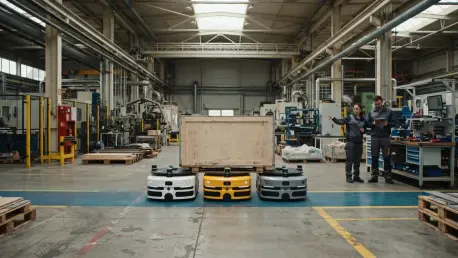
In the high-stakes environment of smart manufacturing, VGS has found a critical niche in the transport of oversized and fragile components, such as aerospace wing sections or large-scale semiconductor equipment. Because these items require a rigid yet delicate touch, the ability of multiple robots to act as a single cohesive unit without communication lag is transformative. In the automotive sector, this technology allows for the movement of entire vehicle chassis between assembly stations without the need for fixed conveyor belts, giving factory managers the flexibility to redesign their floor layouts in minutes rather than weeks.
Beyond the factory floor, the technology is being deployed in medical logistics within large hospital complexes. In these settings, robots must navigate through hallways crowded with unpredictable human traffic, making traditional “fixed-path” robotics dangerous and inefficient. The low communication footprint of VGS ensures that the hospital’s critical medical networks, which handle everything from patient monitoring to surgical data, are never compromised by robot traffic. These use cases highlight that VGS is not just about moving boxes; it is about providing a safe and silent infrastructure for high-density autonomous activity.
Technical Hurdles and Operational Constraints
Despite these clear advantages, the implementation of VGS faces significant hurdles when dealing with high-entropy environments where the initial preplanned trajectory becomes obsolete rapidly. The “cold start” problem remains a concern, as every robot must be flawlessly synchronized and loaded with the same global map before the operation commences. If there is a discrepancy in the initial data upload, the robots may believe they are in formation while they are actually drifting apart, a situation that can only be corrected by triggering a high-bandwidth emergency synchronization.
Furthermore, sensor noise in outdoor or heavy industrial environments can trigger false Epsilon Max alerts. Dust, steam, or electromagnetic interference can make a robot’s onboard sensors believe it has drifted off-course, causing it to send unnecessary “realignment” messages. This can lead to a phenomenon known as a “broadcast storm,” where multiple robots attempt to resync simultaneously, briefly clogging the network. Ongoing development efforts are focusing on more robust filtering algorithms that can distinguish between actual physical drift and temporary sensor glitches, ensuring that the system remains as silent as possible.
Future Outlook for Multi-Robot Systems
Looking ahead from 2026 to 2030, the integration of VGS with generative spatial models is expected to allow robot swarms to maintain formation even when sensor data is partially lost. We are likely to see the expansion of this technology into extreme environments, such as orbital satellite assembly or deep-sea infrastructure repair, where communication latency is measured in seconds rather than milliseconds. In these domains, the ability to operate as a shadow of a virtual plan is the only viable method for complex coordination, as real-time remote control is physically impossible due to the speed of light.
As machine learning continues to mature, we will see the emergence of “self-healing” trajectories. Instead of relying on a human-defined map, future VGS systems will likely observe their environment and negotiate their own virtual geometries on the fly. This will allow robot fleets to enter completely unmapped territories, such as disaster zones or new construction sites, and immediately establish a cooperative transport network. This evolution will likely drive a new standard where the physical movement of a robot swarm is simply the final expression of a sophisticated, shared digital consciousness.
Final Assessment of Shadowing Capabilities
The review of virtual geometry shadowing demonstrated that the technology successfully resolved the long-standing conflict between formation precision and network efficiency. It was observed that the decoupling of time and space mapping provided a robust defense against signal loss, effectively shielding the operation from the unpredictability of wireless environments. The implementation of event-triggered protocols proved that silence was indeed a form of intelligence, allowing for a 95 percent reduction in data congestion while maintaining superior accuracy. This evidence suggested that the technology was no longer just an experimental curiosity but a fundamental requirement for large-scale automation.
Ultimately, the shift to VGS-based systems marked the end of the era of “tethered” robots that were slaves to a central controller. The assessment indicated that companies adopting this framework realized significant gains in both operational speed and safety, particularly when handling expensive or fragile payloads. As the industry moved toward 2027 and beyond, the next logical step involved the standardization of these virtual geometries across different robot manufacturers to allow for cross-brand cooperation. This review concluded that the framework provided a scalable, resilient, and highly efficient blueprint for the future of cooperative robotic transport.