
The era of speculative technological experimentation has officially surrendered to a rugged landscape where every silicon-based investment must justify its existence through immediate, measurable returns on the balance sheet. The state of logistics in 2027 reflects a fundamental pivot from the rapid, often disorganized adoption of tools seen in the middle of the decade toward a rigorous demand for accountability and tangible operational impact. Corporate boardrooms have replaced general enthusiasm for innovation with a disciplined scrutiny that requires technology vendors and internal logistics teams to prove how their systems mitigate risk and reduce overhead in real time.
Global trade is currently shaped by persistent geopolitical instability, tightening corporate budgets, and a decisive shift toward localized, resilient supply chain networks. The realization that globalized routes are increasingly fragile has led many organizations to prioritize proximity over the lowest possible transport cost, resulting in a more regionalized trade map. This evolution has transformed logistics from a background service into a primary strategic pillar for companies seeking to insulate themselves from international volatility and shifting political climates in Europe and North America.
Technological influences are maturing rapidly, characterized by the deployment of proactive AI agents and the successful integration of previously fragmented datasets across transport and warehousing. These agents are no longer just tools for passive observation; they have become active participants in the supply chain, identifying potential delays and suggesting strategic network optimizations before disruptions manifest. Consequently, regulatory bodies are increasing their focus on carbon emissions enforcement, digital identity verification, and cross-border trade transparency to ensure that this digital growth remains compliant with environmental and security standards.
Emerging Trends and Market Growth Projections
Digital Transformation and the End of Experimental Spending
Organizations are transitioning from a philosophy of acceleration for its own sake to a strategic focus on proven operational efficiency and return on investment. This shift has given rise to the concept of governed autonomy, where AI agents operate within secure, predefined frameworks to identify inefficiencies and mitigate risks without constant human intervention. By allowing technology to handle routine execution tasks, human teams are finally being empowered to focus on higher-level strategic planning and complex problem-solving that requires nuanced judgment.
The digital divide is closing as smaller players leverage their leaner organizational hierarchies to implement advanced digital tools faster than many legacy-burdened enterprises. These mid-sized firms are discovering that they can compete with global giants by specializing in tech-enabled, agile services that provide higher levels of transparency and reliability. This democratization of technology has removed the advantage of pure scale, making digital efficiency the primary differentiator for success in a market where agility is now more valuable than traditional infrastructure alone.
Market Indicators and Long-Term Performance Forecasts
Market data from 2026 to 2028 suggest a surge in consolidation as larger firms aggressively acquire tech-savvy small and medium enterprises to modernize their internal processes. These acquisitions are driven by a need to ingest sophisticated data architectures and proprietary algorithms that can streamline transport execution and freight auditing. This wave of mergers is creating a new class of logistics providers that possess the physical assets of a traditional carrier but operate with the technical precision of a software company.
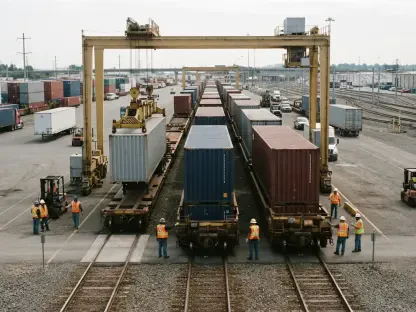
Growth projections for intermodal transport remain steady but are increasingly constrained by long-term infrastructure bottlenecks in rail and inland waterways. While there is a strong desire to shift freight away from carbon-intensive road routes, the physical capacity of rail networks has not kept pace with digital improvements. As a result, investment is shifting toward use-case-specific data management rather than broad, disorganized attempts at enterprise-wide data cleaning. Companies have learned that high-quality, targeted datasets provide a far better return on investment than vast, unstructured data lakes.
Overcoming Operational and Geopolitical Obstacles
Persistent regional conflicts and shifting political climates have created a state of perpetual readiness for supply chain disruption, particularly along major trade lanes connecting Europe and North America. Capacity bottlenecks in rail infrastructure continue to hinder the displacement of freight from climate-sensitive routes like the Rhine, which has seen fluctuating water levels impact barge capacity. These physical constraints necessitate a more creative approach to routing, forcing logistics managers to utilize every available data point to maximize the efficiency of existing infrastructure.
Labor shortages, particularly in the driver pool, remain a chronic issue that necessitates the use of digital tools to eliminate empty loads and optimize existing human resources. The industry is rapidly adopting exception management strategies to allow human teams to focus on complex troubleshooting rather than routine tracking tasks. By automating the mundane aspects of logistics, firms are not only improving efficiency but also making the profession more attractive to a new generation of workers who expect a digitally enabled workplace.