
Industrial automation is moving beyond simple repetitive movements toward highly flexible systems capable of interacting with a diverse array of retail goods. This transition marks the beginning of a historic expansion within the logistics and manufacturing sectors, where the adoption of mobile robotics is no longer a luxury but a fundamental necessity for survival. Projections for the upcoming decades indicate that the combined market for mobile robots, autonomous vehicles, and drones is poised for a fifteen-fold increase. By 2046, annual equipment revenue in this sector is estimated to hit approximately $233.6 billion. This massive surge is primarily fueled by a convergence of rising labor costs and a chronic shortage of skilled warehouse personnel, forcing companies to reevaluate their operational strategies. As global fulfillment requirements become increasingly complex, the reliance on manual material handling is being phased out in favor of scalable, automated solutions that can keep pace with the demands of modern commerce and high-speed distribution networks.
The Shift: Moving Beyond Fixed Infrastructure
The industry is currently moving away from Automated Guided Vehicles (AGVs) that rely on fixed infrastructure like magnetic tape or floor sensors to define their movement. While these systems remain reliable for repetitive tasks in stable, unchanging environments, they lack the adaptability required for modern, fast-paced logistics operations where flexibility is paramount. The need for constant physical modifications to warehouse floors makes AGVs less attractive for facilities that require frequent layout changes to accommodate seasonal demand or new product lines. In a rigid setup, every change to the workflow necessitates downtime to remap or reinstall the guiding hardware, which creates a significant bottleneck in efficiency. Consequently, many forward-thinking operators are viewing these legacy systems as transitional tools rather than permanent solutions for the automated future, leading to a gradual phase-out of infrastructure-dependent hardware in high-traffic distribution centers.
In contrast, Autonomous Mobile Robots (AMRs) represent the next generation of industrial mobility, utilizing advanced sensors like Lidar, high-resolution cameras, and Simultaneous Localization and Mapping (SLAM) technology. This sophisticated suite of hardware allows them to navigate unpredictable environments and reroute themselves without human intervention or physical guides. Independence from fixed infrastructure enables what industry experts call incremental automation, allowing businesses to deploy robots one at a time and scale their fleets as needed without overhauling their entire facility at once. This decentralized approach to navigation means that if an obstacle appears in a robot’s path, it can calculate a new route in real time rather than stopping and waiting for assistance. As a result, the deployment of AMRs drastically reduces the initial capital expenditure associated with site preparation, making high-tech automation accessible to a much broader range of enterprises regardless of their current facility age or design.
Architecture: Specialization for Diverse Operational Demands
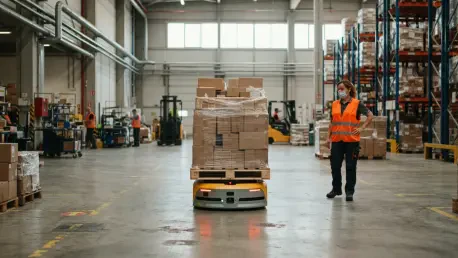
The mobile robotics market is diversifying into specialized designs to meet specific operational demands, moving away from a one-size-fits-all approach that once dominated the sector. Unit-load AMRs are becoming the standard for e-commerce fulfillment, where small, agile machines must sort and transport individual bins or parcels at high speeds to satisfy consumer expectations. These robots prioritize maneuverability and quick cycle times to keep up with the demands of rapid delivery schedules, often operating in swarms that are coordinated by centralized software platforms. By focusing on smaller, lighter payloads, these machines can operate in dense environments that would be inaccessible to larger industrial equipment. This level of specialization allows warehouses to maximize their vertical and horizontal storage density, effectively increasing throughput per square foot without requiring a massive expansion of the physical building footprint or a significant increase in the manual workforce.
Heavy-load Autonomous Mobile Vehicles (AMVs) are designed for the more rugged environments of heavy industry, such as automotive manufacturing and raw material handling. These machines are built to transport large pallets, engine blocks, and chassis, providing a critical bridge between traditional heavy machinery and modern autonomous software. While small autonomous platforms are gaining ground in the retail sector, grid-based carts and heavy-duty movers remain relevant for high-density storage where throughput and repeatability are the primary metrics for success. In these scenarios, the focus shifts from agility to sheer power and reliability, ensuring that massive components move through the assembly line with millimeter precision. The coexistence of these diverse robot architectures demonstrates that the future of automation is not about a single type of machine, but rather a heterogeneous ecosystem where various robotic forms work in concert to address the specific physical challenges of different industrial sectors.
The Challenge: Technical Frontiers in Autonomous Manipulation
A significant technological frontier in this market is the development of mobile picking, which adds the complexity of manipulation to basic transport tasks. Identifying and grasping items of various shapes, weights, and textures remains a technical hurdle that the industry is aggressively tackling with new software and sensor combinations. Currently, many operations use structured case-picking, which relies on consistent item dimensions to simplify the vision and grasping requirements for the robot. This method provides high reliability but limits the robot to a specific set of goods, which is increasingly problematic in a market defined by product diversity. To overcome this, developers are refining the algorithms that allow robots to distinguish between different types of packaging, such as plastic wraps, cardboard boxes, and delicate glass containers, ensuring that the machine can apply the correct amount of force and the appropriate gripping technique for every unique object it encounters.
The ultimate goal for many manufacturers is the commercialization of mobile manipulators, which combine an autonomous base with a highly articulate robotic arm. These “holy grail” systems use AI-driven object recognition and force-feedback sensors to handle diverse goods in unstructured settings, effectively mimicking the versatility of a human worker. As these technologies mature and hardware costs decrease, they are expected to become a massive revenue driver, allowing robots to perform complex tasks previously reserved for humans, such as “each-picking” or shelf stocking. The integration of advanced computer vision allows these systems to learn from their environments, improving their success rates with every successful grasp. Over the next decade, the shift from simple “point-to-point” movement to “pick-and-place” autonomy will likely represent the most disruptive change in warehouse logistics, finally closing the gap between automated transport and fully autonomous fulfillment operations.
Strategy: Economic Drivers and Long-Term Integration
The decision to adopt robotics is increasingly based on a sophisticated calculation of the Total Cost of Ownership (TCO) rather than just the initial price tag of the hardware. Facility operators now evaluate how easily new hardware integrates with existing warehouse management software and how effectively a fleet can be managed to prevent bottlenecks. Modern robotic fleets require robust data ecosystems that allow for real-time monitoring and predictive maintenance, ensuring that the machines remain operational during peak periods. Safety validation is also a critical factor in this economic equation, as robots must be able to operate seamlessly and safely alongside human staff in shared work zones. Companies that invest in high-quality sensors and rigorous safety protocols often see a faster return on investment because they can deploy their robots in more areas of the facility without the need for expensive safety cages or restricted zones that limit the flexibility of the floor staff.
Building on this foundation, the long-term implementation of mobile robotics will be characterized by a steady redistribution of market value as autonomous platforms become the global industry standard. This evolution will see smarter, more versatile robots gradually replace older, fixed-route systems as they reach the end of their service lives between now and 2046. The transition is not merely a replacement of machines but a fundamental shift in how supply chains are organized and managed. By adopting a software-centric approach, companies can future-proof their operations, allowing them to push over-the-air updates to their robotic fleets to improve performance or add new capabilities without needing to purchase new hardware. This shift toward “robotics-as-a-service” and modular hardware designs ensures that the logistics landscape remains resilient in the face of fluctuating market demands and technological advancements, providing a stable framework for long-term growth and innovation.
Implementation: Observations on the Automated Transition
The industry successfully transitioned from experimental pilot programs to full-scale robotic deployments as the reliability of autonomous navigation reached a critical mass. Early adopters found that the most effective strategies involved a phased integration, where robots first handled the most hazardous or repetitive tasks before moving into more complex roles. This methodical approach allowed human workers to adjust to the presence of autonomous partners, reducing friction and improving overall site productivity. Managers who focused on software interoperability avoided the pitfalls of vendor lock-in, creating flexible environments where machines from different manufacturers could share data and navigate the same pathways. The data collected during this period proved that the primary value of robotics lay not just in labor savings, but in the massive amounts of operational data that could be used to optimize every aspect of the supply chain, from inventory placement to final outbound shipping.
Moving forward, businesses should prioritize the development of internal expertise in robotic orchestration to maximize the potential of their automated assets. It is no longer enough to simply purchase robots; organizations must cultivate teams capable of managing the complex interaction between hardware, software, and human labor. This includes investing in robust wireless communication infrastructure, such as private 5G networks, to ensure that autonomous fleets have the low-latency connectivity required for high-density operations. Additionally, facility planners should design new buildings with “robot-friendly” features, such as optimized floor surfaces and standardized charging stations, to further lower the operational barriers to autonomy. By treating robotics as a core competency rather than a peripheral tool, companies will be better positioned to capitalize on the multi-billion dollar growth of the market, ensuring their logistics operations remain competitive in an increasingly automated global economy.