To support the massive computational demands of training large-scale AI models, JD Cloud is building a dedicated infrastructure focused on high-performance embodied-AI workloads. This initiative marks a pivotal shift in how global supply chains operate, moving beyond simple automation toward a fully integrated ecosystem of physical intelligence. As the retail landscape undergoes a fundamental transformation, the company has introduced a comprehensive roadmap known as the Physical AI Acceleration Plan. This strategy focuses on deploying an unprecedented volume of hardware over a five-year period, including three million robots, one million autonomous vehicles, and one hundred thousand delivery drones. The objective is to bridge the gap between digital processing and real-world execution, ensuring that logistics networks can adapt to the rising expectations of modern consumers. By investing heavily in these tangible assets, the organization aims to redefine efficiency, ensuring that the movement of goods becomes as fluid and predictable as the flow of data across a fiber-optic network.
Engineering the Future: Specialized Hardware Systems
Robust Robotic Solutions: The Wolf Series and Global Expansion
A cornerstone of this ambitious expansion involves the deployment of specialized robotics designed to operate in diverse and often challenging environments. The Wolf Robot series represents a significant leap forward in this regard, offering the durability needed to function across various sectors, including the demanding field of pharmaceutical logistics. These machines are engineered to withstand extreme conditions, such as temperatures dropping to minus 20 degrees Celsius, allowing them to maintain operational integrity in cold-chain environments where human labor faces significant safety risks. Beyond the domestic market, the company is aggressively expanding its footprint by introducing automated warehousing solutions like the LangzuTech system to international territories. Currently operational in dozens of locations within China, these systems are now being integrated into logistics hubs in the United Kingdom and Germany, illustrating a commitment to standardizing automated distribution on a global scale. This international push is aimed at creating a seamless cross-border supply chain that leverages local automation to reduce delivery times significantly.
Intelligent Systems: Meta Brain 3.0 and Embodied Physical Learning
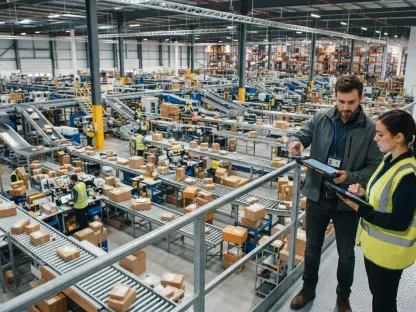
The intelligence driving this mechanical army is found in the Meta Brain 3.0, a sophisticated central nervous system that manages complex logistics tasks with incredible speed. By utilizing high-speed computation, the system can calculate optimal delivery routes for millions of individual packages in just a few seconds, minimizing delays across the network. This cognitive layer is essential for the success of embodied AI tools, such as the LangzuTech Packer, which utilizes advanced sensors and reinforcement learning to navigate the physical world. Unlike traditional robots that follow rigid scripts, these robotic arms can identify and handle parcels of various shapes and sizes by understanding their physical properties. Through simulations of loading layouts, the system maximizes container space and employs precise force control to protect delicate items. This level of environmental awareness ensures that the robots do not merely move objects but interact with them intelligently, which significantly reduces damage rates and improves overall throughput during the peak sorting hours.
Infrastructure Backbone: Processing Power and Physical Assets
Digital Foundations: Computing Clusters and Data-Driven Navigation
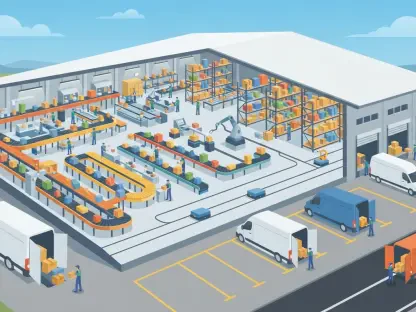
Developing the necessary intelligence for physical AI requires an immense amount of data and processing power, prompting the construction of a massive digital backbone. To achieve this, a partnership with domestic chipmakers has led to the creation of a computing cluster equipped with 100,000 graphics processing units. This hardware provides the raw power needed to process ten million hours of video data documenting human activities, which is used to train robots on how to navigate human-centric environments safely. By learning from real-world interactions, these machines develop a better understanding of spatial dynamics and safety protocols, making them more effective in public spaces. This digital infrastructure is paired with a vast physical network consisting of over 1,800 self-operated warehouses. These facilities cover a staggering 36 million square meters, providing the necessary staging ground for the large-scale rollout of automated systems and ensuring that data-driven insights are applied directly to a global logistics footprint.
Autonomous Mobility: Urban Ground Vehicles and Aerial Solutions
The implementation of autonomous technology has moved from experimental trials to regular, high-frequency operations across a wide geographical range. Thousands of unmanned delivery vehicles are currently active in more than 20 provinces, establishing 24-hour delivery cycles in major urban centers like Shenzhen. These vehicles navigate complex city streets with minimal intervention, providing a consistent solution to the logistical bottlenecks often found in dense urban environments. Furthermore, the focus on aerial logistics has led to the establishment of over 100 drone routes, primarily used for medical transport and emergency disaster relief. In rural regions like Sichuan, these drones have proven to be transformative, reducing delivery times to remote mountain villages from several hours to just seven minutes. By bypassing difficult terrain and inadequate road infrastructure, the company is effectively solving the expensive and persistent last-mile challenge, bringing a new level of accessibility to isolated populations while optimizing delivery costs.
Shaping the New Economy: Investment and Human Capital
Market Dynamics: Financial Commitment and the Instant Retail Shift
The shift toward a robot-centric logistics model was driven by a massive financial commitment, with research and development spending seeing a year-over-year increase of nearly 24 percent. This aggressive investment became necessary as the e-commerce market transitioned toward a model known as instant retail, where the standard for fulfillment moved from days to under an hour. In this high-stakes environment, the ability to sort, pack, and deliver goods with lightning speed served as a critical competitive advantage. While other players in the market historically relied on heavy subsidies to gain market share, the focus here shifted toward building a permanent, high-tech infrastructure that included lightning warehouses and fully automated sorting centers. This strategic positioning was designed to capture a significant portion of an industry that was projected to reach a valuation of over $170 billion. By prioritizing long-term structural efficiency over short-term price wars, the organization set a new benchmark for global trade and local delivery excellence.
Workforce Transformation: Technical Retraining and New Operational Roles
As robotics and automation took over the bulk of manual labor, the focus on human capital shifted toward retraining and technical oversight. To manage the transition for 700,000 employees, the company partnered with 120 educational institutions to provide specialized training for roles that did not exist a few years ago. This evolution in the workforce was essential for maintaining long-term operational stability while integrating new technologies. The project prepared staff for high-tech positions such as robot maintenance, repair, and system management, ensuring that human expertise remained at the core of the automated network. Over 100,000 new jobs were targeted for robotics service engineers, signaling a definitive move away from traditional manual delivery tasks. For the industry at large, the key takeaway involved prioritizing the continuous upskilling of personnel to keep pace with rapid technological change. Organizations found that embracing this shift was vital for any business aiming to thrive in an era where the synergy between human intelligence and physical AI defined leadership.