
Rohit Laila stands as a pillar in the logistics industry, boasting decades of experience that bridge the gap between traditional supply chain management and cutting-edge technological integration. His deep-seated passion for innovation has guided numerous organizations through the complexities of modern delivery demands, focusing particularly on how robotics can revolutionize the movement of goods. In this discussion, we explore the transformative impact of robotic automation on warehouse operations, focusing on how strategic technology adoption allows companies to redefine delivery speed, maximize storage footprint, and build a more resilient infrastructure capable of weathering both peak seasons and unexpected environmental crises.
First Supply has recently made headlines by guaranteeing next-morning delivery for orders placed as late as 5 p.m. How does a company practically bridge the gap between such a late cutoff and a first-thing-in-the-morning arrival?
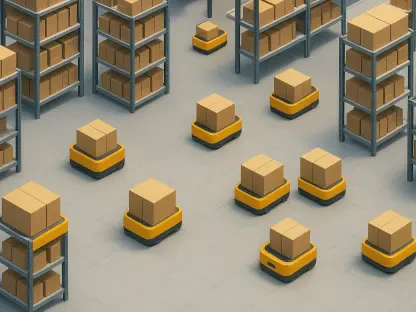
The shift to a 5 p.m. cutoff is a massive logistical hurdle that requires moving away from manual labor toward high-velocity robotics. By utilizing the Skypod-powered system, the facility can now achieve picking speeds that are 10 times faster than traditional manual processes, which is essential for that evening crunch. They are currently managing over 14,000 SKUs within this automated environment, ensuring that a vast variety of industrial parts are ready for immediate dispatch. This ultra-fast throughput means that even when an order comes in late in the afternoon, the system can locate, pick, and prepare it for shipment in a fraction of the time it once took. It is this specific combination of speed and accuracy that allows them to handle overnight replenishment so effectively that it now accounts for up to 20% of the distribution center’s total daily volume.
Space is often the most expensive component of any logistics operation. How has the implementation of vertical robotic systems changed the way these facilities are designed and utilized?
Modern automation allows us to think upward rather than just outward, which is a game-changer for established regional players. In this specific case, the technology enabled a 4x growth in storage capacity without requiring any expansion of the existing racking footprint. By vertically concentrating products, the facility maximizes every square inch of available air space while still maintaining a 30% buffer for future hardware expansion. This strategy doesn’t just save on real estate costs; it also simplifies the internal logic of the warehouse by keeping a high density of goods within the reach of the robotic fleet. It’s about building a scalable operation that can grow alongside the business without the need for disruptive construction or moving to a larger, more expensive site.
Beyond day-to-day efficiency, how does this level of automation help a supply chain remain resilient when faced with unexpected disasters or extreme demand spikes?
Resilience is truly tested during a crisis, such as the massive flash flooding that hit southeastern Wisconsin in the summer of 2025. When that disaster struck, the automated systems allowed the team to quickly pivot and deliver essential products to hundreds of affected customers who were in desperate need of recovery supplies. Because the system is designed to handle peak seasonal demand with minimal friction, it didn’t buckle under the sudden surge of emergency orders. This ability to maintain high performance during an exceptional situation proves that automation is a safeguard for the community, not just a tool for profit. Having a significant percentage of daily volume move through such an efficient system ensures that even when the outside world is in chaos, the internal supply chain remains steady and reliable.
There is often a concern that automation might make the warehouse environment more sterile or difficult for the people working there. What impact does this technology have on the daily experience of the employees?
On the contrary, the integration of these robotic systems significantly improves the physical well-being and productivity of the workforce. By bringing the goods directly to the operators, the system drastically decreases the travel time and distance that employees previously had to cover on foot. This reduction in physical strain leads to a much better operating environment, allowing the staff to focus on higher-level tasks rather than the exhaustion of manual picking. We see a noticeable boost in morale when workers are supported by state-of-the-art tools that make their jobs safer and more intuitive. Ultimately, it’s about empowering the human element of the 5th-generation legacy with technology that handles the “heavy lifting,” both literally and figuratively.
What is your forecast for the evolution of omnichannel distribution centers?
I believe we are entering an era where the distinction between local branch inventory and centralized distribution will become nearly invisible to the end customer. As more companies adopt these scalable robotic solutions, the ability to offer same-day or next-morning delivery will transition from a premium service to a standard expectation across all industrial sectors. We will likely see distribution centers becoming even more dense and data-driven, using AI to predict local needs before the orders are even placed. This will further solidify the resilience of regional supply chains, making them capable of supporting local economies through both steady growth and unforeseen challenges. The “right” automation strategy will no longer be an elective upgrade but the foundational bedrock of any competitive 5th-generation business.