
With nearly two decades of experience navigating the complexities of the Consolidated Rail Corporation, Steven Vant has witnessed the transformation of the Northeastern United States rail landscape firsthand. Serving as the Chief Engineer of Communication and Signals, he oversees the intricate operations of three high-density shared asset areas in Detroit and New Jersey, where reliability is not just a goal but a necessity. His expertise bridges the gap between mid-century legacy systems and the digital-first infrastructure of today. In this conversation, we explore how strategic automation, vibration-resistant technology, and streamlined power distribution are redefining the standards for modern rail networks and ensuring the safety of millions of tons of freight.
Rail systems often transition from legacy hardware to integrated automation during major yard upgrades. What specific challenges arose during the 2019 hump yard automation rollout, and how did implementing a full suite of PLCs and HMIs change your daily troubleshooting capabilities?
The primary challenge during the 2019 rollout was transitioning from fragmented legacy systems to a cohesive digital framework without interrupting critical freight flow. By integrating a full suite of PLCs, HMIs, and optocouplers, we moved away from the era of manual diagnostics toward a system where every component communicates its status in real time. For example, during a typical troubleshooting event, instead of a technician having to manually probe dozens of points to find a failure, they can now use the HMI to pinpoint the exact relay or circuit that is malfunctioning. This shift has allowed our team to configure systems more dynamically and address potential bottlenecks before they cause a yard-wide delay. The simplicity of the interface means our engineers spend less time digging through documentation and more time optimizing the throughput of the yard.
Movable bridges present unique structural challenges, particularly regarding the intense vibrations caused by heavy freight traffic. Why did traditional AAR terminals struggle in these high-vibration environments, and what technical advantages does spring pressure technology offer for maintaining electrical continuity on large-scale infrastructure?
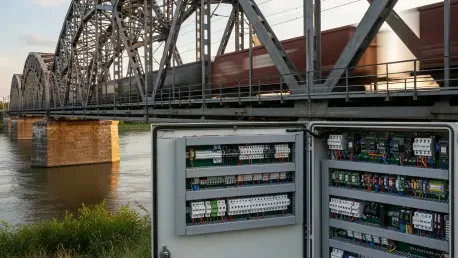
Traditional AAR terminals, which have been our industry standard since before 1950, rely on solid copper wire and bolted connections that simply cannot withstand the mechanical stress of our 11 movable bridges. When a heavy freight train crosses these massive structures, the resulting vibration frequently causes traditional nuts to loosen and copper wires to fatigue or snap, leading to intermittent signal failures. We found a solution in spring pressure technology, specifically CAGE CLAMP® terminals, which provide a constant, uniform force on the conductor regardless of the external movement. These terminals effectively “float” with the vibration, ensuring that electrical continuity remains unbroken even during the most intense heavy-haul transits. This change has drastically reduced the frequency of emergency maintenance calls to our largest bridges, which are among the most complex in the world.
Modernizing trackside bungalows involves moving away from legacy energy loops toward streamlined power distribution. How do DIN-rail mounted terminals simplify the cable termination process for field technicians, and what specific metrics have you observed regarding the time required to isolate and test individual circuits?
The modernization of our bungalows has been about eliminating the “spaghetti” of legacy energy loops that made maintenance a nightmare. In the past, a technician might have to manipulate six or seven different pieces of hardware just to terminate a single wire, but with the new DIN-rail mounted feed-through terminals, they simply strip the wire and push it into the slot. This “push-in” capability has made the wiring process significantly faster and much cleaner, resulting in a layout that is intuitive even for a technician who didn’t perform the original installation. While the specific time savings vary by location, we have seen that the ability to isolate individual circuits for testing is now a matter of seconds rather than minutes of tedious unscrewing. This improved access allows for more frequent and thorough inspections, ensuring the power busing and relay energy feeds remain stable.
Reliability is paramount when managing high-density rail regions like Detroit and Northern New Jersey. How have specialized components like knife disconnect switches and automated labeling tools improved technician safety during maintenance, and how do you ensure these new standards are adopted consistently across the network?
In high-density regions like Detroit and Northern New Jersey, the margin for error is zero, so technician safety and clarity are our top priorities. By incorporating knife disconnect switches into our bridge retrofits, we allow technicians to physically see a gap in the circuit, providing a clear visual confirmation that a line is de-energized before they begin work. We have also replaced handwritten tags with automated labeling and printing tools, which ensures that every terminal is legible and correctly identified, reducing the risk of accidental contact with live circuits. To ensure these standards are adopted, we have integrated these components into our master design templates for all new Shared Assets projects. This consistency means that whether a crew is working in Philadelphia or Staten Island, the equipment and safety protocols remain identical.
The rail sector is increasingly looking to replace outdated hardware with integrated electronic solutions like signal line arrestors. What is the strategic logic behind phasing out traditional AAR terminals in favor of modern track circuit arrestors, and how does this shift influence your long-term infrastructure planning?
The strategic logic is centered on moving toward a “maintenance-free” infrastructure where electronic components provide both connectivity and protection in a single footprint. Phasing out AAR terminals in favor of integrated signal line and track circuit arrestors allows us to consolidate our hardware, reducing the number of potential failure points in the signaling chain. These modern arrestors offer superior protection against lightning strikes and power surges, which are frequent threats to our trackside electronics. Looking ahead, this shift influences our planning by allowing us to design smaller, more efficient bungalows that require fewer manual interventions over their thirty-year lifespans. We are essentially setting a new standard where the terminal block is no longer just a connection point, but an active participant in the reliability of the entire network.
What is your forecast for the future of rail automation and smarter infrastructure?
I believe the future lies in the total integration of smart components that can self-diagnose and report their health to a centralized cloud system before a physical failure occurs. We are moving toward an era where the “dumb” hardware of the 20th century is entirely replaced by intelligent interfaces that provide granular data on everything from vibration levels on a bridge to the exact current draw of a switch motor. My forecast is that rail networks will become significantly more autonomous, with predictive maintenance algorithms dictating schedules rather than fixed calendar intervals. For our readers, I would say: embrace the transition to modular, spring-loaded, and digital systems now, because the speed of modern freight demand will soon make legacy manual-reset hardware completely obsolete.