
Modern supply chains no longer rely on the sheer strength of human labor but on the surgical precision of robotic systems that demand absolute physical consistency. Automated material handling packaging has transitioned from being a passive storage medium to a critical technical component within the warehouse ecosystem. As facilities integrate more sophisticated robotics and sensor-driven sorters, the margin for error regarding container dimensions has narrowed to almost zero. This review examines how the physical architecture of pallets and bins determines the uptime and profitability of highly automated distribution centers.
Fundamentals of Packaging in Automated Environments
Packaging engineered for automation operates on the principle that a robot is only as efficient as the predictability of the object it handles. Unlike traditional manual setups where workers can adjust for a warped pallet or a crushed corner, automated storage and retrieval systems (ASRS) require strict dimensional accuracy to avoid costly system jams. These specialized assets must maintain their shape under heavy loads and repetitive stress, ensuring that sensors can reliably identify and track them through every stage of the journey.
Beyond structural integrity, these environments utilize standardized footprints that align with the pitch of conveyor rollers and the reach of robotic grippers. This shift toward “smart” packaging integrates surfaces that are compatible with vision systems and scanners, reducing misreads that lead to downtime. By prioritizing repeatability, manufacturers have created a bridge between the digital logic of Industry 4.0 software and the physical reality of moving goods through a facility.
Key Specialized Packaging Solutions and Technical Components
High-Performance Pallet Platforms: The Foundation of Stability
Advanced pallet families, such as the Odyssey series, serve as the load-bearing backbone for diverse automated setups. Unlike wood, which can splinter or change weight based on moisture content, these recyclable plastic platforms offer a constant tare weight and a rigid profile. This consistency allows conveyor systems to operate at higher speeds without the risk of slippage or instability. Their design ensures they remain flat across racking systems, preventing the “deflection” that often triggers safety sensors in high-density storage environments.
Precision-Engineered Totes and Internal Containers: Optimizing System Compatibility
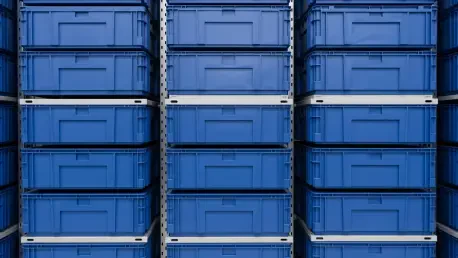
Containers like the AROS totes represent the pinnacle of injection-molded precision, specifically designed to interface with high-speed shuttles and systems like AutoStore. These units feature ultra-tight tolerances and reinforced corners to withstand the high-acceleration forces exerted by modern robotic pickers. The internal capacity is maximized to increase the density of stored goods, which directly improves the throughput-per-square-foot of the warehouse. Their specialized base designs minimize noise and vibration, contributing to the longevity of the mechanical components they travel upon.
Collapsible and High-Capacity Bulk Systems: Maximizing Return Logistics
For bulk movements, systems like OpteBulk and MaxCube focus on the technical challenge of optimizing the “empty” leg of the supply chain. These sleeve packs offer a high return ratio—often reaching 4:1—allowing hundreds of collapsed units to fit into a single return trailer. This efficiency is achieved through rodless hinges and locking mechanisms that provide the strength of a rigid bin with the flexibility of a knockdown system. By replacing traditional one-way cardboard gaylords, these assets reduce material waste while maintaining the structural rigidity necessary for automated stacking and decanting.
Current Trends and Innovations in Reusable Assets
The move toward custom injection-molded and thermoformed solutions has accelerated as companies seek to protect increasingly delicate or high-value components. Recent strategic acquisitions in the industry have expanded the ability to create dunnage that fits the specific geometry of a product, preventing movement during rapid robotic handling. This evolution marks a shift toward a “win-win-win” scenario where the packaging is simultaneously more durable, more protective of the contents, and fully recyclable at the end of its multi-year lifespan.
Furthermore, there is a growing demand for circularity that does not sacrifice mechanical performance. Innovations in material science have led to high-impact plastics that incorporate recycled content without losing the tensile strength required for heavy-duty industrial use. This balance is crucial as global brands face pressure to meet sustainability targets while scaling up their automation investments. The result is a specialized class of assets that are engineered for the long haul, rather than the single trip.
Real-World Applications Across Diverse Sectors
Industrial warehousing and high-speed distribution centers are the primary testing grounds for these advanced assets. In these settings, the deployment of standardized packaging eliminates the variability that causes bottlenecks. For instance, in omnichannel retail, the XpressPickup system illustrates how specialized totes and dollies can streamline “buy-online/pick-up in-store” workflows. By creating a seamless transition from the warehouse rack to the curbside pickup point, these tools reduce the labor hours required to process a single order.
The cold chain sector has also seen a significant impact from these technological advancements. In refrigerated or frozen environments, traditional materials often become brittle or harbor moisture, but advanced polymers remain stable at sub-zero temperatures. This reliability is vital for maintaining the integrity of food and pharmaceutical supply chains, where any delay in an automated system can lead to temperature excursions and product loss. Custom-designed trays and bins ensure that even in these harsh conditions, the robots can maintain peak picking rates.
Challenges and Constraints in Automation Integration
Despite the benefits, transitioning to advanced reusable assets presents significant logistical hurdles. The initial capital expenditure for a fleet of high-performance totes or pallets is substantially higher than that for wood or corrugated alternatives. Maintaining repeatability in high-speed environments also places immense mechanical stress on the packaging, as repetitive robotic grippers can eventually cause wear at specific contact points. Companies must carefully calculate the total cost of ownership, factoring in the reduction in system downtime against the upfront investment.
Standardization remains another persistent obstacle across global supply chains. A container designed for a specific ASRS in North America may not be compatible with the conveyor heights or sensor types used by a partner in Europe or Asia. This lack of universal standards forces manufacturers to maintain multiple packaging profiles or invest in modular systems that can adapt to different automation vendors. Bridging these gaps requires deep collaboration between packaging manufacturers and the providers of the robotic hardware themselves.
Future Outlook for Material Handling Technology
The trajectory of automated packaging is moving toward even deeper integration with autonomous mobile robots (AMRs). As these robots move freely through warehouses without the guidance of fixed tracks, the packaging they carry must become even more “intelligent,” perhaps incorporating embedded tracking sensors or RFID tags that communicate directly with the robot’s onboard computer. This would allow for real-time inventory adjustments and autonomous rerouting based on the condition or destination of the package itself.
Material science breakthroughs will likely play a defining role in the next generation of containers. We may see the introduction of self-healing polymers or ultra-lightweight composites that reduce the energy consumption of the robotic systems moving them. As collaborative partnerships between packaging firms and system providers become the norm, the distinction between the “box” and the “machine” will continue to blur, leading to a more cohesive and responsive material handling infrastructure.
Final Assessment and Review Summary
The convergence of physical hardware and sophisticated automation proved that the efficiency of a warehouse is ultimately limited by the quality of its packaging. It was observed that companies investing in precision-engineered, reusable assets achieved significantly higher uptime and lower maintenance costs than those relying on traditional materials. The transition from disposable one-way solutions to durable, standardized containers became a prerequisite for any facility aiming to leverage the full potential of robotics and AI-driven logistics.
Ultimately, the future of global supply chains was secured by those who recognized that packaging is an active participant in the automation process. The shift toward high-performance pallets and totes not only addressed the immediate need for mechanical reliability but also aligned with long-term sustainability mandates. As the industry moved forward, the focus remained on refining these assets to be lighter, smarter, and more integrated, ensuring that the physical foundation of logistics remained as innovative as the software guiding it.