
Rohit Laila brings a wealth of perspective to the table, having spent decades navigating the intricate pulse of the logistics and supply chain industries. His deep-seated passion for technological innovation and industrial resilience makes him a vital voice in understanding the current transformation of American rail infrastructure. We discuss the historic partnership between Union Pacific and the Rocky Mountain Steel Mills, exploring how a billion-dollar investment in Pueblo, Colorado, is reshaping the very tracks that connect the nation. This conversation touches upon the resolution of complex legal disputes, the engineering shift toward 100-meter long-rails, and the ambitious integration of renewable solar energy into heavy manufacturing.
Union Pacific and the Pueblo mill have a partnership dating back to the 1890s, though it recently faced legal challenges in Nebraska. How did both parties navigate the resolution of that lawsuit, and what specific terms in the new seven-year agreement ensure future commercial stability?
The resolution of the legal dispute in Nebraska was less about a courtroom victory and more about a mutual recognition of a 140-year shared history that simply could not be discarded. By withdrawing the lawsuit, both Union Pacific and Rocky Mountain Steel cleared the path for a new seven-year agreement that solidifies a predictable, domestic supply chain for the essential materials of railroading. This contract isn’t just a piece of paper; it’s a commitment to American workers and the industrial stability of the region, ensuring that the only remaining dedicated steel rail site in the country stays operational. You can feel the weight of that history when you realize this relationship survived the logistical pressures of the First World War and continues to thrive under new ownership today. The specific terms focus on a long-term supply of US-made rail, providing the mill with the confidence to move forward with massive infrastructure upgrades while giving the railroad the reliability it needs to serve its customers.
The new billion-dollar mill produces rail sections up to 100 meters in length. How does this shift change standard track installation practices, and what specific metrics can you share regarding the safety and maintenance benefits of significantly reducing the number of welds required per mile?
The shift to 100-meter rail sections represents a monumental leap in domestic manufacturing, backed by a significant investment of over 1 billion USD. Traditionally, rail was produced in much shorter segments, requiring frequent welds that created potential points of failure and increased the rhythmic “click-clack” of the track, which often signals mechanical stress. By producing rails that reach lengths of 100 meters, we are drastically reducing the number of welds per mile, which directly translates to a smoother, safer journey for heavy freight and a lower risk of track-related incidents. Maintenance crews will spend significantly less time inspecting and repairing joints, allowing for more consistent and reliable service across the western United States. It’s an evolution you can see in the sheer scale of the new Pueblo facility, designed to handle these massive lengths of steel with precision that was previously unimaginable in the American market.
Modernizing steel production often involves massive energy consumption, yet this facility utilizes a dedicated 1,800-acre solar installation. What were the logistical steps required to integrate a solar plant of this size, and how does this renewable transition impact the overall cost-efficiency of domestic manufacturing?
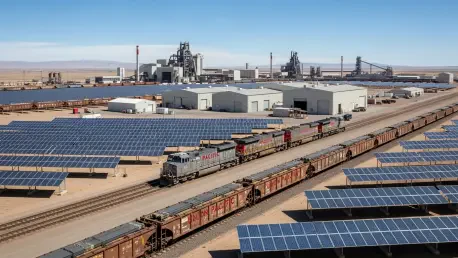
Integrating an 1,800-acre solar installation into a heavy industrial environment is a feat of logistical coordination that matches the complexity of the steel production itself. To power a mill of this magnitude, the planners had to align the high-energy demands of the furnace and rolling mill with the steady, clean output of thousands of solar panels sprawling across the Colorado landscape. This transition to renewable energy isn’t just an environmental choice; it’s a strategic move to insulate domestic manufacturing from the volatility of traditional energy markets. By securing a dedicated, onsite power source, the mill can manage its operational costs more predictably over the long term, making American steel more competitive on a global scale. There is a profound sense of irony and progress in seeing the sun’s energy being used to forge the very steel that will carry the nation’s goods into the next century.
Maintaining the only dedicated steel rail facility in the United States relies heavily on the United Steelworkers union. What specific operational training is necessary for this workforce to run the new long-rail mill, and how does this partnership help insulate the American industrial core from global supply shocks?
The workforce at the Pueblo facility, represented by the United Steelworkers union, is the backbone of this entire operation, requiring specialized training to manage the sophisticated technology found in the new long-rail mill. Operating a billion-dollar facility that produces 100-meter sections involves a high degree of technical expertise in metallurgy and automated precision systems, ensuring each rail meets exacting safety standards. This partnership is vital for national security and economic resilience because it maintains a domestic source for critical infrastructure, shielding us from the unpredictable nature of global supply shocks. When you have a dedicated, local workforce that has been part of the regional industrial fabric since the late 19th century, you build a level of institutional knowledge that is impossible to replicate overnight. Their collective commitment ensures that Union Pacific can rely on a steady stream of high-quality, American-made rail, regardless of international trade tensions or shipping disruptions.
Union Pacific is currently pursuing a merger with Norfolk Southern to establish the first transcontinental railroad in the nation. How does securing a long-term domestic rail supply impact the feasibility of this expansion, and what role will the Pueblo mill play in supporting such a vast network?
The ambition to create the nation’s first transcontinental railroad through a merger with Norfolk Southern hinges entirely on the strength of the underlying infrastructure. Securing a long-term, domestic supply of rail from the Pueblo mill provides the logistical bedrock necessary to maintain a network that spans the entire continent. As this vast system expands, the demand for high-quality steel to replace aging tracks and build new spurs will be unprecedented, and having a reliable partner in Rocky Mountain Steel is critical to making that growth sustainable. This partnership is positioned to strengthen the very core of American manufacturing, fueling domestic job growth as the expanded rail network carries more goods across more miles. The Pueblo mill essentially becomes the heartbeat of this transcontinental vision, pumping out the steel arteries that will connect the Atlantic to the Pacific with greater efficiency and safety than ever before.
What is your forecast for the future of American rail infrastructure and domestic steel production?
My forecast is one of significant revitalization, where we see a convergence of massive capital investment and sustainable technology driving a new era for American industry. We are looking at a future where 100-meter rails become the new standard, drastically improving the safety and longevity of our national network while reducing the environmental footprint through projects like the 1,800-acre solar farm. The success of the billion-dollar Pueblo mill will likely serve as a blueprint for other domestic manufacturers, proving that high-tech, union-backed, and sustainably powered production is not just possible but highly profitable. As we move toward a transcontinental rail system, the synergy between railroads and steelmakers will deepen, ensuring that the United States remains a global leader in both logistics and infrastructure for the next 140 years. We are witnessing the beginning of a domestic manufacturing renaissance that is built on the lessons of the past and the technology of the future.