
The sudden immobilization of over one thousand commercial vessels in the Arabian Gulf has created a logistical nightmare that threatens the very foundations of international energy distribution. President Donald Trump has officially greenlit “Project Freedom,” a high-stakes maritime operation designed to break the deadlock and rescue approximately 20,000 seafarers caught in the crossfire of a regional conflict that ignited on February 28. This initiative represents one of the most significant naval interventions in recent history, aiming to address a burgeoning humanitarian crisis while simultaneously restoring the flow of international commerce through one of the world’s most volatile chokepoints.
The relevance of this operation cannot be overstated; the closure of the Strait of Hormuz by Iranian forces has not only stranded thousands of workers but has also sent shockwaves through global energy markets. This analysis explores the logistical complexities of the rescue mission, the military strategy underpinning the intervention, and the broader implications for the future of global trade. By examining administrative mandates and the tactical realities on the water, we provide a comprehensive look at how the United States intends to navigate this multifaceted crisis.
The Geopolitical Catalyst: Contextualizing the Blockade
The current maritime paralysis is the direct result of a sharp escalation in hostilities involving the United States, Israel, and Iran. Following the outbreak of conflict in late February, the Iranian government moved to shutter the Strait of Hormuz, effectively trapping a massive fleet of international merchant ships. This move transformed a regional military engagement into a global economic emergency, prompting numerous nations—many of which have remained neutral in the hostilities—to petition Washington for assistance in liberating their crews and assets.
Historically, the Strait of Hormuz has served as a primary artery for the world’s oil supply, and its closure has always been viewed as a red line for international security. The shift from diplomatic posturing to an active blockade marked a turning point in the conflict, necessitating a robust response that transcends traditional naval escort duties. Understanding this background is essential to grasping why the rescue is framed not just as a military maneuver, but as a fundamental restoration of the right to free navigation in international waters.
Navigating the Tactical and Humanitarian Dimensions
The Dual-Track Strategy: Balancing Aid and Deterrence
The operation is defined by a unique dual-track strategy that blends humanitarian concern with an uncompromising military stance. The administration has characterized the mission as a humanitarian gesture intended to protect innocent lives and stabilize the Middle Eastern economy. However, this olive branch is backed by a steel fist; officials issued a stern warning that any attempt to interfere with the evacuation will be met with immediate and forceful military retaliation. This approach highlights a growing trend in modern geopolitics where aid is delivered under the umbrella of significant military deterrence.
Operational Logistics: The Omani Security Corridor
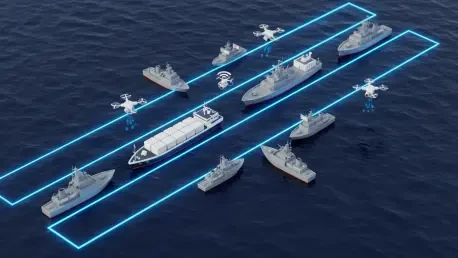
The logistical execution is scheduled to begin on the morning of May 4, guided by strict protocols from the Joint Maritime Information Center. Because the traditional Traffic Separation Scheme is currently deemed extremely hazardous due to the presence of unmitigated naval mines, authorities have established an alternative security corridor. This route sits south of the standard lanes, primarily within Omani territorial waters. To navigate this corridor safely, transiting vessels are required to maintain persistent communication with Omani authorities via VHF channel 16 to prevent misidentification.
Military Mobilization: The Scale of CENTCOM Support
The sheer scale of the U.S. commitment to this operation is a testament to the perceived risk. U.S. Central Command confirmed that 15,000 service members, over 100 land and sea-based aircraft, and several guided-missile destroyers will support the mission. Furthermore, the inclusion of various unmanned platforms signals a shift toward high-tech surveillance and mine-clearing operations. Military leadership framed this as a defensive mission essential for regional security, emphasizing that while the U.S. maintains its own blockade in the area, the priority remains the safe extraction of non-combatant commercial interests.
Future Projections: Shifts in Maritime Security Models
The launch of this mission likely signals a long-term shift in how maritime security is managed in high-conflict zones. As naval warfare increasingly incorporates unmanned systems and swarming tactics, the traditional freedom of navigation doctrine is evolving into a model of protected navigation. This shift suggests that in the future, commercial shipping through strategic chokepoints may require permanent international military coordination rather than relying on the assumption of safe passage in neutral waters.
Moreover, the economic and regulatory landscape is likely to adapt to these recurring volatilities. We may see a rise in the development of alternative trade routes and a heavier reliance on integrated maritime intelligence centers. As technological innovations in mine detection and drone defense become standard, the cost and insurance structures of global shipping will likely undergo a significant transformation to account for the new normal of militarized trade corridors.
Strategic Recommendations: Best Practices for Global Stakeholders
For shipping companies and maritime professionals, the current situation offers several critical takeaways. First, strict adherence to established security corridors and communication protocols is no longer optional; it is a prerequisite for survival in contested waters. Operators should prioritize the installation of advanced communication systems and ensure that crews are trained in the latest emergency response procedures dictated by international task forces.
Additionally, businesses must diversify their logistics strategies to mitigate the risks of single-point failures in global trade routes. Investing in real-time maritime intelligence and maintaining flexible scheduling can help firms navigate sudden closures or escalations. By applying the lessons learned from this intervention—specifically the importance of military-civilian coordination—stakeholders can better prepare for future disruptions in the world’s most sensitive shipping lanes.
Restoring Order: Tactical Gains and Strategic Precedents
Project Freedom stood as a pivotal moment in the Middle Eastern conflict, representing a massive effort to decouple international commerce from regional warfare. By deploying a formidable array of military assets to protect a thousand-ship convoy, the United States reasserted the principle of maritime sovereignty while addressing a pressing humanitarian need. The success of this operation determined the fate of 20,000 seafarers and established a new precedent for how the international community responded to the weaponization of global trade routes. As the world watched the events of May 4 unfold, the significance of this intervention remained clear: the stability of the global economy was inextricably linked to the security of the seas. This transition toward protected corridors provided a necessary blueprint for future maritime stability in an increasingly fragmented geopolitical landscape.