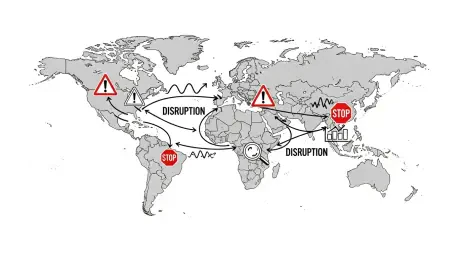

The modern logistics landscape is currently undergoing a fundamental transformation as the primary sources of delay migrate from centralized port origins to a more fragmented series of downstream hurdles. Recent data from the Ocean Shipping Index reveals that while major Asian export hubs have streamlined their departure processes, the global end-to-end shipment time has increased to an average of 68 days as of early 2026. This represents a notable rise of two days over the previous quarter, indicating that efficiency at the starting line does not necessarily translate to a faster finish. Instead of facing concentrated queues at the point of origin, freight now encounters a distributed network of disruptions that occur during transit, booking, and final unloading. This shift creates a deceptive environment where initial cargo movement appears smooth, yet the overall journey remains unpredictable. Consequently, logistics managers are finding that traditional predictive models, which relied heavily on monitoring port-side congestion, are no longer sufficient to ensure timely delivery in a world where the bottleneck itself has become mobile.
Navigating Geopolitics and Infrastructure Vulnerabilities
The decentralization of shipping delays is largely driven by a combination of persistent geopolitical instability and localized infrastructure failures that ripple across the entire maritime network. Significant conflict within the Middle East has restricted access to the Suez Canal and the Strait of Hormuz, forcing a substantial volume of global trade to divert around the Cape of Good Hope. These longer routes add thousands of miles to the voyage, naturally extending transit times and straining vessel capacity. Meanwhile, Northern Europe has dealt with severe weather patterns that have caused intermittent shutdowns at major transshipment hubs like the Port of Rotterdam. These environmental factors, coupled with labor shortages and aging terminal infrastructure in Western ports, ensure that even when a ship arrives on schedule, the unloading and inland distribution phases remain highly susceptible to stalling. This environment demands a transition toward more resilient operational frameworks that emphasize real-time visibility over static scheduling.
To mitigate the impact of these shifting bottlenecks, logistics professionals must move toward an “observe and adapt” strategy that leverages advanced data analytics to detect disruptions as they emerge. Relying on historical averages is no longer a viable method for inventory planning; instead, organizations should prioritize diversifying their carrier partnerships and investing in predictive software that can recalculate arrival windows based on live oceanic conditions. By establishing secondary routing options and maintaining flexible warehousing agreements near multiple entry points, businesses can bypass localized congestion as it shifts geographically. The goal was to build a system that viewed the supply chain not as a fixed line, but as a fluid network capable of rerouting around obstacles. Future success in this sector depended on the ability to anticipate the next downstream failure point and adjust procurement cycles well before the cargo left the origin port, ensuring that the final mile did not become a permanent roadblock for global trade.