
With decades of experience navigating the complexities of global supply chains and a profound passion for logistics innovation, Rohit Laila stands as a leading voice in the air cargo sector. Having witnessed the industry’s evolution from simple transport to high-tech, integrated ecosystems, he offers a unique perspective on how infrastructure and technology intersect to keep global trade moving. Today, we explore the strategic expansion of air freight networks, the critical role of specialized hubs, and the logistical maneuvers required to handle everything from sensitive pharmaceuticals to high-demand electronics in an increasingly connected world.
Exports from Canada to the UAE increased by 24% last year. How has improved air connectivity fueled this growth, and what specific steps should businesses take to leverage the 100 tons of additional weekly export capacity now available?
The double-digit growth we’ve seen in Canadian exports to the UAE is a direct result of reliable, high-frequency air links that bridge the geographical gap between North America and the Middle East. When businesses see a 24% year-on-year increase in trade, it signals a massive appetite for Canadian electronics, components, and agri-food products in the Gulf region. To truly capitalize on the 100 tons of fresh weekly capacity, Canadian exporters must move beyond sporadic shipping and integrate these scheduled freighter services into their core supply chain planning. Shippers should focus on optimizing their “speed to market” for high-value goods, ensuring that their palletization and documentation processes are synchronized with the Friday departure times to maximize this new direct gateway.
A new freighter route includes an Amsterdam stopover between the Middle East and Canada. What logistical advantages does this provide for EU-Canada trade, and how does maindeck capacity specifically benefit the movement of temperature-sensitive pharmaceuticals and perishables?
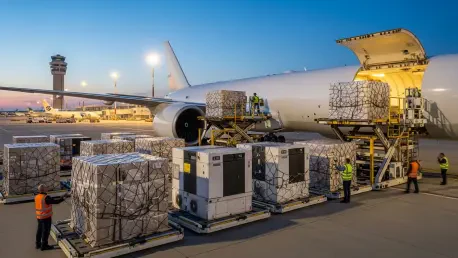
Integrating Amsterdam Schiphol as a strategic stopover creates a vital bridge between the European Union and Canada, allowing for a seamless flow of manufactured goods and high-grade perishables. The primary advantage here is the “maindeck” capability of the Boeing 777 freighter, which offers much larger dimensions and more precise environmental controls than traditional bellyhold space on passenger planes. This is absolutely critical for the pharmaceutical industry, where maintaining a strict cold chain for life-saving medicines is a non-negotiable requirement. For perishables, having that dedicated maindeck space means we can transport larger volumes of fresh produce in a temperature-controlled environment, ensuring they arrive on Canadian shelves with their quality and shelf-life fully intact.
The cargo fleet is expanding from 11 to 21 Boeing 777 freighters this year. What operational hurdles occur during such rapid scaling, and how do passenger-to-freighter conversions help balance the immediate need for capacity against long-term fleet modernization?
Scaling a fleet from 11 to 21 aircraft within a single year is a massive undertaking that requires incredible precision in crew scheduling, maintenance rotations, and ground handling logistics. One of the biggest hurdles is ensuring that the global network of hubs—like those in Dubai, Liege, and Toronto—can handle the increased throughput without creating bottlenecks. By utilizing passenger-to-freighter conversions, such as the 10 aircraft ordered from Israel Aerospace Industries, we can bridge the gap between immediate market demand and the delivery of brand-new production models. These conversions allow us to breathe new life into existing airframes, providing a cost-effective and faster way to add capacity while we wait for the six production-line freighters to join the fleet and modernize the long-term operation.
Toronto Pearson handles nearly half of Canada’s air cargo, including electronics and fresh produce. How does adding dedicated freighter service alongside existing bellyhold operations change the local market dynamic, and what impact does this have on supply chain transit times?
By funneling roughly 45% of Canada’s air cargo through Toronto Pearson, the addition of a dedicated freighter service transforms the airport from a standard transit point into a high-capacity strategic gateway. This move provides shippers with a “best of both worlds” scenario: they can use bellyhold for smaller, frequent shipments and the freighter for massive, 100-ton bulk exports that simply wouldn’t fit on a passenger jet. For industries like electronics and fresh produce, this redundancy significantly reduces transit times and the risk of cargo being “bumped” due to passenger baggage constraints. It creates a more predictable and reliable pipeline, which is the “holy grail” for supply chain managers trying to meet just-in-time manufacturing deadlines or grocery delivery schedules.
New cargo services in Liege, Mumbai, and Ahmedabad target specific sectors like e-commerce and medical supplies. How do these specialized hubs improve global distribution, and what criteria determine whether a region requires a dedicated freighter versus utilizing passenger flight capacity?
Specialized hubs like Liege, which now operates five times weekly with specific focuses on Chicago and Hong Kong, allow us to tailor the infrastructure to the specific needs of the cargo, such as high-volume e-commerce or sensitive medical supplies. The decision to deploy a dedicated freighter versus using passenger bellyhold usually comes down to three factors: volume, consistency, and commodity type. If a region like Ahmedabad shows a consistent need to move heavy perishables or personal electronics that exceed the 20-30 ton capacity of a passenger plane, a freighter becomes a necessity. Furthermore, freighters provide the schedule flexibility needed to move “critical” goods—like the 11,000 tons of export cargo we’ve handled from Canada—without being tied to the peak travel times of human passengers.
What is your forecast for global air cargo expansion?
The future of air cargo lies in the “precision of connectivity,” where we move away from generic routes toward specialized corridors that serve high-growth sectors like e-commerce and pharmaceutical manufacturing. I expect we will see a continued surge in demand for dedicated freighter capacity, especially as businesses prioritize supply chain resilience and seek out carriers with modernized, fuel-efficient fleets like the Boeing 777F. As we expand into new markets like Mumbai and Ahmedabad, the focus will shift toward integrating advanced tracking and temperature-control technologies to provide shippers with total visibility. Ultimately, the industry will evolve from merely transporting goods to becoming an indispensable, high-speed extension of the global production line.