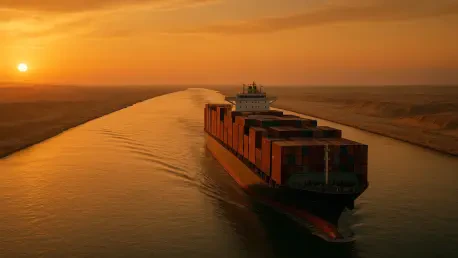

The global maritime trade environment in 2026 operates under a permanent state of tactical flexibility where the historical reliability of the Suez Canal has been traded for a multi-nodal risk management strategy that prioritizes supply chain security over sheer speed. This shift marks the end of an era defined by predictable transit patterns, replacing it with a complex calculation that balances the immediate cost of fuel against the long-term price of inventory stagnation. Shippers moving cargo between the manufacturing hubs of Asia and the consumer markets of Europe now find that the choice of a routing is no longer a simple logistics preference; it has become a fundamental pillar of capital efficiency. This modern landscape is heavily influenced by the integration of predictive analytics and high-frequency tracking, tools that attempt to mitigate the inherent volatility found at physical maritime chokepoints.
The current industry is clearly divided between two distinct operational philosophies that dictate how goods move across the globe. On one side, carriers and international navies are tasked with the daily management of security and the underwriting of the Red Sea, while on the other, cargo owners must navigate the profound financial implications of these high-level decisions. Regulatory shifts, particularly those concerning environmental standards and updated maritime security protocols, continue to dictate vessel positioning on a global scale. As major market players diverge in their individual willingness to transit contested waters, shippers have been forced to recognize that the old industry standard has been replaced by carrier-specific risk tolerances that can change within a single voyage.
Success in this environment requires a departure from traditional reactive planning toward a more structural understanding of maritime geography. The industry is no longer waiting for a return to normalcy because the definition of normalcy has been permanently altered to include the possibility of sudden, large-scale diversions. In this context, the strategic significance of the Suez Canal is being weighed against the reliability of the Cape of Good Hope on a daily basis. Shippers who have survived the recent periods of disruption are those who have stopped viewing routing as a binary choice and started treating it as a dynamic risk-management exercise that requires constant recalibration.
Primary Trends and Market Forecasts for 2026
The most significant trend currently reshaping the industry is the definitive move away from recovery narratives toward a permanent state of operational optionality. Shippers are increasingly abandoning the hope for a stable return to pre-crisis Suez transit volumes, which have remained approximately 60 percent below the levels recorded in 2023. Instead, the market is witnessing the entrenchment of contingency-first planning, where the Cape of Good Hope is treated as the operational baseline rather than a temporary exception to the rule. Furthermore, the expansion of regional blockades and broader systemic tensions has shifted the focus from the targeting of specific vessels to a wider evaluation of the Bab el-Mandeb strait as a potential long-term bottleneck.
Despite the pervasive volatility, the Suez Canal Authority forecasts a revenue trajectory reaching toward 8 billion dollars for the 2026/2027 financial year. This growth is being driven largely by aggressive surcharge increases and toll adjustments rather than a return to the peak vessel traffic of previous years. Performance indicators suggest that while vessel numbers may see a marginal year-on-year growth of roughly 5 percent, the overall operational stability of the route remains notably low. Forecasts for the second half of 2026 suggest that freight differentials will remain within the 200 to 400 dollar per TEU range, but the true driver of market behavior will be the rising cost of capital.
With inventory frequently tied up for an additional 14 days on Cape routings, large-scale shippers are facing annual working capital swings that can exceed 1.5 million dollars per major lane. This financial pressure is forcing a re-evaluation of just-in-time manufacturing models, as the cost of holding goods on the water begins to outweigh the savings of leaner inventory systems. Moreover, the increased bunker consumption associated with the longer route is colliding with stricter environmental regulations, making the carbon footprint of the Cape detour a significant factor for corporations with aggressive sustainability targets. The result is a market that is more sensitive to time and carbon than it is to the base price of freight.
Emerging Trends in Global Routing Volatility
The rise of unilateral routing decisions by carriers has created a new layer of volatility that shippers must now manage with contractual precision. In the current market, it is not uncommon for a vessel to be diverted mid-transit based on a sudden change in the security assessment of the Red Sea, effectively adding two weeks to the arrival date without prior warning. This unpredictable behavior has led to a surge in demand for real-time visibility tools that can predict such shifts before they occur. Shippers are no longer content with knowing where their cargo is; they need to know the probability of where it will be 10 days from now.
Another emerging trend involves the divergence of vessel types and their respective routing preferences. While container lines often seek the shortest possible transit to maintain their weekly schedules, dry bulk and tanker operators are showing a higher sensitivity to the new Suez surcharges. This has created a fragmented maritime landscape where different commodities are effectively taking different paths across the globe. The result is a specialized logistics market where the optimal route for a shipment of electronics may be entirely different from the optimal route for a shipment of raw materials, even if they share the same origin and destination.
Market Data and Forward-Looking Projections
Quantitative analysis of the current shipping lanes reveals that the Cape of Good Hope now accounts for a permanent share of the Asia-Europe trade that would have been unthinkable three years ago. Data points to a consolidation of services around the southern tip of Africa, with infrastructure investment in regional ports increasing to handle the additional traffic. Forward-looking projections suggest that even if security in the Red Sea improves, a significant portion of the fleet will remain on the Cape route to avoid the financial volatility of canal tolls. This suggests that the maritime industry has reached a new equilibrium where the Cape is a co-equal corridor to the Suez.
Economic models for the remainder of the year indicate that the freight and bunker differential will likely stabilize as carriers optimize their vessel speeds for the longer journey. However, the volatility of war risk premiums remains the great unknown, as these costs can fluctuate wildly based on individual incidents. Shippers are increasingly using these premiums as a live market indicator to guide their procurement strategies, treating the price of insurance as the most honest assessment of route safety. As the industry moves toward the final quarter, the focus is shifting toward securing capacity for 2027 under these new, more expensive conditions.
Overcoming Obstacles in Modern Maritime Logistics
The primary challenge for the modern shipper is the management of supply-failure risk that is often disguised as a simple pricing problem. The 14-day transit gap between the Suez and the Cape is not merely a logistical delay; it is a profound variance that threatens the integrity of production lines and the reliability of retail windows. To overcome this hurdle, sophisticated shippers are moving toward buffer-based decision-making. If the inventory buffer for a specific shipment is less than the 14-day diversion window, the slower but more reliable Cape route becomes the logical choice, regardless of any lower freight rates offered by a Suez transit.
Another significant hurdle is the risk of unilateral conversion, where a carrier switches from the Suez to the Cape mid-voyage for security or operational reasons. The solution to this instability lies in rigorous structural contract reform. Shippers are increasingly demanding named routing for each service string and the inclusion of explicit switching clauses that define exactly who bears the cost of a mid-transit diversion. By pricing the risk rather than just describing it in a qualitative sense, shippers can use the live cost of war risk premiums to guide their procurement strategies. This approach transforms a vague security concern into a concrete financial variable that can be managed within a standard budget.
The physical constraints of the Cape route also present obstacles in terms of bunkering and vessel maintenance. The ports along the African coast have had to rapidly scale their operations to support the influx of ultra-large container vessels that were never originally intended to call there in such high numbers. Shippers must account for the potential for port congestion in these regions, which can add even more time to an already lengthy voyage. Overcoming these logistical bottlenecks requires a deeper level of collaboration with carriers to ensure that the chosen service has guaranteed berth windows and reliable refueling schedules at key points along the route.
The Regulatory and Surcharge Landscape of 2026
The regulatory environment has been significantly reshaped by the Suez Canal Authority’s July 2026 surcharge adjustments, which represent a fundamental change in the cost of transit. These are not minor corrections but significant step changes, with laden tanker surcharges rising to 37 percent and dry bulk carriers seeing their surcharges more than double to 22 percent. Compliance in this new era requires a rigorous and ongoing audit of carrier quotes to ensure they accurately reflect the post-July schedule. Shippers who fail to monitor these adjustments risk being hit with unexpected costs that can erode the margins of an entire quarter’s worth of shipments.
Security measures also continue to dictate the regulatory flow, and war risk insurance mechanics have become the most accurate price of maritime security. Underwriters now act as the ultimate arbiters of route viability, effectively deciding which ships can enter contested waters and at what price. For the modern shipper, this means that compliance is no longer just about adhering to safety standards; it is about ensuring that cargo insurance policies remain valid during the materially longer Cape voyages. Some policies contain geographical or duration-based clauses that are automatically triggered by the 4,000-nautical-mile detour, potentially leaving cargo unprotected if the paperwork is not updated.
Furthermore, the introduction of regional carbon taxes and emissions monitoring has added a layer of complexity to the routing decision. The longer voyage around Africa naturally results in higher total emissions, which can lead to increased costs under various environmental regulatory frameworks. Shippers must now calculate the trade-off between the security of the Cape and the lower carbon impact of the shorter Suez route. This regulatory pressure is driving an interest in more fuel-efficient vessel deployment and the use of alternative fuels, as companies look for ways to mitigate the environmental cost of their necessary logistics diversions.
Future Outlook: Technological Disruptors and Alternative Corridors
The future of Asia-Europe trade is no longer a binary choice between two primary sea routes as the landscape becomes more fragmented. The Trans-Caspian Middle Corridor has emerged as a vital third routing, specifically for high-value cargo that cannot tolerate the 44-day Cape transit but cannot justify the extreme expense of air freight. The digitalization of border dwell times and the streamlining of paperwork along this corridor are expected to be major areas of growth through 2027. This land-bridge offers a strategic alternative that is entirely unaffected by maritime chokepoints, providing a level of certainty that is currently hard to find on the open ocean.
Innovation in predictive procurement and vessel deployment is also playing a critical role in how shippers plan for the coming years. Emerging technologies in digital twinning and supply chain visibility allow companies to size their at-risk volumes more accurately than ever before. Future growth will likely be found in the use of hybrid books, where a portion of a company’s volume is committed to Cape routings for stability, while high-value components are pre-emptively shifted to rail or air conversion plans. As vessel deployment logic continues to reshuffle, the specific class of vessel assigned to a string will become a key indicator of a carrier’s likely routing strategy.
Smaller, more nimble vessels are being increasingly utilized on routes that require frequent adjustments, while the largest ships are being consolidated on the more stable Cape services. This technological and operational shift is creating a more resilient global network that is less dependent on any single point of failure. Shippers who embrace these disruptions and integrate them into their long-term planning will be better positioned to navigate the uncertainties of the global market. The focus is moving away from finding the one perfect route toward building a portfolio of options that can be activated as conditions change.
The Rise of the Middle Corridor and Rail Integration
The Middle Corridor is rapidly evolving from a niche alternative into a mainstream logistics solution for many European and Asian firms. This route, which bypasses both the Suez and the Cape, relies on a combination of rail and short-sea shipping across the Caspian Sea. Investment in rail gauge standardization and automated customs processing has significantly reduced the transit times that once made this path unreliable. For shippers of automotive parts and specialized electronics, the Middle Corridor now represents a middle ground that provides a predictable schedule without the volatility of the Red Sea or the length of the African detour.
As rail integration continues to improve, the cost gap between land-based and sea-based transport is narrowing in specific segments. Governments along the corridor are offering incentives to attract more volume, recognizing the strategic importance of becoming a global trade hub. This has led to the development of new logistics parks and distribution centers that allow for more efficient handling of containers as they move across borders. Shippers are now incorporating rail as a standard part of their annual tenders, ensuring they have pre-allocated capacity on the tracks before a maritime crisis forces everyone to seek the same alternative at once.
Innovation in Predictive Procurement and Vessel Deployment
Predictive procurement is becoming the standard for companies that need to manage high levels of logistics uncertainty. By using machine learning to analyze historical transit data, weather patterns, and geopolitical signals, shippers can now assign a risk score to every potential route. This allow for more intelligent bidding processes where the price of a contract is weighted against the probability of on-time delivery. The ability to simulate thousands of different scenarios through a digital twin of the supply chain enables logistics managers to identify vulnerabilities before they manifest as delayed shipments.
Vessel deployment is also seeing a shift toward specialized fleets designed for specific environmental and security conditions. Carriers are experimenting with ships that are optimized for the heavy seas and long distances of the Cape route, as well as smaller vessels that can more easily navigate the Suez during windows of lower risk. This specialization allows for more precise service levels, as shippers can choose a carrier that has the right equipment for their preferred routing. The integration of these technological and operational innovations is creating a more sophisticated market where data is just as important as the physical movement of the goods themselves.
Strategic Summary and Recommendations for Shippers
The strategic landscape of late 2026 was defined by a transition toward total routing transparency and the aggressive management of inventory buffers. Shippers successfully moved away from the reactive posture of previous years, choosing instead to build resilience into their baseline operations. The evaluation of transit days, freight differentials, and the updated canal surcharges became a standard monthly ritual, ensuring that every logistics decision was supported by live data. The industry discovered that the most effective way to handle the Suez versus Cape dilemma was not to predict the future of the Red Sea, but to build a supply chain that remained profitable regardless of which route was chosen.
Contractual hardening became a primary focus during this period, as shippers successfully insisted on named routings and defined remedies for mid-voyage switches. This shift in the power dynamic between carriers and cargo owners was a direct response to the volatility that had previously left shippers holding all the risk. The use of war risk premiums as a transparent pricing mechanism allowed for more honest negotiations, where the cost of security was clearly identified rather than hidden within a general rate increase. By the end of the year, the market had largely accepted that flexibility was a service that required a clear contractual framework to function fairly for both parties.
Ultimately, the successful shippers of 2026 were those who diversified their logistics menu to include more than just two sea routes. The integration of the Middle Corridor and the proactive use of rail and air conversions provided a safety valve that prevented localized disruptions from turning into global supply chain failures. These companies realized that the reliability of a route was worth more than a marginal saving in freight cost, and they adjusted their procurement strategies to reflect this new reality. As the industry moved toward 2027, the focus remained on maintaining this diversified approach, ensuring that no single maritime chokepoint could again hold the global economy hostage to its internal instabilities.