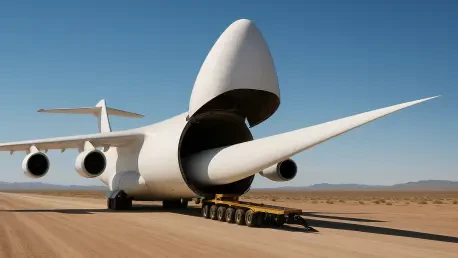

With a cargo hold capacity of 242,000 cubic feet, the WindRunner offers seven times the volume of a Lockheed Martin C-5M Super Galaxy to accommodate physically massive but relatively light payloads. This monumental scale represents a paradigm shift in how the industry views aerial transport, moving away from weight-centric designs toward a focus on pure dimensional capacity. Radia has recently transitioned this project from the conceptual design phase into the intensive period of industrialization, signaling that the era of the world’s longest aircraft is rapidly approaching. Measuring 356 feet in length, the airframe is specifically engineered to solve the logistics gap that has long hindered the expansion of onshore wind energy. By allowing the transport of turbine blades exceeding 100 meters directly to their installation sites, the aircraft eliminates the bottlenecks of narrow roads and tight turns. This strategic evolution ensures that the ambitious 2030 flight target remains within reach as development intensifies.
Industrialization and Backing: Building the Global Supply Chain
Moving from blueprint to reality requires a robust industrial foundation, and Radia has successfully secured partnerships with approximately two dozen Tier 1 suppliers across the globe. This international coalition brings together expertise from major aerospace hubs in Italy, Spain, Brazil, and the United Kingdom, ensuring that the components for such a massive airframe meet rigorous certification standards. These agreements represent more than just procurement; they are a validation of the technical feasibility of the WindRunner project by the world’s leading aerospace engineers. As the supply chain solidifies, the focus has shifted toward selecting the primary assembly sites where these gargantuan components will be integrated. Current evaluations are centered on locations in both Southern Europe and the United States, prioritizing areas with access to skilled labor and expansive testing grounds. Establishing these facilities is the next critical step in maintaining the momentum required for the maiden flight.
The scale of the production facilities required for the WindRunner is unprecedented in commercial aviation, necessitating hangars and assembly lines that can accommodate its 356-foot length. This physical demand has led Radia to explore regional partnerships that offer not only space but also strategic logistical advantages for moving finished aircraft into service. By diversifying its industrial footprint across two continents, the company mitigates risks associated with regional economic fluctuations or supply disruptions. This approach also positions the project closer to key markets for renewable energy and defense, where the aircraft’s unique capabilities are most needed. The industrialization phase involves rigorous testing of sub-assemblies and the development of specialized tooling designed to handle components of this magnitude. As these industrial sites take shape, they represent the tangible progress of a project that once seemed purely speculative. This maturation of the manufacturing strategy ensures that the project remains on schedule.
Volumetric Logistics: Reimagining the Heavy-Lift Freighter
While traditional heavy-lift freighters like the Antonov An-124 were built for the dense, heavy equipment of the late twentieth century, the WindRunner prioritizes internal volume to address modern logistical challenges. It carries a respectable payload of 160,000 pounds, but its primary advantage is the cavernous cargo hold designed for items that are physically massive yet relatively light. This design philosophy recognizes that the modern industrial landscape is increasingly dominated by oversized components, such as aerospace parts and renewable energy infrastructure, which often exceed the dimensional limits of existing aircraft. By providing a cargo bay that is significantly wider and longer than any military or commercial predecessor, Radia is carving out a new niche in the global freight market. This shift allows logistics providers to rethink the transport of outsize goods, moving away from slow sea and land routes toward the speed and flexibility of air transport. The airframe serves as a specialized tool for cargo that was previously deemed un-transportable by air.
The primary driver for this volumetric expansion is the requirement to transport the next generation of wind turbine blades, which are essential for maximizing the efficiency of onshore energy projects. Current logistics often limit blade lengths to what can be maneuvered around highway corners or through railway tunnels, effectively capping the potential of wind farm output. The WindRunner bypasses these terrestrial constraints by accommodating blades up to 344 feet in length, which translates to 100-meter-plus components. This capability allows energy companies to deploy larger, more efficient turbines in remote interior regions that were previously inaccessible for such hardware. By removing these geographic barriers, the aircraft directly supports the global transition to renewable energy and lowers the overall cost of wind power installation. Furthermore, the 33-foot internal width—nearly double that of many military transporters—allows for the movement of pre-assembled industrial modules. This streamlined delivery process reduces on-site labor and assembly time.
Defense Integration: The Strategic Reach of the C-242 Variant
Beyond its role in the renewable energy sector, Radia has identified a significant opportunity within the defense industry through a specialized variant designated as the C-242. This aircraft is designed to revolutionize strategic military airlift by providing the volume necessary to transport large assets without the extensive disassembly typically required for current fleets. The U.S. military has recognized the potential of this platform, entering into a formal research agreement to explore how the C-242 can complement existing assets like the C-17 and C-5. By allowing for the rapid movement of oversized equipment, the aircraft enhances operational readiness and provides a more flexible response capability in various global theaters. The ability to load and unload massive hardware via a roll-on, roll-off system significantly cuts down the time needed for deployment. This strategic versatility ensures that the WindRunner is not just a niche tool for energy, but a vital component of future national security infrastructure. The defense variant leverages core engineering to provide unmatched logistical speed.
The logistical advantages of the C-242 are most apparent when considering the transport of rotary and fixed-wing assets that usually require days of preparation for air shipment. For instance, the aircraft is projected to carry up to six CH-47 Chinook helicopters or four F-16 fighter jets simultaneously over a distance of 1,100 nautical miles. Currently, such movements would require multiple flights or extensive teardowns, which increase the risk of damage and prolong the time before assets are mission-ready. The WindRunner’s wide fuselage allows these platforms to be loaded in a near-ready state, facilitating immediate deployment upon arrival at a forward operating base. This capability is particularly valuable for humanitarian missions and disaster relief, where the speed of delivering large-scale equipment can be a matter of life and death. By providing a bridge between tactical airlifters and sea transport, the C-242 fills a critical gap in the logistics chain. This utility has garnered attention from international defense partners.
Technical Readiness: Engineering for Austere Environments
Engineering an aircraft of this size usually implies a need for massive, high-specification international airports, yet the WindRunner is designed with surprising operational flexibility. Radia has engineered the airframe to take off and land on runways as short as 6,000 feet, which is significantly shorter than what is required for most large wide-body jets. More impressively, the aircraft is capable of operating from austere or unpaved surfaces, such as dirt or gravel landing strips. This feature is crucial for its primary mission, as wind farms and forward military bases are often located in remote areas with minimal infrastructure. By landing directly at the point of need, the WindRunner avoids the last mile challenges that frequently delay large-scale projects and inflate costs. This ability to operate independently of major logistical hubs makes it an ideal solution for developing regions where transport infrastructure may be underdeveloped or damaged. The landing gear and wing design are optimized to distribute weight effectively, preventing damage to less robust surfaces.
This development process prioritized established technology to ensure that the 2030 flight target remained feasible while providing actionable pathways for future global supply chains. The decision to use commercially available turbofans and a cruise speed of Mach 0.6 simplified the maintenance landscape for early adopters in the energy and defense sectors. As the program matured, stakeholders successfully integrated these high-volume delivery capabilities into their strategic planning, effectively ending the era of dimensional constraints in heavy-lift transport. The industrialization of the WindRunner served as a catalyst for a new generation of onshore wind projects, proving that aerial logistics could unlock geographic regions previously deemed unreachable. This shift encouraged engineers to design even larger components, knowing that the physical limits of traditional roads were no longer a barrier to innovation. Finally, the project bridged a vital gap in international airlift capacity, securing a more resilient and versatile infrastructure for both commercial and strategic missions worldwide.